Glossary · Automotive
Automotive Production
121 terms in the Automotive glossary, each with its one-line definition.
121 terms, A to Z
- Andon Signal system of cords, buttons and lit boards that lets an assembly worker call for help or stop the line when something goes wrong.
- Blanking Cutting flat blanks out of coiled steel or aluminum so they can later be stamped into body panels.
- Body Shop Plant area where stamped panels and castings are joined, mostly by robots, into the bare metal body in white.
- Build to Order BTO Building each car only after a customer orders it to their chosen specification, cutting unsold stock on dealer lots.
- Build to Stock BTS Building cars to sales forecasts and shipping them to dealer lots before anyone buys them, so customers can drive away the same day.
- Calendering Pressing coated battery electrodes between precise steel rollers to an exact thickness and density to raise energy density.
- Capacity Utilization Actual plant output as a percentage of what it is equipped to build, a key driver of profit for high fixed-cost plants.
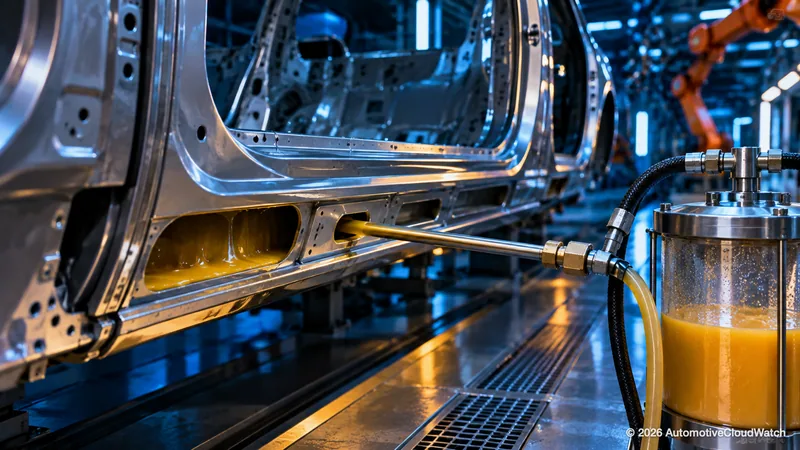 Cavity Wax Wax rust protection injected or flooded into hollow body sections such as sills and door bottoms after painting.
- Cell Manufacturing Factory process that makes individual battery cells, from electrode mixing and coating to assembly, filling and formation.
- Clinching Joining metal sheets by pressing them into a die so they lock together, with no fastener, adhesive or heat.
- Color Batching Grouping same-color cars through the paint booth so robots change colors less often, saving paint, solvent and time.
- Completely Built Unit CBU Vehicle imported fully assembled and ready to sell, usually facing higher import duties than kits.
- Completely Knocked Down CKD Shipping a vehicle as a full kit of loose parts for assembly in another country, often to cut duties or meet local content rules.
- Coordinate Measuring Machine CMM Precise machine that touches or scans many points on a part or body and compares them with design data.
- Cubing Checking production part fit by mounting parts on a precisely machined full-size master model of the car or assembly.
- Cycle Time How long an operator or machine actually takes to complete one unit of work at a station, compared against takt time.
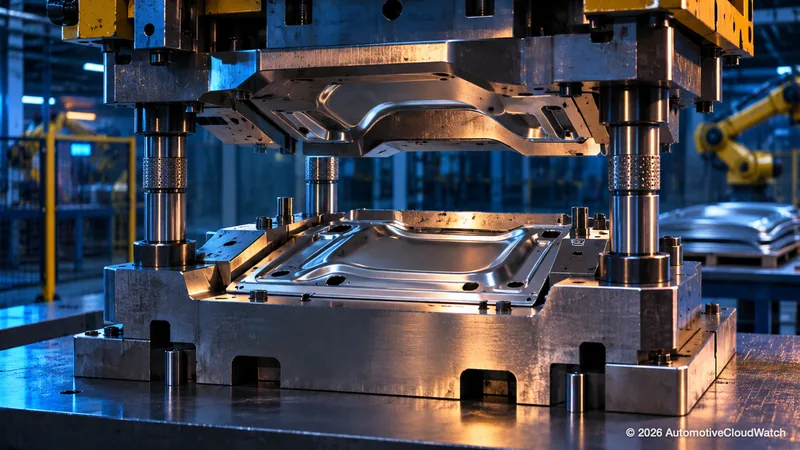 Die Hardened steel tool a press uses to cut or shape sheet metal into a part, with each panel needing its own die set.
- Die Tryout Trial-and-adjust process of running a new stamping die and reworking its surfaces until panels come out right.
- Dimensional Quality How closely parts and bodies match their designed shape and size, which drives gaps, flush, rattles and leaks.
- Door-Off Assembly Removing painted doors at the start of final assembly, building them up on a separate line and refitting them to the same car.
- Down Week Planned week or more when a car plant stops building vehicles to cut stock, retool or wait for parts.
- Dry Electrode Process Making battery electrodes by pressing dry powder into a film on foil, skipping wet slurry, drying ovens and solvent recovery.
- Dry Room Sealed room kept at extremely low humidity so moisture cannot reach lithium battery materials during cell assembly.
- Electrocoat E-coat, ELPO First paint layer, applied by dipping the whole body in a paint bath with an electric current to coat every metal surface.
- Electrode Coating Spreading a thin even layer of electrode paste onto metal foil and drying it in long ovens during cell making.
- Electrode Slurry Mixing First cell-making step, blending active material, conductive additive and binder with liquid into a smooth paste.
- Electrolyte Filling Injecting liquid electrolyte into an assembled battery cell before sealing, then letting it soak into the electrodes.
- Electrostatic Rotary Bell Robot-mounted paint applicator with a fast spinning cup that atomizes charged paint so it is drawn onto the body.
- End of Production EOP Date when series production of a model or part stops, though spare parts supply continues for years.
- End-of-Line Testing EOL Checks every finished car passes before leaving the factory, such as alignment, headlamp aim, brakes, rollers and leak tests.
- Finished Vehicle Logistics FVL Moving finished cars from plant to dealer or customer by truck, rail and ship, including storage and port handling.
- First Time Through FTT Percentage of vehicles that complete production with no repair or rework along the way.
- Flow Drill Screw FDS Screw spun at high speed that friction-heats stacked sheets, bores through and forms its own thread, joining from one side.
- Fluid Fill Assembly stations that vacuum-check and fill a new car with brake fluid, coolant, refrigerant, washer fluid and other liquids.
- Formation and Aging First controlled charge and discharge of a new cell, then a storage period that reveals faulty cells.
- Framing Station Body shop station that clamps floor, sides and roof in exact position and welds them to give the body its final shape.
- Friction Stir Welding FSW Joining metal without melting it by moving a spinning tool along the joint so the softened metal stirs together.
- Genchi Genbutsu Toyota principle of going to see a problem with your own eyes where the work happens rather than relying on reports.
- General Assembly GA Plant area where the painted body becomes a finished car by fitting wiring, interior, glass, powertrain, wheels and fluids.
- Gigafactory Very large battery cell factory with output measured in gigawatt-hours per year, a name coined by Tesla.
- Greenfield and Brownfield Plants Greenfield plants are built on empty land, while brownfield projects reuse, convert or expand an existing factory site.
- Heijunka Leveling production into a steady, evenly mixed sequence of models instead of large batches of one model.
- Hemming Folding the edge of an outer panel tightly over an inner panel to join doors, hoods and trunk lids.
- High-Pressure Die Casting HPDC Forcing molten aluminum or magnesium into a steel mold at high pressure to make complex thin-walled parts in one shot.
- Hot Stamping Forming red-hot steel and quenching it in the tool to make extremely strong safety parts such as pillars and roof rails.
- Hours per Vehicle HPV Worker hours needed to build one vehicle, the standard yardstick for comparing car plant productivity.
- Hydroforming Shaping a metal tube or sheet by pumping fluid into it at high pressure so it expands against a mold.
- Inline Gauging Automatically measuring every body or part on the line with laser or camera sensors to catch process drift early.
- Jidoka Toyota principle of building quality in by letting machines and workers stop the line the moment a problem appears.
- Job One First saleable production vehicle of a new model built at a plant, often marked with a ceremony.
- Just in Sequence JIS Suppliers delivering parts to the line in the exact order the cars will be built, such as matching seats for each car.
- Just in Time JIT Running a plant so parts arrive only when and in the quantity needed, keeping inventory very low.
- Kaizen Continuous small improvements made every day by the people doing the work.
- Kanban Card or electronic signal sent only when parts are used up, telling a supplier or upstream process to make or deliver more.
- Kikanko Fixed-term contract production workers hired by Japanese automakers and suppliers for set months to staff lines.
- Laser Brazing Joining panels with a laser that melts filler wire into the seam without melting the panels, giving a smooth sealed joint.
- Laser Welding Joining metal with a focused laser beam to make a narrow continuous seam with little heat distortion.
- Lights-Out Manufacturing Production that runs largely without people on the floor, called dark factories in China.
- Line Rate JPH How fast a production line turns out vehicles, counted in jobs or units per hour.
- Line-Side Logistics Getting the right parts to each workstation and placing them within reach using racks, kits and sequenced carts.
- Manufacturing Yield Share of a factory's output that meets specification and is not scrapped, critical in battery cell plants.
- Marriage Final assembly step that joins the body to the powertrain or battery, suspension and subframes underneath.
- Milk Run Delivery pattern in which one truck follows a fixed scheduled route collecting from or delivering to several points.
- Mixed-Model Production Building several models, body styles or powertrains on the same line one after another in a planned mix.
- Model Changeover Converting a plant to build a new model or generation by changing fixtures, dies, conveyors and stations.
- Monozukuri Japanese idea of the craft of making things, expressing pride, skill and attention to detail in production.
- Muda, Mura and Muri Three lean wastes to eliminate, meaning waste, unevenness and overburden.
- Orange Peel Slightly bumpy paint texture resembling orange skin, caused when paint does not flow out smoothly.
- Order-to-Delivery OTD Total time from a customer's car order to delivery, covering scheduling, production, shipping and dealer prep.
- Overall Equipment Effectiveness OEE Single percentage combining availability, performance and quality to show how much of planned time produces good parts.
- Paint Defect Visible flaw in a car's paint such as dirt specks, craters, runs, orange peel or blisters.
- Paint Shop Plant area where bodies are cleaned, rust-protected, sealed, primed, painted and baked.
- Painted Body Storage PBS Buffer between paint shop and final assembly that holds painted bodies and restores the build sequence.
- Part Traceability Recording which parts, batches and process results went into each vehicle, linked to its VIN, to narrow recalls.
- Pilot Build Building trial vehicles with real production tools and processes before mass production to check fit and process.
- Poka-Yoke Simple devices or designs that make it impossible or obvious to do a job wrong.
- Press Shop First area of a car plant, where coils are cut and pressed into body panels by large presses.
- Pretreatment Cleaning the bare body and giving it a thin chemical conversion coating before the first paint layer.
- Primer Surfacer Paint layer over the rust-protection coat that smooths small flaws and gives a good base for color.
- Product Audit Detailed customer-eye inspection of randomly picked finished cars, scoring defects by how much they would bother a buyer.
- Progressive Die Stamping tool through which a metal strip advances step by step, with one operation at each station per stroke.
- Pure Car and Truck Carrier PCTC Large ocean ship with many internal decks that vehicles drive on and off, the main way cars cross oceans.
- Quality Gate Checkpoint where work must meet defined criteria before moving on, on the line or between program phases.
- Quick Die Change QDC Methods for swapping press dies in minutes instead of hours so small batches become economical.
- Ramp-Up Period after production start when a plant raises output from a trickle to full planned volume.
- Reference Point System RPS Shared set of locating holes and surfaces on each part used by design, tooling and measurement alike.
- Resistance Spot Welding RSW Joining overlapping sheets by squeezing them between copper tips and passing current to melt a small fused spot.
- Respot Body shop stations after framing where robots add the remaining spot welds to a body whose shape is already fixed.
- Rework Fixing a defective vehicle or part after it left the station where it should have been done right.
- Roll Forming Shaping a long metal strip into a constant profile by passing it through a series of progressively bending rollers.
- Roll Test End-of-line check where each new car runs a short test program on floor rollers.
- Safe Launch Period of extra inspection and tighter control during the first weeks or months after production start or a major change.
- Sealer Paste, often PVC-based, applied along body seams to keep out water, dust and noise.
- Self-Piercing Rivet SPR Rivet pushed through the top sheet and flared inside the bottom sheet, joining aluminum and mixed materials without pre-drilling.
- Semi-Knocked Down SKD Vehicle shipped partly assembled so only final assembly is done in the destination country.
- Servo Press Stamping press driven by electric servo motors so ram speed and position are programmable through every stroke.
- Skillet Conveyor Floor conveyor of large moving platforms that carry each body while workers ride along beside it.
- Slitting and Notching Cutting coated electrode rolls into narrow strips and then cutting out the tabs or individual electrode sheets.
- Springback Partial elastic return of pressed sheet metal toward its original shape, so the part differs from the die shape.
- Stamping Shaping flat sheet metal into parts such as doors, hoods and floors by pressing it between matched dies.
- Standardized Work Written, agreed best way to do each job, with steps in order, their timing and the parts and tools needed.
- Start of Production SOP Milestone when a new model or part begins regular production for sale, around which the whole program is scheduled.
- Structural Adhesive Very strong, usually epoxy-based glue applied along body flanges and cured in paint ovens to stiffen the body.
- Sub-Assembly Group of parts built on a separate line or at a supplier and installed in the vehicle as one unit.
- Supplier Park Cluster of supplier factories built next to or on the grounds of a car assembly plant.
- Tailor Welded Blank TWB Flat sheet made by laser welding pieces of different thickness or strength before stamping, putting metal only where needed.
- Takt Time Pace a line must work to meet demand, found by dividing available working time by units needed.
- Tandem Press Line Row of separate stamping presses with robots moving each panel from press to press, one operation per press.
- Tooling Custom dies, molds, fixtures, jigs and gauges made to produce one particular part or vehicle.
- Topcoat Outer paint layers, usually a colored basecoat and a protective clear coat, that give a car its color and shine.
- Toyota Production System TPS Toyota's way of running factories, built on just in time and jidoka and supported by continuous improvement.
- Transfer Efficiency TE Share of sprayed paint that ends up on the car rather than drifting away as overspray.
- Transfer Press Large single press doing several forming steps at once, with automatic fingers moving parts to the next die each stroke.
- Trim and Final Final assembly sections before and after marriage, where interior, glass, seats, wheels and fluids are fitted.
- Unboxed Process Tesla assembly method that builds and fits out major car sections in parallel and joins them near the end.
- Vehicle Sequencing Planning and holding the order in which vehicles move through the plant to balance work, batch colors and cue suppliers.
- Volatile Organic Compounds VOC Carbon-based solvent chemicals that evaporate from paints and sealers and help form smog, so paint shop emissions are regulated.
- Water Leak Test Near-end-of-line test where each car drives through strong water sprays and is checked inside for leaks.
- Wet-on-Wet Paint Process Shorter paint process that sprays primer, color and clear in sequence without a separate primer oven.
- Winding and Stacking Cell step that combines electrode sheets and separators by rolling them up or laying them flat in layers.
- Yokoten Copying a proven fix or improvement across all similar lines, plants, models and suppliers.
Full entry for members
Every term has a full entry for members: the plain-words definition, the practitioner note and the typed links between terms.
ACW Automotive Glossary, edition 2026.11.1. The headword and one line are open to everyone.