Glossary · Automotive
Chassis and Dynamics
117 terms in the Automotive glossary, each with its one-line definition.
117 terms, A to Z
- Ackermann Steering Geometry Steering linkage layout that turns the inner front wheel more sharply than the outer one so both roll cleanly around the same turn center.
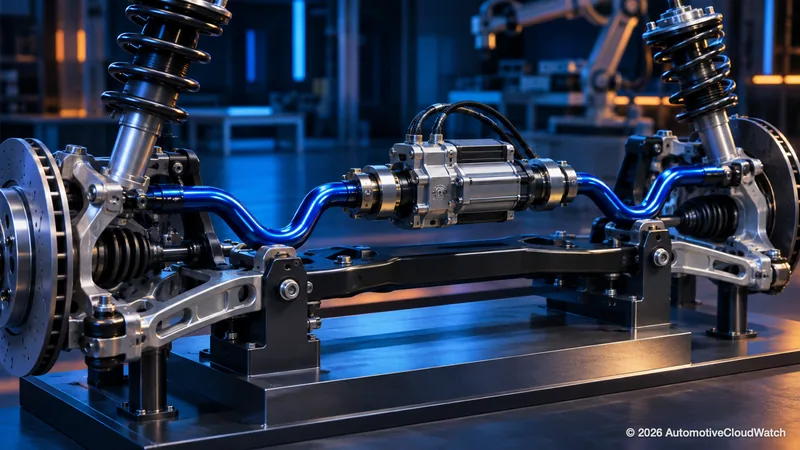 Active Anti-Roll Bar A split anti-roll bar joined by a motor or hydraulic actuator that can stiffen to keep the body flat or decouple for comfort and off-road travel.
- Active Suspension Suspension that uses powered actuators to push and pull the body, holding it level and smoothing the road beyond what springs and dampers can do.
- Adaptive Damping Shock absorbers whose firmness is changed electronically while driving, letting one car switch between soft comfort and firm control.
- Air Suspension Suspension that uses compressed air bags instead of steel springs so the vehicle can raise, lower and level itself under any load.
- Anti-Dive and Anti-Squat Suspension geometry features that limit nose dip under braking and rear sag under acceleration by angling the links.
- Anti-lock Braking System ABS A system that stops wheels locking under hard braking by rapidly pulsing brake pressure, so the driver can still steer.
- Anti-Roll Bar A spring steel bar linking the left and right wheels that twists in corners to resist body lean.
- Body Roll The sideways lean of a car's body toward the outside of a corner.
- Brake Assist BA A system that detects a panic stop and applies full braking force even if the driver does not press the pedal hard enough.
- Brake Blending Coordination of regenerative motor braking and friction brakes in an electrified vehicle so the pedal feels smooth and consistent.
- Brake Booster The device that multiplies the driver's pedal force, using engine vacuum or, in EVs, an electric motor.
- Brake Caliper The clamp on a disc brake that squeezes the pads onto the spinning disc using hydraulic pistons.
- Brake Fade A loss of braking power when brakes overheat during long descents or repeated hard stops.
- Brake Judder A vibration felt through the steering wheel and pedal when braking, usually caused by uneven brake disc thickness.
- Brake Proportioning The split of braking force between front and rear wheels so the rear wheels never lock before the front.
- Brake-by-Wire Braking in which the pedal sends an electronic signal to a controller instead of pushing fluid directly to the wheels.
- Bump Steer Unwanted steering of a wheel by itself as the suspension moves up and down over bumps.
- Bump Stop The rubber or foam cushion that limits suspension compression and progressively stiffens it near full travel.
- Bushing A flexible rubber sleeve at suspension joints that allows small movements and absorbs vibration.
- Camber The inward or outward tilt of a wheel seen from the front, with negative camber helping cornering grip.
- Caster The backward or forward tilt of the steering axis seen from the side, which makes the steering want to return to straight ahead.
- Center of Gravity CG The single point where a vehicle's weight can be treated as concentrated, whose height drives rollover risk and handling.
- Chassis A car's running gear, meaning the suspension, steering, brakes, wheels and tires and the subframes they mount on.
- Coil Spring A spiral steel spring that holds up the car's weight and compresses over bumps.
- Conicity and Ply Steer Small sideways forces a tire makes even when rolling straight, caused by tiny build asymmetries, which can make a car pull.
- Contact Patch The small area of each tire that touches the road at any moment, roughly the size of a hand on a passenger car.
- Control Arm A hinged suspension link connecting a wheel to the body or subframe while letting it move up and down.
- Corner Module A self-contained unit packaging steering, braking, suspension and sometimes a drive motor for a single wheel.
- Cornering Stiffness How much sideways force a tire builds for each degree of slip angle, a core input to handling balance.
- Damper The suspension part, usually called a shock absorber, that stops the body bouncing after a bump.
- Differential A set of gears that drives the two wheels on an axle while letting them turn at different speeds in corners.
- Disc Brake A brake that slows the wheel by squeezing friction pads against a spinning metal disc attached to the hub.
- Double Wishbone Suspension Suspension that locates each wheel with two A-shaped arms, one above the other, for precise camber control.
- Drum Brake A brake that slows the wheel by pushing curved shoes outward against the inside of a spinning drum.
- Effective Rolling Radius The distance a tire travels in one revolution divided by two pi, which is smaller than its unloaded radius.
- Electric Power Steering EPS Steering assisted by an electric motor instead of an engine-driven hydraulic pump.
- Electro-Hydraulic Brake EHB A brake-by-wire system in which an electric pump creates brake pressure on demand while keeping conventional wheel calipers.
- Electromechanical Brake EMB A dry brake-by-wire system in which an electric motor at each wheel presses the pads directly with no brake fluid.
- Electronic Brakeforce Distribution EBD An ABS-based function that automatically shares braking effort between front and rear and left and right wheels according to load.
- Electronic Parking Brake EPB A parking brake applied by a switch, usually through motors in the rear calipers, instead of a lever or pedal.
- Electronic Stability Control ESC A safety system that brakes individual wheels and cuts power to stop a car skidding or spinning.
- Fishhook Test A US rollover test in which a robot steers sharply one way then hard the other to see if a tall vehicle lifts its wheels.
- Four-Poster Rig A lab test machine with a hydraulic actuator under each wheel that shakes a complete car to reproduce roads indoors.
- Friction Circle A picture of a tire's fixed total grip, which must be shared between braking or accelerating and turning.
- Hill Descent Control HDC An off-road feature that automatically holds the vehicle at a slow steady speed down steep or slippery slopes.
- Hill Start Assist HSA A feature that briefly holds the brakes on a slope so the car does not roll back while the driver moves to the accelerator.
- Hydraulic Power Steering HPS Steering assisted by fluid pressure from a pump, usually engine driven, now largely replaced by electric systems.
- In-Wheel Motor An electric motor built into a wheel that drives it directly without shafts or gears from a central motor.
- Independent Suspension Suspension that lets each wheel on an axle move up and down on its own without directly affecting the other side.
- Integrated Brake System IBS A single compact unit combining the brake booster, master cylinder and stability control pump.
- Jounce and Rebound The upward movement of a wheel toward the body over a bump and its downward movement away from the body.
- Kinematics and Compliance K&C Rig measurement of how wheel position changes as the suspension moves and as forces act on the tires.
- Lateral Acceleration The sideways acceleration a car and its occupants feel while cornering, usually expressed in g.
- Lateral Load Transfer The shift of load from the inside tires to the outside tires when a car corners.
- Leaf Spring A suspension spring of stacked curved steel strips, usually mounted lengthwise under a solid rear axle.
- Limited-Slip Differential LSD A differential that stops one wheel spinning uselessly when it loses grip, sending more drive to the wheel that can use it.
- Longitudinal Slip The percentage difference between a tire's tread speed and the vehicle's speed during braking or acceleration.
- MacPherson Strut The most common front suspension, in which a combined spring and damper unit also serves as the steering pivot.
- Magnetorheological Damper A shock absorber filled with iron-particle fluid that thickens instantly in a magnetic field to change firmness.
- Moose Test An emergency swerve maneuver that steers sharply out of the lane and back at speed to test stability.
- Motion Ratio How far a spring or damper compresses for each unit the wheel moves, which converts spring rate to wheel rate.
- Multilink Suspension Suspension that locates each wheel with three to five separate links so each motion can be tuned independently.
- Oversteer When the rear tires lose grip before the front ones and the car turns more sharply than intended.
- Pitch The forward and backward rocking of a car body, seen as nose dive under braking and rear squat under acceleration.
- Pneumatic Trail The distance by which a tire's cornering force acts behind the center of its contact patch, creating self-aligning torque.
- Primary and Secondary Ride The two parts of ride quality, slow body motions controlled by springs and dampers and quicker harshness and shake.
- Rack-and-Pinion Steering The steering mechanism in almost every modern car, in which a pinion on the steering shaft moves a toothed rack side to side.
- Rear-Wheel Steering A system that turns the rear wheels a few degrees to tighten turning at low speed and improve stability at high speed.
- Redundant Braking Unit RBU A backup brake module that lets an automated car still brake and stay stable if the main brake system fails.
- Ride and Handling The two halves of how a car feels to drive, comfort over bumps and response and stability in maneuvers.
- Ride Frequency The natural rate at which the body bounces on its springs, typically about 1 to 1.5 hertz on comfort-oriented cars.
- Ride Height How high the body sits above the ground or wheel centers at a specified load.
- Road Load Data Acquisition RLDA Driving an instrumented vehicle on tracks and roads to record the forces it experiences and set durability targets.
- Roll Center An imaginary point, set by suspension geometry, about which the body leans in a corner.
- Roll Stiffness Distribution The share of a car's resistance to body roll provided by the front suspension versus the rear, a key handling balance tool.
- Rolling Resistance The energy a tire loses as it flexes while rolling, acting like a small constant brake on the car.
- Run-Flat Tire A tire that can keep carrying the car for a limited distance after a puncture thanks to stiff sidewalls or an inner support.
- Scrub Radius The distance at the road between the tire contact patch center and the point where the steering axis meets the ground.
- Self-Aligning Torque SAT The twisting force a cornering tire produces that tries to steer the wheel back toward straight ahead.
- Sideslip Angle The angle between the direction the car body points and the direction it actually travels.
- Slip Angle The small difference between the direction a tire points and the direction it actually moves.
- Solid Axle A single rigid beam linking the left and right wheels, so one wheel's movement affects the other.
- Spring Rate How stiff a spring is, meaning the force needed to compress it a given distance, such as newtons per millimeter.
- Sprung and Unsprung Mass The split between mass carried by the springs, mainly the body, and mass below them, such as wheels, brakes and hubs.
- Static Stability Factor SSF A simple rollover risk number equal to half the track width divided by center of gravity height.
- Steady-State Circular Test A standard handling test in which a car drives a fixed-radius circle at increasing speed to measure understeer.
- Steer-by-Wire SbW Steering with no mechanical shaft between the steering wheel and road wheels, using sensors, motors and simulated feel.
- Steering Angle Sensor SAS A sensor that measures how far and how fast the steering wheel is turned, a key input to stability control.
- Steering Axis Inclination SAI The inward tilt of the steering pivot axis seen from the front, which helps self-centering and reduces scrub radius.
- Steering Feel What the driver senses through the steering wheel, including effort buildup, on-center precision and road feedback.
- Steering Knuckle The strong metal part at each front corner that holds the wheel hub and connects to suspension arms and steering linkage.
- Steering Ratio How much the steering wheel must turn for the front wheels to turn one degree, typically around 12 to 18 to 1.
- Steering System Everything that turns a vehicle's wheels when the driver turns the steering wheel, from the column to the tie rods.
- Stopping Distance How far a vehicle travels from the moment braking starts until it comes to a stop.
- Subframe A separate frame bolted under the body that carries the suspension, steering rack and often the engine or motor.
- Suspension The springs, shock absorbers, links and bushings that connect the wheels to the body and control ride and handling.
- Tie Rod The link between the steering rack and each front wheel's steering arm that pushes or pulls the wheel to steer it.
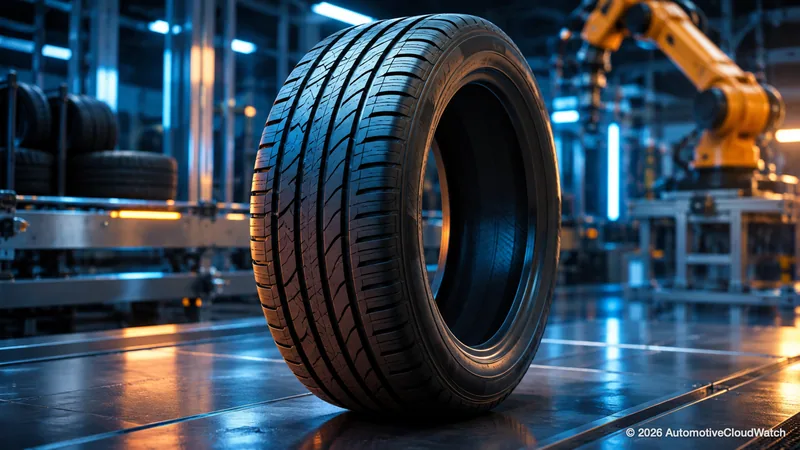 Tire The rubber, fabric and steel assembly that is a vehicle's only contact with the road, shaping grip, braking, noise and range.
- Tire Pressure Monitoring System TPMS A system that warns the driver when one or more tires are underinflated, using direct sensors or wheel speed data.
- Tire Size Designation The sidewall code, such as 225/45R17 94W, that describes a tire's width, profile, construction, rim size, load and speed rating.
- Toe The angle of the wheels relative to the car's center line seen from above, pointing slightly in or out.
- Torque Steer A tug on the steering wheel under hard acceleration in a powerful front-wheel-drive car.
- Torque Vectoring Sending different drive torque to individual wheels to help the car turn more sharply and stably.
- Torsion Beam A simple rear suspension joining two trailing arms with a cross beam that twists, common on small front-drive cars.
- Traction Control System TCS A system that stops the wheels spinning when accelerating on slippery surfaces by cutting power or braking the wheel.
- Trailing Arm A suspension link running backward from a body pivot to the wheel, locating it fore and aft while letting it move up and down.
- Turning Circle The diameter of the smallest circle a vehicle can drive around, measured at the outer wheels or outer body.
- Understeer When the front tires lose grip before the rear ones and the car turns less than asked and runs wide.
- Understeer Gradient A number in degrees per g that describes a car's basic cornering balance, measured in steady-state circle tests.
- Vehicle Axis System The agreed axes engineers use to describe vehicle motion, with x forward, y sideways, z vertical and roll, pitch and yaw.
- Vehicle Dynamics The engineering field that studies how a vehicle moves in response to the driver and to road and air forces.
- Weight Distribution The share of a vehicle's weight carried by the front and rear axles, often quoted as a ratio such as 50/50.
- Wheel Alignment Adjusting the wheel angles, mainly camber, toe and caster, to the manufacturer's specifications.
- Wheel Bearing The bearing that lets each wheel spin smoothly on its axle or knuckle, usually as an integrated hub unit.
- Wheel Speed Sensor WSS A sensor at each wheel that measures its rotational speed for ABS, traction control and stability control.
- Yaw A vehicle's rotation about its vertical axis, the turning motion seen from above when a car corners or spins.
Full entry for members
Every term has a full entry for members: the plain-words definition, the practitioner note and the typed links between terms.
ACW Automotive Glossary, edition 2026.11.1. The headword and one line are open to everyone.