Glossary · Automotive
Connectivity, Cockpit and Cybersecurity
99 terms in the Automotive glossary, each with its one-line definition.
99 terms, A to Z
- 5G Reduced Capability RedCap Lower-cost, lower-bandwidth version of 5G for devices such as car telematics units that do not need full 5G speeds.
- Attack Feasibility Rating Score of how hard a given attack on a vehicle would be to carry out, combined with impact to rank cybersecurity risks.
- Attack Path Step-by-step route an attacker could take to reach and misuse a vehicle function, mapped to decide where defenses go.
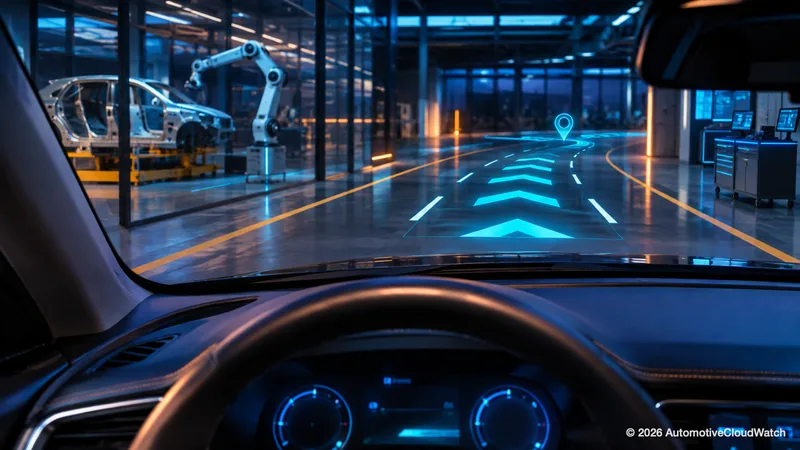 Augmented Reality Head-Up Display AR-HUD Head-up display that projects graphics so they seem to lie on the road, such as navigation arrows over the correct lane.
- Automotive Cybersecurity Protecting cars, their networks and connected services from attackers who could steal data or vehicles or interfere with driving.
- Automotive Data Security Provisions Chinese rules in force since 2021 on how automakers handle car data, favoring minimal collection, in-car processing and keeping data in China.
- Automotive Information Sharing and Analysis Center Auto-ISAC US-founded industry group where automakers and suppliers privately share cyber threat and vulnerability information.
- Basic Safety Message Standard radio message a connected car broadcasts many times a second with its position, speed, heading and braking status.
- Bluetooth Low Energy BLE Low-power Bluetooth that lets a phone stay in touch with the car, for example to unlock the doors as the owner walks up.
- CAN Injection Attack Theft method in which criminals tap a car's network wire from outside and send fake key messages to unlock and start it.
- Car Connectivity Consortium Digital Key CCC Digital Key Cross-brand industry standard that lets a phone or smartwatch act as a car key for tap entry, hands-free entry and key sharing.
- Car-to-Cloud Internet link between a car and its maker's servers, carrying vehicle data up and services such as updates and app commands down.
- Cellular Vehicle-to-Everything C-V2X Mobile network technology that lets vehicles talk to each other, to roadside units and to the network to share hazard warnings.
- Child Presence Detection CPD System that detects a child or pet left in a parked car and alerts the driver, often with in-cabin radar that senses breathing.
- Cockpit Domain Controller CDC Single computer that runs all cabin displays and audio, such as cluster, center screen and HUD, instead of separate boxes.
- Code Signing Attaching a digital signature to software so a vehicle can confirm where it came from and that it has not been tampered with.
- Common Vulnerabilities and Exposures CVE Public catalog that gives each known security flaw a unique ID, used to track vulnerabilities in vehicle software.
- Connected Car Car with a built-in cellular link that enables live navigation, app control, software updates and automatic crash calls.
- Cooperative Intelligent Transport Systems C-ITS European term for services in which cars, roadside equipment and traffic centers share hazard and signal information by radio.
- Crypto Service Manager CSM AUTOSAR module giving software one standard way to request encryption, signing, hashing and random numbers from software or an HSM.
- Cybersecurity Asset Anything in or around a vehicle worth protecting from attackers, such as a cryptographic key, a software image or personal data.
- Cybersecurity Assurance Level CAL Rating from 1 to 4 that sets how much cybersecurity rigor a vehicle component needs, with 4 the most demanding.
- Cybersecurity Case Evidence-backed argument that a vehicle system is secure enough to release, compiled for reviewers and approval authorities.
- Cybersecurity Event Security-relevant information, like a researcher report or fleet alert, that becomes an incident if exploitation is confirmed.
- Cybersecurity Goal Top-level security requirement stating what must be protected from what, to which every detailed security measure traces back.
- Cybersecurity Interface Agreement CIA Agreement between an automaker and a supplier stating who handles which security tasks on a shared part, from testing to incident response.
- Cybersecurity Monitoring Ongoing collection and screening of security information about vehicles already on sale, so new threats are spotted early.
- Cybersecurity Property Qualities of an asset that an attack could damage, usually confidentiality, integrity and availability.
- Damage Scenario Description of the harm that could follow if an attacker compromised part of a vehicle, the starting point for ranking risks.
- Dedicated Short-Range Communications DSRC Older Wi-Fi-based radio for direct vehicle and roadside safety messages, now being replaced by cellular V2X in the US and China.
- Defense in Depth Security approach that stacks several independent protection layers, so getting past one still leaves others in the way.
- Digital Instrument Cluster Screen behind the steering wheel that replaces analog dials, showing speed, warnings, assistance status and navigation.
- Digital Key Technology that lets a phone, watch or card act as the car key, including lending access to others through an app.
- Embedded SIM eSIM SIM built into the car as a soldered chip whose operator profile can be changed remotely for each market.
- Emergency Call eCall System that automatically calls emergency services after a serious crash and sends the car's location.
- End of Cybersecurity Support Date after which a maker stops fixing security problems in a vehicle or component, increasingly expected to be disclosed.
- EU Data Act EU law applying from September 2025 that gives users of connected products, including car owners, rights to access and share their data.
- EVITA European research project from 2008 to 2011 that defined the hardware security module profiles used to protect car computers.
- Fifth-Generation Cellular 5G Current mobile network generation, faster and lower latency than 4G, which speeds car downloads and supports services like remote driving.
- Fuzz Testing Hunting for bugs and security holes by bombarding a system with huge numbers of malformed or random inputs.
- GB 44495 China's mandatory vehicle cybersecurity standard requiring a security management system and built-in protections on every new car sold.
- Hardware Security Module HSM Protected chip area that stores a car's secret keys and runs security calculations apart from the main processor.
- Head-Up Display HUD Display that projects speed and directions so they appear to float ahead of the windshield in the driver's line of sight.
- Human-Machine Interface HMI Everything people use to interact with the car, including screens, buttons, voice, sounds and lights.
- Immobilizer Anti-theft device that lets the vehicle start only when it electronically recognizes the correct coded key.
- Impact Rating Score of how severe the consequences of a successful vehicle attack would be for safety, finances, operation and privacy.
- In-Vehicle AI Agent AI assistant built on a large language model that understands natural requests and completes multi-step tasks such as routes and bookings.
- In-Vehicle Infotainment IVI System behind the car's central screen that runs audio, navigation, calls, apps and vehicle settings.
- Intelligent Connected Vehicle ICV China's official policy term for cars that combine connectivity with driver assistance and automated driving.
- Intrusion Detection System IDS In-vehicle security software that watches network traffic and ECU behavior for signs of hacking and reports to the automaker.
- Intrusion Detection System Manager IdsM AUTOSAR module that collects, filters and forwards security events from software in an ECU toward backend monitoring.
- JAMA and JAPIA Cybersecurity Guidelines Baseline cybersecurity checklist for companies in the Japanese auto supply chain, published by JAMA and JAPIA for supplier assessment.
- Japan Automotive ISAC J-Auto-ISAC Japan's automotive cybersecurity information sharing center, the counterpart of the US Auto-ISAC.
- Key Management Handling a car's cryptographic keys over its whole life, from creation and factory injection to storage, renewal and revocation.
- Media Access Control Security MACsec Ethernet-layer security that encrypts and authenticates every data frame traveling between computers in the car.
- Message Authentication Code MAC Short tag computed from a message and a secret key so the receiver can confirm the sender and detect any alteration.
- MQTT Lightweight publish and subscribe messaging protocol widely used between connected cars and cloud platforms.
- Near-Field Communication NFC Very short-range radio that works only when devices almost touch, used to unlock cars by tapping a phone or card.
- Next-Generation eCall NG eCall Updated automatic crash emergency call built for 4G and 5G networks as older 2G and 3G networks shut down.
- Non-Terrestrial Network NTN Mobile connectivity delivered by satellites so a car can send messages or call for help where ground towers do not reach.
- On-Board Unit OBU In-vehicle device that talks to roadside equipment, for example to pay tolls automatically or exchange V2X messages.
- Passive Entry Passive Start PEPS Keyless system that unlocks as the owner with the fob or phone approaches and starts with a button, the main target of relay theft.
- PC5 Sidelink PC5 Direct radio link letting cellular V2X devices talk to each other without a cell tower or mobile subscription.
- Penetration Testing Authorized expert attacks on a vehicle, its ECUs, apps or servers to find weaknesses before criminals do.
- Pillar-to-Pillar Display Very wide screen, or joined screens, spanning the whole dashboard between the two front window pillars.
- Post-Quantum Cryptography PQC New encryption and signature methods built to resist future quantum computers, relevant because cars stay in service for many years.
- Public Key Infrastructure PKI System of trusted authorities and certificates that lets vehicles, ECUs, servers and tools prove their identities to each other.
- Rear-Seat Entertainment RSE Screens and controls that let rear passengers watch video, play games and adjust their own climate and seat settings.
- Relay Attack Theft trick in which criminals relay signals between a keyless car and its distant fob so the car unlocks and starts.
- Remote Vehicle Commands Phone app functions that let owners lock, unlock, precondition, flash lights or locate their car from anywhere.
- Risk Treatment Decision Choice for each identified cyber risk to avoid, reduce, share or accept it, turning threats into security goals or claims.
- Roadside Unit RSU Roadside radio device on signals, gantries or poles that broadcasts signal timing, hazards and speed limits to passing vehicles.
- Root of Trust Unchangeable hardware and code inside a chip that is trusted completely and anchors every later security check.
- Secure Boot Startup process in which each software stage checks the signature of the next, from a hardware anchor, so tampered code never runs.
- Secure Element Small tamper-resistant chip that guards secrets such as keys and runs tiny security programs, resisting even physical attacks.
- Secure Hardware Extension SHE Simple low-cost security feature in microcontrollers that stores keys and performs basic AES encryption for small ECUs.
- Secure Onboard Communication SecOC AUTOSAR function that adds an authentication tag to in-vehicle network messages so forged or replayed ones are rejected.
- Signal Phase and Timing SPaT Radio message from traffic lights telling approaching cars the current signal state and how long until it changes.
- Smart Cockpit Highly digital car interior with large screens, voice assistants, AI features and apps, a term especially popular in China.
- STRIDE Memory aid for six threat types, spoofing, tampering, repudiation, information disclosure, denial of service and elevation of privilege.
- Telematics Technology for vehicles to exchange data with remote computers wirelessly, powering crash calls, tracking, fleet management and updates.
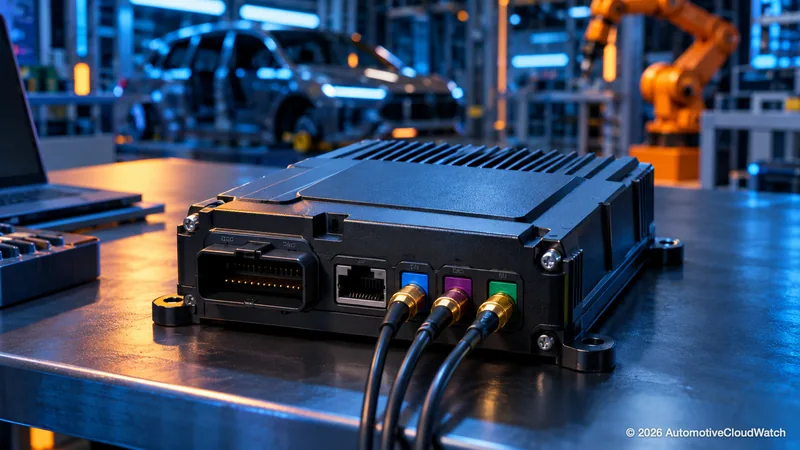 Telematics Control Unit TCU In-car box with the cellular modem, SIM, satellite receiver and often Wi-Fi and Bluetooth, linking the car to its maker's cloud.
- Threat Scenario Description of how a vehicle part could be attacked to bring about a damage scenario, turning vague worries into specific risks.
- Transport Layer Security TLS Standard internet encryption and authentication for connections, protecting traffic between a car's telematics unit and servers.
- Trusted Execution Environment TEE Hardware-isolated area inside a processor where sensitive code runs apart from the main operating system.
- Trusted Information Security Assessment Exchange TISAX Industry information security assessment that auto suppliers pass so customers can share confidential designs and data with them.
- Ultra-Wideband UWB Short-range radio that measures distance between devices to a few centimeters, making phone keyless entry much harder to fool.
- Uptane Open security framework for over-the-air updates that resists attacks even if a server is breached or a signing key is stolen.
- Vehicle Data Privacy Protecting the personal information cars collect, such as locations, driving behavior, cabin images and phone contacts.
- Vehicle Firewall Rules in the car's network hubs that let only expected messages pass between zones and from outside connections.
- Vehicle Security Operations Center VSOC Team and tools that monitor a carmaker's whole fleet and online services for attacks and coordinate the response.
- Vehicle-Road-Cloud Integration China's approach linking smart vehicles with sensing roadside equipment and cloud platforms rather than relying on the car alone.
- Vehicle-to-Everything V2X Umbrella term for a vehicle communicating wirelessly with other vehicles, infrastructure, pedestrians and the network.
- Vehicle-to-Infrastructure V2I Wireless communication between vehicles and roadside equipment such as traffic lights and roadside units.
- Vehicle-to-Network V2N Communication between a vehicle and online servers over the ordinary cellular network, the most widely used V2X form today.
- Vehicle-to-Pedestrian V2P Communication between vehicles and pedestrians or cyclists, usually through smartphones, to warn of possible collisions.
- Vehicle-to-Vehicle V2V Direct radio communication in which vehicles broadcast their position, speed and direction several times a second.
- Voice Assistant System that lets occupants control navigation, music, climate and other functions by speaking naturally.
- Vulnerability Management Ongoing work of finding, ranking and fixing security weaknesses in vehicle software for as long as the vehicle is on the road.
Full entry for members
Every term has a full entry for members: the plain-words definition, the practitioner note and the typed links between terms.
ACW Automotive Glossary, edition 2026.11.1. The headword and one line are open to everyone.