Glossary · Automotive
E/E Architecture
57 terms in the Automotive glossary, each with its one-line definition.
57 terms, A to Z
- 12-Volt Board Net 12V Low-voltage electrical network that powers lights, wipers, infotainment and ECUs from a 12-volt battery, kept even in high-voltage EVs.
- 48-Volt Electrical System 48V Low-voltage power network at four times the usual 12 volts, allowing thinner wiring and bigger loads such as mild hybrid motors while staying touch-safe.
- Advanced SoC Research for Automotive ASRA Japanese research association of automakers and chip companies developing chiplet-based automotive SoCs for central computers around 2028 to 2030.
- AEC-Q100 Stress-test qualification standard that integrated circuits must pass, across temperature grades, before automakers accept them for vehicle use.
- Automotive Grade Label for electronic parts designed, qualified and produced to survive vehicle conditions and lifetimes, implying AEC-Q and IATF 16949 practices.
- Body Control Module BCM ECU that runs comfort and convenience features such as lights, door locks, wipers and power windows.
- Central Compute Architecture in which one or a few powerful computers run most vehicle software instead of dozens of single-function ECUs.
- Central Gateway CGW Controller that routes and translates messages between a car's separate internal networks and acts as a security checkpoint.
- Central Processing Unit CPU General-purpose processor that runs a device's main software, one instruction after another, and directs the other parts of the chip.
- Chiplet Small single-function silicon die packaged with others to form one large chip, letting makers mix capabilities without designing a new chip each time.
- CISPR 25 International standard setting limits and test methods for radio noise emitted by vehicle electronic components and modules.
- Cockpit-ADAS Integration Running cockpit and driver assistance software on one controller or chip, which saves hardware but demands strict isolation between them.
- Distributed Architecture Traditional E/E layout in which each function has its own ECU linked over CAN and LIN, leading to many ECUs and heavy wiring.
- Domain Architecture E/E layout that groups functions such as powertrain, chassis and infotainment under one powerful controller per domain.
- Domain Controller DCU Powerful computer that runs the software of one vehicle domain, such as ADAS or cockpit, replacing several smaller ECUs.
- ECU Consolidation Combining the jobs of many small ECUs into fewer, more capable computers to cut hardware and wiring and ease software updates.
- Electrical/Electronic Architecture E/E architecture Overall plan for how a vehicle's computers, sensors, actuators, power supply, wiring and networks are arranged and connected.
- Electromagnetic Compatibility EMC Ability of electronics to work without being disturbed by electrical noise and without emitting noise that disturbs other devices.
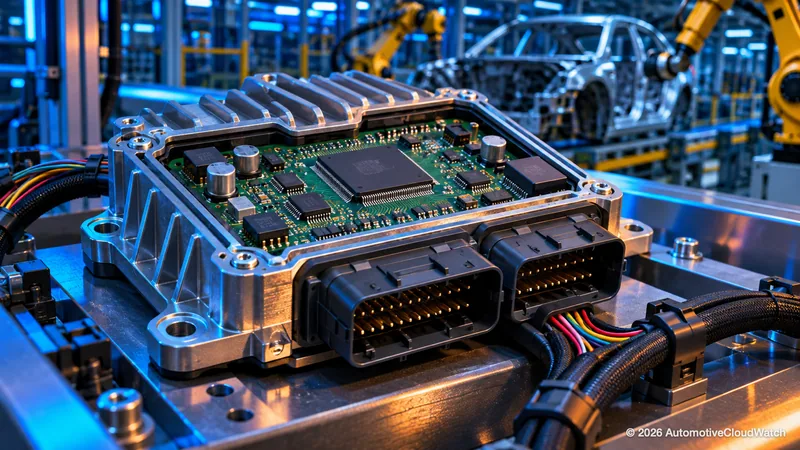 Electronic Control Unit ECU Small embedded computer in a vehicle that controls one or more functions, such as the engine, brakes or windows.
- Electronic Fuse eFuse Semiconductor switch that cuts power within microseconds on overcurrent and can be reset by software, central to zonal power distribution.
- Engine Control Module ECM Computer that runs a combustion engine, controlling fuel injection, ignition, boost and exhaust aftertreatment and monitoring emissions faults.
- Ethernet Backbone High-speed automotive Ethernet network linking a car's main computers and carrying large data such as camera feeds and updates.
- Fail-Operational Power Supply Low-voltage power design with independent redundant paths so one fault cannot cut power to safety-critical and automated driving systems.
- Graphics Processing Unit GPU Processor with many parallel cores that renders cockpit graphics and also runs AI models for interpreting sensor data.
- High-Performance Computer HPC Powerful onboard vehicle computer built around advanced SoCs that runs central, ADAS or cockpit software with AI acceleration.
- Horizon Robotics Journey Family of AI chips for driver assistance and automated driving from Chinese company Horizon Robotics, widely used in Chinese vehicles.
- Image Signal Processor ISP Chip or circuit block that turns raw camera sensor data into a usable image, handling color, high dynamic range, noise and LED flicker.
- Infineon AURIX Infineon family of multicore automotive safety microcontrollers widely used in braking, steering, airbags, powertrain and domain controllers.
- ISO 16750 International standard series defining the electrical, mechanical, climatic and chemical stresses vehicle electronics must survive and how to test them.
- Load Dump Sudden voltage spike on a 12 or 24 volt system when the battery disconnects while the alternator is charging, a standard electronics test case.
- Memory Protection Unit Microcontroller hardware that restricts which memory each software partition may access, isolating less critical code from safety functions.
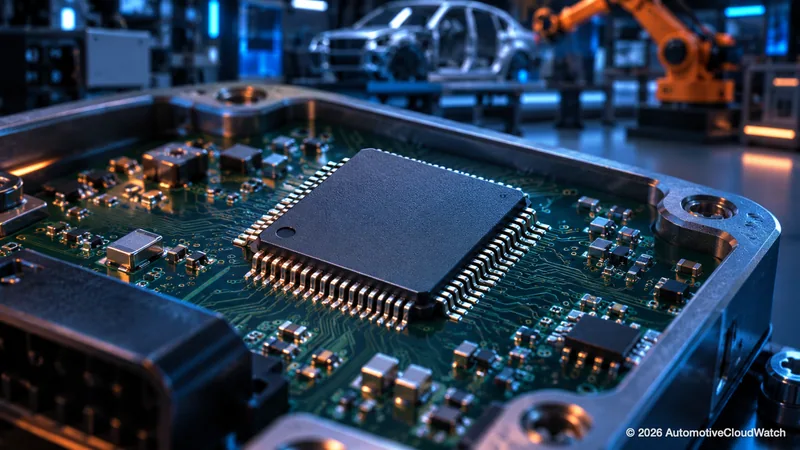 Microcontroller MCU Single chip with processor, memory and input and output circuits that runs real-time control software inside most ECUs.
- Microprocessor Unit MPU Processor using external memory that is powerful enough to run full operating systems, used in gateways, telematics and cockpits.
- Mixed Criticality Running software of very different safety importance on the same hardware with proof that lower-criticality code cannot disturb the rest.
- Mobileye EyeQ EyeQ Family of Mobileye vision processing chips sold with Mobileye perception software as turnkey front camera ADAS systems.
- Neural Processing Unit NPU Chip block built to run AI models fast and efficiently, used in vehicles for perception, driver monitoring and voice.
- NVIDIA DRIVE NVIDIA's automotive chips, reference hardware and software for ADAS, automated driving and cockpits, including DRIVE Orin and Thor.
- NXP S32 NXP family of automotive processors and microcontrollers for gateways, zone controllers, radar, networking and safety systems.
- Power Distribution Unit PDU Module that distributes battery power to the vehicle's electrical loads and protects each circuit with fuses, relays or eFuses.
- Quiescent Current Small current a parked, switched-off vehicle draws from its 12-volt battery to keep sleeping ECUs and always-on features alive.
- Quintauris Munich-based company founded by chipmakers and suppliers to develop standardized RISC-V chip platforms for automotive and other industries.
- Renesas R-Car Renesas family of automotive SoCs for infotainment, cockpits, ADAS and central computers, widely used by Japanese automakers.
- RISC-V Open, royalty-free processor instruction set architecture that chipmakers can use without license fees, seen as an alternative to Arm.
- Safety Island Separate, independently powered safety processing block inside a large SoC that monitors the main cores and takes over critical tasks on faults.
- Signal-to-Service Transformation Shift from ECUs broadcasting raw signals on fixed schedules to offering functions as software services that programs request.
- Smart Actuator Motor, valve or flap with built-in electronics that takes commands over a digital network and reports its own faults.
- Smart Power Switch Chip that switches loads such as lamps, heaters and motors while measuring current, protecting itself and reporting faults, replacing relays.
- Smart Sensor Sensor with built-in processing and a digital network link that sends finished measurements instead of raw signals.
- Snapdragon Digital Chassis Qualcomm's umbrella brand of automotive chips and software for cockpit, ADAS, connectivity and cloud services.
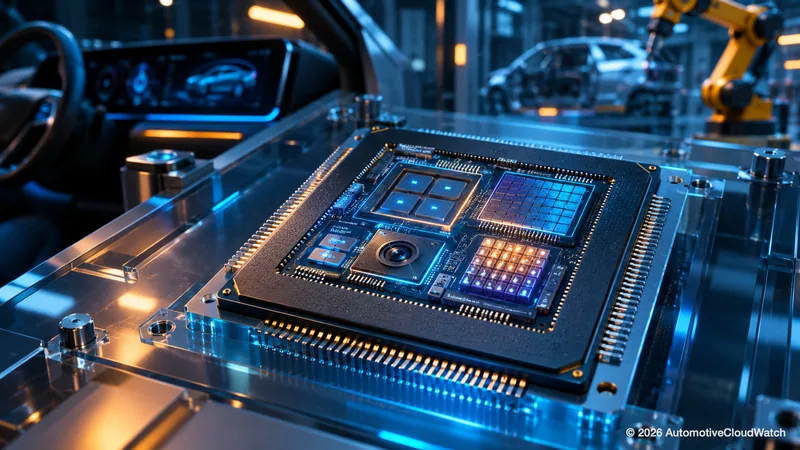 System on Chip SoC Single chip combining CPU cores, graphics, AI accelerators, camera processing and fast interfaces for cockpit and ADAS computers.
- Tera Operations Per Second TOPS Headline measure of a chip's AI processing capacity in trillions of operations per second, usually quoted at INT8.
- Terminal 15 and Terminal 30 Standard names for ignition-switched power (terminal 15) and permanent battery power (terminal 30) in vehicle wiring.
- Transmission Control Module TCM Computer that runs an automatic transmission, deciding gear shifts and controlling clutches and torque converter.
- Vehicle Control Unit VCU Supervisory computer in electric and hybrid cars that turns driver requests into torque and coordinates inverter, battery and charging.
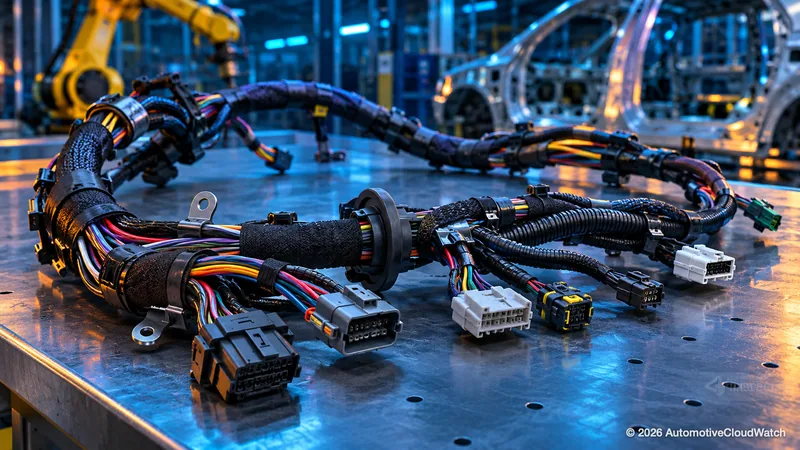 Wiring Harness Bundle of wires, connectors and sleeves carrying power and signals through a vehicle, among its heaviest and most labor-intensive parts.
- Zonal Architecture E/E layout organizing electronics by physical location, with zone controllers linked by Ethernet to central computers.
- Zone Controller ZCU Computer serving one physical area of the car that connects local sensors and actuators, distributes power via eFuses and forwards data.
Full entry for members
Every term has a full entry for members: the plain-words definition, the practitioner note and the typed links between terms.
ACW Automotive Glossary, edition 2026.11.1. The headword and one line are open to everyone.