Glossary · Automotive
In-Vehicle Networks
59 terms in the Automotive glossary, each with its one-line definition.
59 terms, A to Z
- 1000BASE-T1 Automotive Ethernet at 1 gigabit per second over one twisted wire pair, used as the backbone between zone controllers and central computers.
- 100BASE-T1 Automotive Ethernet at 100 megabits per second over one twisted wire pair, the first in-vehicle Ethernet to reach mass production.
- 10BASE-T1S Slow 10 megabit Ethernet that lets many devices share one wire pair like a bus, aimed at sensors and actuators in zonal designs.
- ASA Motion Link ASA-ML Open standard from the Automotive SerDes Alliance for high-speed camera and display links, avoiding lock-in to proprietary SerDes chips.
- Audio Video Bridging AVB Ethernet standards that stream audio and video with guaranteed timing, and the precursor of Time-Sensitive Networking.
- Automotive Audio Bus A2B Analog Devices digital bus that carries many audio channels, control data and power over one thin twisted pair from device to device.
- Automotive Ethernet Ethernet adapted for cars to run over a single thin wire pair, forming the high-speed data backbone of modern vehicles.
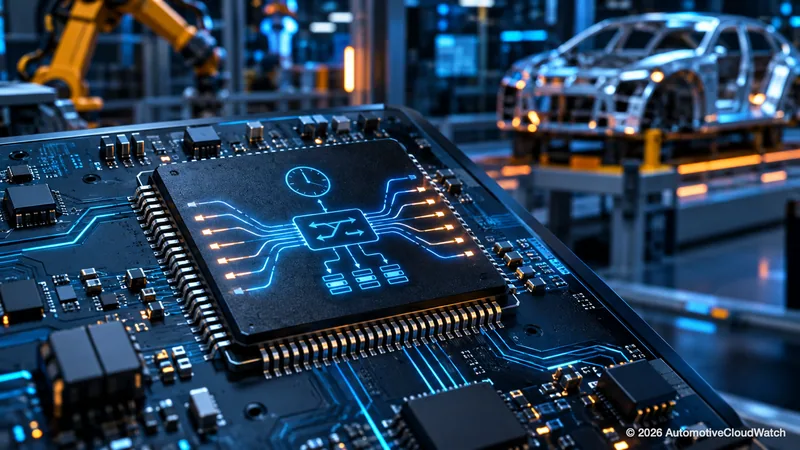 Automotive Ethernet Switch Chip that directs Ethernet traffic between a car's computers and sensors, with added timing, traffic separation and security features.
- AUTOSAR COM AUTOSAR Classic module that packs signals into network messages and unpacks them, handling send timing and timeouts.
- Bus Load Percentage of a network's capacity actually in use, most often quoted for CAN buses to keep spare headroom.
- Bus-Off CAN state in which a device that keeps making transmission errors disconnects itself so it cannot disrupt the network.
- CAN Arbitration Way CAN decides which device may send when several start at once, with the lowest message number winning without data loss.
- CAN Identifier CAN ID Number at the start of every CAN message that names its content and sets its priority on the bus.
- CAN Signal Improvement Capability CAN SIC Improved CAN transceiver that suppresses signal ringing so CAN FD can run faster with more nodes and longer stubs.
- CAN Transceiver Small chip that links an ECU's CAN controller to the bus wires and handles sleep and wake-up.
- CAN with Flexible Data-Rate CAN FD Upgraded CAN carrying up to 64 bytes per message and switching to a faster rate for the data part.
- CAN XL Third generation of CAN, carrying messages up to 2,048 bytes at about 20 megabits per second and able to tunnel Ethernet.
- Clock Extension Peripheral Interface CXPI Low-speed Japanese-developed network for simple body electronics, offered as a faster-reacting alternative to LIN.
- Communication Matrix Carmaker's master list of every network message, its sender, receivers, timing and signals, from which network files are generated.
- Controller Area Network CAN The most common car network, a twisted wire pair that lets dozens of ECUs share messages such as speed or door status.
- Cyclic Redundancy Check CRC Short checksum sent with a block of data so the receiver can detect corruption from electrical noise.
- Data Distribution Service DDS Publish and subscribe messaging standard with fine control of reliability and timing, used mainly for automated driving sensor data.
- DBC File Text file describing every CAN message, its identifier, signals and scaling, used by tools to decode bus traffic.
- Eclipse Zenoh Open-source protocol that moves data between devices, vehicles and cloud with publish and subscribe, queries and storage in one system.
- Error Frame Signal a CAN device sends on spotting a fault, deliberately destroying the message so all nodes discard it and the sender retries.
- Field Bus Exchange Format FIBEX Older ASAM file format for describing messages on FlexRay, CAN, LIN, MOST and Ethernet, now mostly replaced by ARXML.
- FlexRay Fast, time-triggered vehicle network for safety-critical chassis functions, now largely replaced by CAN FD and Ethernet.
- FPD-Link Texas Instruments family of high-speed links carrying video from cameras to computers and from computers to displays.
- Gateway Routing Passing messages between a car's networks, such as copying data from a CAN bus onto the Ethernet backbone.
- Generalized Precision Time Protocol gPTP Protocol that aligns clocks of all devices on an Ethernet network to within a fraction of a microsecond.
- Gigabit Multimedia Serial Link GMSL Analog Devices family of high-speed links that carry camera and display video, and can power cameras over the same coax.
- IEEE 802.1DG IEEE standard published in 2025 that profiles which Time-Sensitive Networking features in-vehicle Ethernet should use.
- ISO 11898 International standard series that defines the Controller Area Network, covering frame format, arbitration and physical layers.
- LIN Description File LDF File describing a LIN network's devices, messages, signals and the master polling schedule.
- Local Interconnect Network LIN Cheap, slow single-wire network for simple body functions such as windows, mirrors, seat motors and rain sensors.
- Low-Voltage Differential Signaling LVDS Technique for sending fast data over a wire pair as a small voltage difference, resisting noise and using little power.
- Media Oriented Systems Transport MOST Older ring network for infotainment audio and video, often over plastic optical fiber, since replaced by Ethernet and SerDes.
- MIPI A-PHY Open MIPI Alliance standard for long high-speed links carrying camera, sensor and display data in cars.
- MIPI CSI-2 CSI-2 Standard short-reach connection between a camera image sensor and the processor that reads it.
- Multi-Gigabit Automotive Ethernet MultiGBASE-T1 Automotive Ethernet at 2.5 to 25 gigabits per second for links between central computers and zone controllers.
- Network Management NM Rules that coordinate when ECUs on a network wake, stay awake and sleep so a parked car's battery does not drain.
- OPEN Alliance Industry group promoting single-pair automotive Ethernet and publishing interoperability and conformance tests.
- OPEN Alliance TC10 TC10 OPEN Alliance specification that lets automotive Ethernet links sleep and wake in a coordinated way to save battery.
- Partial Networking Feature that lets some ECUs stay asleep while others on the same bus communicate, waking only on specific messages.
- PDU Router PduR AUTOSAR module that forwards message data between communication, diagnostic and transport layers and networks.
- Peripheral Sensor Interface 5 PSI5 Two-wire interface that powers and reads sensors, especially airbag crash and pressure sensors.
- Physical Layer Collision Avoidance PLCA Round-robin scheme that lets 10BASE-T1S devices share one wire pair without collisions and with predictable delay.
- Power over Coax PoC Sending power to a remote camera or sensor through the same coaxial cable that carries its video.
- Power over Data Lines PoDL Sending power over the same single twisted pair that carries Automotive Ethernet data.
- Protocol Data Unit PDU Single packet of data at a given layer of a communication system, carried inside network frames.
- Scalable Service-Oriented Middleware over IP SOME/IP BMW-developed AUTOSAR protocol that lets vehicle software offer and use services over Ethernet.
- Serializer/Deserializer SerDes Chip pair that turns parallel data into one fast serial stream over a single cable and back again.
- Signal Single named value such as vehicle speed or door state, packed into a set position within a network message.
- Single Edge Nibble Transmission SENT Simple one-way digital link from sensor to ECU that encodes values in the timing between pulses.
- SOME/IP Service Discovery SOME/IP-SD Protocol that lets services on an automotive Ethernet network announce themselves and find each other automatically.
- Time-Aware Shaper TAS TSN feature where switches open and close gates for each traffic type on a precise shared schedule.
- Time-Sensitive Networking TSN Set of Ethernet standards adding guaranteed timing and reliability so control and sensor data can share one network.
- Time-Triggered Communication Scheme in which every message is sent at a fixed pre-planned time on a shared schedule, like a train timetable.
- Virtual LAN VLAN Dividing one physical Ethernet network into separate logical networks by tagging each frame.
Full entry for members
Every term has a full entry for members: the plain-words definition, the practitioner note and the typed links between terms.
ACW Automotive Glossary, edition 2026.11.1. The headword and one line are open to everyone.