Glossary · Automotive
Powertrain and Electrification
218 terms in the Automotive glossary, each with its one-line definition.
218 terms, A to Z
- 4680 Cell Large cylindrical battery cell format, 46 mm wide and 80 mm tall, introduced by Tesla to cut pack cost with fewer, bigger cells.
- 800 Volt Architecture EV electrical design running the battery and drive system at about 800 volts, halving current for faster charging and lighter cabling.
- AC Charging Charging an EV from ordinary alternating current at home or a public post, with the car's on-board charger converting it to DC.
- All-Electric Range AER Distance a plug-in hybrid or range-extended car can drive on battery power alone before its engine starts.
- All-Wheel Drive AWD Drivetrain that can send power to all four wheels, usually automatically, for better grip on wet, snowy or loose roads.
- Anode Negative electrode of a battery cell, usually graphite coated on copper foil, that stores lithium when the battery is charged.
- Atkinson Cycle Gasoline engine operating cycle that closes the intake valve late so expansion exceeds compression, trading power for efficiency.
- Automated Manual Transmission AMT Manual gearbox whose clutch and gear changes are worked by actuators instead of the driver, so there is no clutch pedal.
- Automatic Transmission AT Transmission that shifts gears by itself, typically planetary gear sets linked to the engine by a fluid torque converter.
- Axial Flux Motor Disc-shaped electric motor with magnetic flux running along the shaft, giving very high torque in a short, light package.
- Axle Disconnect Clutch that decouples an unneeded axle or motor so it stops spinning and wasting energy, then reconnects when traction is needed.
- Back Electromotive Force Back EMF Voltage generated by a spinning electric motor that opposes the supply voltage and rises with speed.
- Balance of Plant BoP Everything in a fuel cell system except the stack, such as the air compressor, hydrogen supply, humidifier and cooling.
- Battery Abuse Testing Deliberately crushing, overcharging, shorting or overheating battery cells and packs to prove they fail safely.
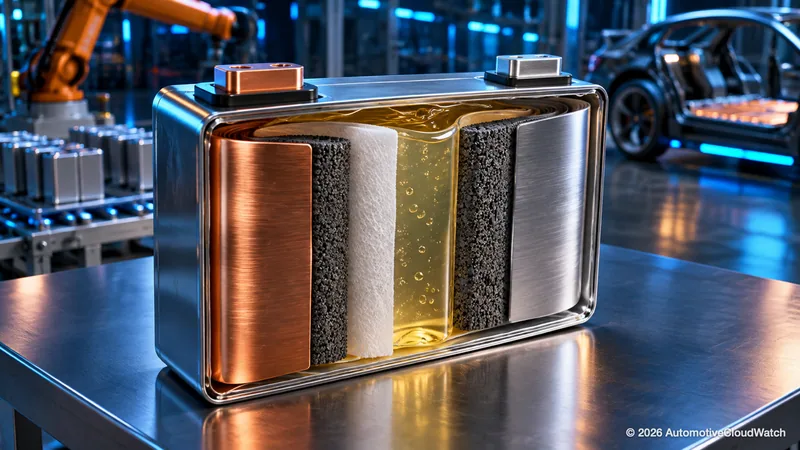 Battery Cell Smallest building block of an EV battery, a sealed unit with anode, cathode, separator and electrolyte that stores electricity.
- Battery Degradation Gradual loss of battery capacity and power with use and age, which slowly reduces an EV's range.
- Battery Disconnect Unit BDU Switch box that connects or isolates an EV's high-voltage battery, housing the main contactors, pre-charge circuit, fuses and current sensor.
- Battery Electric Vehicle BEV Car powered only by a rechargeable plug-in battery and electric motors, with no combustion engine and no tailpipe.
- Battery Management System BMS Electronics that monitor every cell's voltage, current and temperature, estimate charge and keep the battery safe.
- Battery Module Group of cells in a frame with wiring and sensors that forms a mid-level building block of a battery pack.
- Battery Pack Complete EV battery of cells or modules in a sealed case with cooling, wiring, fuses and management electronics.
- Battery Pack Cost Price of an EV battery pack per kilowatt-hour of stored energy, a key driver of when EVs reach price parity with gasoline cars.
- Battery Preconditioning Warming or cooling an EV battery to its ideal temperature before fast charging or driving so it can accept charge quickly.
- Battery Recycling Recovering lithium, nickel, cobalt and other metals from used batteries and factory scrap to make new battery materials.
- Battery Swapping Replacing an EV's depleted battery with a charged one at an automated station in a few minutes instead of recharging.
- Belt-Integrated Starter Generator BISG Motor-generator driven by the engine's accessory belt that replaces the alternator, restarting the engine and giving mild hybrid assist.
- Bidirectional Charging Ability of an EV and its charger to send power out of the car's battery as well as in, enabling V2L, V2H and V2G.
- Bipolar Battery Battery design in which each current collector serves as the negative side of one cell and the positive of the next, cutting resistance and parts.
- Blade Battery BYD's long, thin LFP battery cell, laid side by side in the pack so the cells themselves add structural strength.
- Brake Specific Fuel Consumption BSFC Fuel an engine burns per unit of work it produces, usually in grams per kilowatt-hour, where lower means more efficient.
- Brake Thermal Efficiency BTE Share of fuel energy an engine turns into useful crankshaft work, the headline efficiency number for modern hybrid engines.
- C-Rate Charging or discharging speed relative to a battery's capacity, where 1C would fill or empty it in one hour.
- Calendar Aging Capacity a battery loses with time alone, even unused, sped up by heat and storage at a high state of charge.
- Catalyst Light-Off Point at which a catalytic converter gets hot enough to clean exhaust effectively, typically around 250 to 300 degrees Celsius.
- Catalytic Converter Exhaust device that uses precious metals to convert carbon monoxide, unburned fuel and nitrogen oxides into less harmful gases.
- Cathode Positive electrode of a battery cell, whose chemistry largely sets the cell's energy, cost and safety.
- Cathode Active Material CAM Lithium-containing powder in the cathode, such as NMC, NCA or LFP, that stores and releases lithium as the cell cycles.
- Cell Balancing Battery management function that keeps all cells in a pack at the same charge level so full capacity stays usable.
- Cell Monitoring Unit CMU Electronics that measure individual cell voltages and temperatures and report them to the battery management controller.
- Cell-to-Body CTB Battery design in which the pack top also forms the car's floor, making the battery part of the vehicle structure.
- Cell-to-Pack CTP Battery design that places cells straight into the pack without modules, fitting more cells with fewer parts.
- CHAdeMO Japanese DC fast charging standard developed by TEPCO and automakers, still common in Japan and early to support bidirectional charging.
- Charge-Depleting and Charge-Sustaining Modes Two plug-in hybrid operating modes, first using up stored battery charge, then holding the battery at a low steady level like a hybrid.
- Charging Connector Standards Regional families of EV charging plugs and communication protocols, such as CCS, NACS, CHAdeMO, GB/T and MCS.
- Charging Curve Graph of how charging power changes with battery level during a DC fast charging session, peaking early and tapering as it fills.
- Chassis Dynamometer Roller test bench on which a car is driven in place to measure emissions, fuel use, energy consumption and range.
- Chiller Heat exchanger that lets an EV's air conditioning refrigerant cool the battery coolant below the outside air temperature.
- China Light-Duty Vehicle Test Cycle CLTC China's laboratory driving cycle for fuel consumption and EV range, whose low average speeds yield optimistic range figures.
- Clutch Device that connects and disconnects the engine from the gearbox through friction plates, allowing smooth starts and gear changes.
- Coastdown Test Letting a car roll freely from speed on a flat track to measure the air, tire and driveline drag used to set lab tests.
- Cold Plate Flat metal plate with internal coolant channels pressed against battery cells to remove or add heat.
- Combined Charging System CCS Charging standard whose inlet pairs an AC plug with two DC pins, in CCS1 for North America and CCS2 for Europe.
- Common Rail Injection Diesel fuel system where a shared high-pressure rail feeds electronically controlled injectors for several precise injections per cycle.
- Compression Ratio Ratio of a cylinder's largest volume to its smallest, which sets how tightly an engine squeezes its air and fuel.
- Constant Velocity Joint CV joint Flexible joint at the end of a drive shaft that keeps power flowing smoothly while the wheel steers and moves with the suspension.
- Contactor Heavy-duty switch that connects or cuts off the high-voltage battery, opening when the car is off or detects a crash or fault.
- Continuously Variable Transmission CVT Transmission with no fixed gears that varies its ratio continuously using a belt or chain between variable-width pulleys.
- Coulombic Efficiency CE Share of the charge put into a battery that can be taken back out, where tiny shortfalls reveal life-shortening side reactions.
- Cut-Off Voltage Lowest voltage a cell may reach when discharging, paired with an upper charging limit, enforced by the battery management system.
- Cycle Life Number of full charge and discharge cycles a battery can deliver before its capacity falls to a set level, often 80 percent.
- Cylinder Deactivation Fuel-saving feature that shuts down some engine cylinders at light load, such as steady highway cruising.
- Cylindrical Cell Battery cell in a round metal can, named by size such as 2170 or 4680, long used by Tesla and adopted by BMW.
- DC Fast Charging DCFC Charging in which a station supplies direct current straight to the battery, typically at 50 to 350 kilowatts or more.
- DC-DC Converter Converter that steps the EV's high battery voltage down to 12 or 48 volts for everyday electronics, replacing the alternator.
- Dedicated Hybrid Transmission DHT Transmission designed around electric motors, with few or no fixed gears, so a hybrid's engine can stay in its efficient zone.
- Depth of Discharge DoD Share of a battery's capacity used in one cycle, where shallow cycles are gentler on cells than deep ones.
- Diesel Exhaust Fluid DEF Urea and water solution that diesel vehicles spray into the exhaust so the SCR catalyst can remove nitrogen oxides.
- Diesel Oxidation Catalyst DOC Diesel catalyst that oxidizes carbon monoxide, unburned fuel and some soot, usually as the first stage of diesel aftertreatment.
- Diesel Particulate Filter DPF Diesel exhaust filter that traps soot particles and periodically burns them off in a process called regeneration.
- Displacement Total volume swept by an engine's pistons, given in liters or cubic centimeters, and the basis of vehicle tax in Japan.
- Double Overhead Camshaft DOHC Engine layout with two camshafts per cylinder bank, one working the intake valves and one the exhaust valves.
- Driveshaft Spinning shaft that carries power between drivetrain parts, such as the propeller shaft to the rear axle or half-shafts to the wheels.
- Drivetrain Layout Which wheels a car drives, such as front, rear or all-wheel drive, a choice that shapes cabin space, cost, handling and traction.
- Dual-Clutch Transmission DCT Automatically shifting gearbox with two clutches for odd and even gears that preselects the next gear for near-instant shifts.
- E-Fuels Synthetic liquid fuels made from renewable hydrogen and captured carbon dioxide that can run existing combustion engines.
- Electric Compressor Air conditioning compressor driven by its own electric motor, cooling the cabin and battery even with no engine running.
- Electric Drive Unit EDU Single package that drives one axle of an EV, combining motor, reduction gear and differential, often with the inverter built in.
- Electric Vehicle Supply Equipment EVSE Formal term for EV charging equipment, from a portable cable to a wall box or fast charger, including its safety electronics.
- Electrically Excited Synchronous Motor EESM Electric motor whose rotor uses a current-fed coil instead of permanent magnets, avoiding rare-earth materials.
- Electrification Shift from engine-only cars toward vehicles using electric motors for some or all driving, from mild hybrids to battery EVs.
- Electrolyte Substance inside a battery cell, usually a lithium salt in flammable solvents, that carries lithium ions between the electrodes.
- Energy Density Energy a battery stores per kilogram or per liter, which determines how much range fits in a given weight or space.
- Engine Downsizing Replacing a larger engine with a smaller turbocharged one of similar power to cut pumping and friction losses.
- EPA Fuel Economy Testing US EPA test procedures that produce the fuel economy and EV range figures shown on new car window stickers.
- EV Energy Consumption Electricity an EV uses to travel a set distance, such as kilowatt-hours per 100 km, the electric counterpart of fuel economy.
- Exhaust Aftertreatment All the emissions cleaning equipment downstream of the engine, such as catalysts, particulate filters and NOx removal systems.
- Exhaust Gas Recirculation EGR Routing part of the exhaust back into the intake so combustion runs cooler and produces less nitrogen oxide.
- Field Weakening Motor control technique that reduces the effective magnetic field so an electric motor can keep speeding up above its base speed.
- Final Drive Ratio Last gear reduction before the wheels, setting how many times the engine or motor turns for each turn of the wheels.
- Flash Charging Chinese industry term for extremely fast EV charging that adds hundreds of kilometers of range in about five minutes at megawatt power.
- Flex-Fuel Vehicle FFV Vehicle that can run on gasoline, high-ethanol fuel such as E85, or any mix of the two in the same tank.
- Four-Wheel Drive 4WD Truck and off-road drivetrain that drives all four wheels through a transfer case, often with a low range for crawling.
- Fuel Cell Electric Vehicle FCEV Electric vehicle that makes its own electricity on board from hydrogen in a fuel cell, emitting only water vapor.
- Fuel Cell Stack Hundreds of thin fuel cells stacked in series that combine hydrogen and oxygen from air to make electricity, with water as the by-product.
- Fuel Economy How far a vehicle travels on a given amount of fuel, quoted in mpg, km per liter or liters per 100 km.
- Gallium Nitride GaN Wide-bandgap semiconductor for power transistors that switch faster and waste less energy than silicon, first used in chargers and converters.
- Gasoline Direct Injection GDI Fuel system that sprays gasoline at high pressure directly into each cylinder for better efficiency and power.
- Gasoline Particulate Filter GPF Exhaust filter for direct-injection gasoline engines that traps fine soot particles to meet particle number limits.
- GB/T Charging Standard GB/T China's national EV charging standards, with separate AC and DC connectors, required for every EV sold in China.
- Graphite Anode Standard lithium-ion negative electrode made from natural or synthetic graphite, which stores lithium between its carbon layers.
- Gross and Usable Capacity Total energy a battery pack holds versus the portion the battery management system lets the driver actually use.
- Hairpin Winding Motor stator built from stiff rectangular copper bars bent like hairpins and welded, packing in more copper for more power.
- Heat Pump Climate system that moves outside heat into the car with a reversed refrigerant cycle, using far less electricity than a resistive heater.
- Heavy Rare Earth Elements HREE Rare earth metals such as dysprosium and terbium added to neodymium magnets so they keep their strength at high motor temperatures.
- High-Voltage Interlock Loop HVIL Low-voltage loop running through every high-voltage connector and cover that opens the battery switches if any is unplugged.
- High-Voltage System HV High-power electrical system at roughly 300 to 900 volts that drives an electrified vehicle, including battery, inverter, motor and charger.
- Hybrid Electric Vehicle HEV Car combining an engine with a motor and battery that is charged by the engine and braking, never by plugging in.
- Hydrogen Internal Combustion Engine H2 ICE Piston engine adapted to burn hydrogen, cutting tailpipe carbon dioxide while reusing familiar engine technology.
- Hydrogen Storage Tank High-pressure tank, usually rated at about 700 bar, that stores hydrogen gas aboard a fuel cell vehicle.
- Induction Motor Magnet-free AC motor in which stator coils induce current in the rotor, robust and cheap with little drag when unpowered.
- Insulated-Gate Bipolar Transistor IGBT Silicon power switch that turns large currents on and off rapidly in inverters, on-board chargers and DC-DC converters.
- Integrated Thermal Management Module Single unit combining the valves, pumps and heat exchangers that route heat among an EV's cabin, battery and drive unit.
- Intercooler Radiator that cools air compressed by a turbocharger or supercharger before it enters the engine, raising power and resisting knock.
- Internal Combustion Engine ICE Engine that burns fuel inside its cylinders to drive pistons, mainly spark-ignited gasoline and compression-ignited diesel types.
- Internal Resistance Opposition a cell offers to current flow, which wastes energy as heat and limits fast charging and cold-weather power.
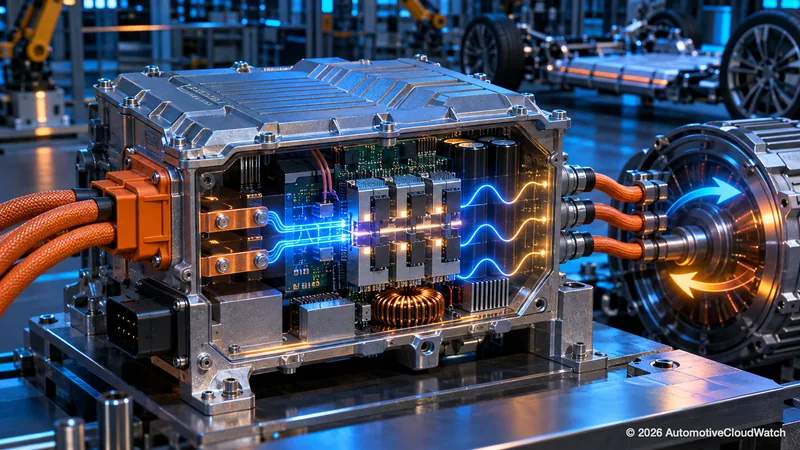 Inverter Power electronics that convert battery DC into AC to drive an EV's motor and back again during regenerative braking.
- ISO 15118 International standard for digital communication between an EV and a charger over the charging cable, enabling Plug and Charge and V2G.
- Isolation Monitoring Continuous check that an EV's high-voltage system stays electrically insulated from the car body, preventing shock risk.
- Kilowatt and Kilowatt-Hour kW and kWh Units for power, the rate energy flows, and for energy, the amount stored or used, often confused in EV reporting.
- Knock Uncontrolled self-ignition of fuel and air in a gasoline engine cylinder that causes a metallic ping and limits efficiency.
- Lithium Iron Phosphate LFP Lithium-ion chemistry with an iron phosphate cathode that is cheaper, longer lasting and safer than nickel types but less energy dense.
- Lithium Manganese Iron Phosphate LMFP LFP variant with manganese added to the cathode, raising voltage and energy density while keeping low cost and safety.
- Lithium Manganese-Rich Cathode LMR Cathode chemistry rich in manganese with little cobalt, aiming at near high-nickel energy density at lower cost.
- Lithium Metal Anode Anode of pure lithium metal, or formed in place in anode-free cells, holding about ten times the charge of graphite per gram.
- Lithium Plating Battery fault in which lithium deposits as metal on the anode surface during fast or cold charging, cutting capacity and risking shorts.
- Lithium Titanate Oxide LTO Anode material used instead of graphite that stores less energy but charges very fast, lasts very long and works well in the cold.
- Lithium-Ion Battery Li-ion Rechargeable battery in which lithium ions shuttle between a graphite anode and a metal oxide or phosphate cathode.
- Locking Differential Differential that can be locked so both wheels on an axle turn together, keeping drive on the wheel that has grip.
- Manual Service Disconnect MSD Removable plug that physically breaks the high-voltage battery circuit so technicians and rescuers can make the system safe.
- Manual Transmission MT Gearbox the driver shifts with a lever and a foot-operated clutch pedal, typically with five or six forward speeds.
- Megawatt Charging System MCS Very high-power DC charging standard for heavy electric trucks and buses, delivering up to several megawatts through one connector.
- Mild Hybrid Electric Vehicle MHEV Vehicle with a small motor-generator, usually 48 volt, that assists the engine and enables stop-start but cannot drive on electricity alone.
- Miles per Gallon Equivalent MPGe US efficiency rating that compares electric vehicles with gasoline cars by treating 33.7 kWh as one gallon of gasoline.
- Miller Cycle Engine operating cycle that closes the intake valve early or late to save fuel, using a turbo or supercharger to recover power.
- Nail Penetration Test Safety test that drives a steel nail through a battery cell to trigger an internal short and observe whether it burns or explodes.
- Naturally Aspirated Engine NA Engine that breathes air at atmospheric pressure, with no turbocharger or supercharger forcing extra air in.
- Neodymium Magnet NdFeB Very strong permanent magnet of neodymium, iron and boron that makes most EV traction motors compact and powerful.
- New Energy Vehicle NEV China's policy category for battery EVs, plug-in hybrids including range extenders and fuel cell vehicles, excluding ordinary hybrids.
- Nickel Cobalt Aluminum NCA High-energy lithium-ion cathode of nickel, cobalt and a little aluminum, closely associated with Panasonic cells for Tesla.
- Nickel Manganese Cobalt NMC Family of lithium-ion cathodes mixing nickel, manganese and cobalt in ratios such as 811, where more nickel means more energy.
- Nominal Voltage Typical average voltage of a cell or pack during discharge, about 3.6 to 3.7 volts for NMC cells and 3.2 volts for LFP.
- North American Charging Standard NACS Tesla's compact AC and DC charging connector, standardized as SAE J3400 and adopted by most automakers selling in North America.
- On-Board Charger OBC Charger built into an EV that converts AC from a home or public post into DC for the battery, typically at 7 to 22 kilowatts.
- One-Pedal Driving Driving mode where lifting off the accelerator slows the car strongly through regenerative braking, often to a full stop.
- Open Charge Point Protocol OCPP Open protocol linking EV charging stations to operators' back-end software for sessions, billing and remote maintenance.
- Open-Circuit Voltage OCV Voltage of a rested battery cell with no current flowing, a key clue the battery management system uses to estimate charge.
- Oxygen Sensor Exhaust sensor that measures leftover oxygen so the engine computer can hold the fuel mixture at the ratio the catalyst needs.
- P2 Hybrid Hybrid layout with the electric motor and a clutch between engine and transmission, allowing electric-only drive through the gearbox.
- Parallel Hybrid Hybrid in which both the engine and the electric motor can turn the wheels directly, alone or together.
- Peak and Continuous Power Short-burst maximum output versus the output a motor, inverter or battery can sustain indefinitely without overheating.
- Permanent Magnet Synchronous Motor PMSM AC motor with rare-earth permanent magnets in its rotor, the most common, efficient and compact EV traction motor.
- Planetary Gear Set Compact gearset of planet gears circling a central sun gear inside a ring gear, giving different ratios by holding different parts.
- Plug and Charge Feature that lets an EV start charging and pay automatically on plug-in, using digital certificates stored in the car.
- Plug-in Hybrid Electric Vehicle PHEV Hybrid with a larger battery that can be plugged in and driven on electricity for tens of kilometers before the engine takes over.
- Port Fuel Injection PFI Gasoline fuel system that sprays fuel into the intake port just before the valve, simpler and lower in soot than direct injection.
- Positive Temperature Coefficient Heater PTC Electric heater whose ceramic elements limit their own temperature, used in EVs to warm cabin air or battery coolant.
- Pouch Cell Battery cell sealed in a flexible laminated foil pouch, light and shape-flexible but needing an external frame for support.
- Power Rate at which work is done, equal to torque times rotational speed, given in kilowatts, horsepower or PS.
- Power Density Power a battery, motor or inverter delivers per kilogram or per liter, which is distinct from energy density.
- Power-Split Hybrid Hybrid that uses a planetary gear set to divide engine power between the wheels and a generator, acting like an electronic CVT.
- Powertrain All the parts that make power and deliver it to the wheels, from the engine or motor to the transmission, shafts and differentials.
- Powertrain Mount Rubber or fluid-filled support holding the engine, transmission or electric drive unit while damping vibration.
- Pre-Charge Circuit Resistor and switch path that gently charges the inverter's capacitors before the main battery contactors close.
- Precursor Cathode Active Material pCAM Intermediate mixed metal hydroxide powder that is later combined with lithium and fired to make cathode active material.
- Prismatic Cell Battery cell in a rigid rectangular aluminum case that stacks neatly, the dominant format in China and for LFP.
- Proton Exchange Membrane PEM Thin polymer membrane at the heart of a vehicle fuel cell that passes protons but blocks electrons and gases.
- Pyrotechnic Fuse Safety device that fires a small explosive charge to cut a high-voltage battery cable within milliseconds in a crash or severe fault.
- R-744 Carbon dioxide used as a vehicle air conditioning and heat pump refrigerant, with a global warming potential of just 1.
- Range How far an EV can drive on a full charge under official tests such as WLTP, EPA or CLTC, which real-world conditions can cut.
- Range Anxiety Driver's worry that an EV will run out of charge before reaching a destination or a working charger.
- Range-Extended Electric Vehicle REEV Electric car always driven by its motors, with a small engine that only runs a generator to recharge the battery.
- Rated Capacity Charge in ampere-hours that the cell maker states a battery will deliver under standard test conditions.
- Regenerative Braking Slowing an electrified vehicle by running its motor as a generator, returning energy to the battery and reducing brake wear.
- SAE J1634 US test procedure for measuring battery EV range and energy consumption, used by the EPA for official range ratings.
- SAE J1772 SAE standard for the AC charging plug used in North America and Japan, known as the Type 1 connector.
- SAE J2601 Standard protocol for refueling hydrogen fuel cell cars, setting how fast a station may safely fill the tank.
- Second-Life Battery EV battery reused, often as stationary storage, after it no longer suits the car, typically still holding 70 to 80 percent capacity.
- Selective Catalytic Reduction SCR Exhaust system that injects urea solution so nitrogen oxides are turned into nitrogen and water over a catalyst.
- Self-Discharge Slow loss of charge in a battery sitting unused, where unusually fast loss often signals a hidden cell defect.
- Semi-Solid-State Battery Battery cell using a reduced amount of liquid or gel electrolyte with solid electrolyte materials, a step toward full solid state.
- Separator Thin porous plastic film inside a cell that keeps the anode and cathode apart while letting lithium ions pass.
- Series Hybrid Hybrid whose engine only drives a generator while the wheels are always driven by the electric motor.
- Shift-by-Wire Gear selector that sends electronic signals to the transmission instead of moving a mechanical cable or linkage.
- Silicon Anode Anode blending silicon into graphite to store more lithium and charge faster, limited by silicon's large swelling.
- Silicon Carbide SiC Wide-bandgap semiconductor for power transistors that switch faster and waste less energy, standard in most 800 volt EVs.
- Smart Charging Charging that adjusts timing and speed based on price, grid or vehicle signals to cut cost and avoid overloading the grid.
- Sodium-Ion Battery Na-ion Rechargeable battery using sodium ions instead of lithium, cheaper and better in the cold but storing less energy than LFP.
- Solid Electrolyte Interphase SEI Thin protective film that forms on the anode during the first charges and whose slow growth consumes lithium over the battery's life.
- Solid-State Battery SSB Battery that uses a solid electrolyte instead of flammable liquid, promising more energy, faster charging and better safety.
- Start-Stop System Function that switches off the engine when the car stops and restarts it when the driver lifts off the brake.
- State of Charge SoC How full a battery is right now as a percentage of usable capacity, estimated by the battery management system.
- State of Health SoH Measure of how worn a battery is compared with new, usually the percentage of original capacity that remains.
- State of Power Real-time estimate of how much power a battery can deliver or absorb without exceeding its safe voltage, current or temperature limits.
- Stoichiometric Air-Fuel Ratio Exact air and fuel mix at which all the fuel burns with no oxygen left, about 14.7 to 1 for gasoline, known as lambda 1.
- Supercharger Engine-driven air compressor that forces extra air into the engine for more power, with instant response but some parasitic loss.
- Synchronous Reluctance Motor SynRM Electric motor whose rotor has no magnets or windings and relies on shaped flux barriers, often assisted by small magnets.
- Tabless Electrode Cell design that collects current along the whole electrode edge rather than a few tabs, cutting resistance and heat.
- Thermal Management System TMS Coolant loops, pumps, valves, chillers and heaters that keep an EV's battery, motor, electronics and cabin at the right temperatures.
- Thermal Propagation Spread of thermal runaway from one failing cell to its neighbors, which can turn a single fault into a pack fire.
- Thermal Runaway Self-feeding chain reaction in a battery cell where heat triggers reactions that release more heat, leading to venting and fire.
- Torque Twisting force an engine or motor produces to turn the wheels, measured in newton-meters or pound-feet.
- Torque Converter Fluid coupling between engine and automatic transmission that lets the car idle in gear and multiplies torque when pulling away.
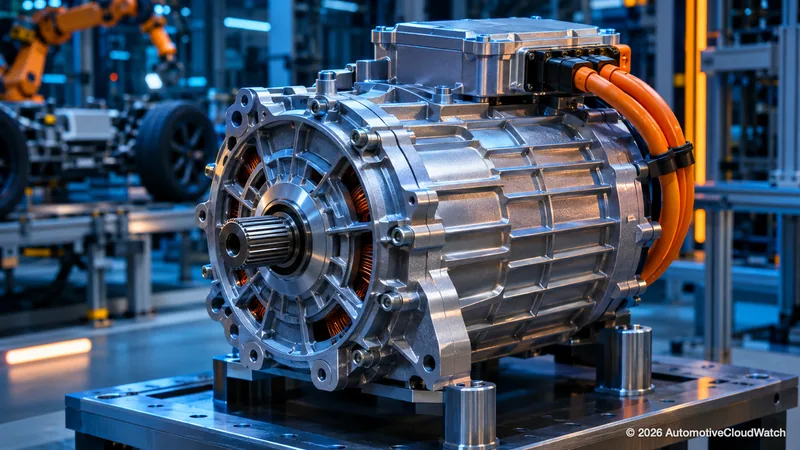 Traction Motor Electric motor that drives the wheels of an electrified vehicle, most often a permanent magnet synchronous type.
- Transfer Case Gearbox that splits power between the front and rear axles on four-wheel-drive vehicles, often with a low-range gear.
- Turbocharger Exhaust-driven turbine that spins a compressor to push extra air into the engine, letting a small engine make big power.
- Type 2 Connector Seven-pin European AC charging plug supporting single- and three-phase power, required on public AC chargers in the EU.
- UN 38.3 UN test series every lithium battery must pass before it can be shipped by air, sea, rail or road.
- Utility Factor Assumed share of driving a plug-in hybrid does on electricity, used to compute its official fuel consumption and CO2.
- Valvetrain Mechanism of camshafts, followers, valves and springs that opens and closes an engine's valves at the right moments.
- Variable Compression Ratio VCR Engine that changes its compression ratio while running, high at light load for efficiency and low under boost to avoid knock.
- Variable Geometry Turbocharger VGT Turbocharger with movable vanes that change exhaust flow onto the turbine, reducing lag across the speed range.
- Variable Valve Timing VVT Technology that shifts when, and sometimes how far, an engine's valves open while it runs, improving power, economy and emissions.
- Vehicle-to-Grid V2G Using a parked EV's battery to send electricity back to the grid for balancing or peak relief, usually in return for payment.
- Vehicle-to-Home V2H Using an EV's battery through a bidirectional charger to power a house during outages or at expensive peak times.
- Vehicle-to-Load V2L EV feature that supplies ordinary AC power through an outlet or adapter to tools, appliances or camping gear.
- Well-to-Wheel WTW Counting a vehicle's energy use or emissions over the whole fuel or electricity supply chain, not just at the tailpipe.
- Wireless Charging Charging an EV without a cable, using magnetic fields from a ground pad to a receiver coil under the car.
- Worldwide Harmonized Light Vehicles Test Procedure WLTP Laboratory test measuring fuel consumption, CO2, pollutant emissions and EV range for new cars in Europe, Japan and other markets.
Full entry for members
Every term has a full entry for members: the plain-words definition, the practitioner note and the typed links between terms.
ACW Automotive Glossary, edition 2026.11.1. The headword and one line are open to everyone.