Glossary · Automotive
Vehicle Architecture and Body
126 terms in the Automotive glossary, each with its one-line definition.
126 terms, A to Z
- A-Pillar The roof post on each side of the windshield, which must be strong in rollovers and crashes yet slim enough not to block the driver's view.
- A-Segment The European size class for the smallest city cars, typically under about 3.7 meters long.
- Active Grille Shutters Motorized flaps behind the grille that close when little cooling is needed to cut aerodynamic drag and open when more airflow is required.
- Active Noise Cancellation ANC A system that plays opposite sound waves through the cabin speakers to cancel low-frequency engine and road noise.
- Advanced High-Strength Steel AHSS A family of specially processed multiphase and martensitic steels that are far stronger than mild steel, allowing thinner, lighter and safer body parts.
- Aeroacoustics The study and control of wind noise made by air flowing over a moving car, such as whistles from mirrors and roar around the pillars.
- Aluminum Body Sheet Thin rolled aluminum used for body panels such as hoods, doors and roofs, much lighter than steel but costlier and harder to join.
- Aluminum Extrusion A long beam made by pushing hot aluminum through a shaped die, giving light hollow sections for bumper beams, rockers and battery enclosures.
- Aluminum-Intensive Body A car body made mostly of aluminum sheet, castings and extrusions instead of steel, to save weight for efficiency and payload.
- Approach and Departure Angles The steepest slopes a vehicle can climb onto or leave without its front or rear bumper striking the ground.
- Automotive Glazing All the glass in a vehicle, including the laminated windshield, side and rear windows and glass roofs.
- B-Pillar The roof post between the front and rear doors, a key part of the body for protecting occupants in side crashes.
- B-Segment The European size class for small cars around 4.0 to 4.2 meters long, one size above city cars.
- Battery Enclosure The sealed underfloor box that holds and protects an EV's battery cells from impacts, water and dust.
- Beltline The line along a car's side where the bottom edge of the side windows meets the doors.
- Bending Stiffness How strongly a car body resists sagging in the middle under the weight of occupants and road loads.
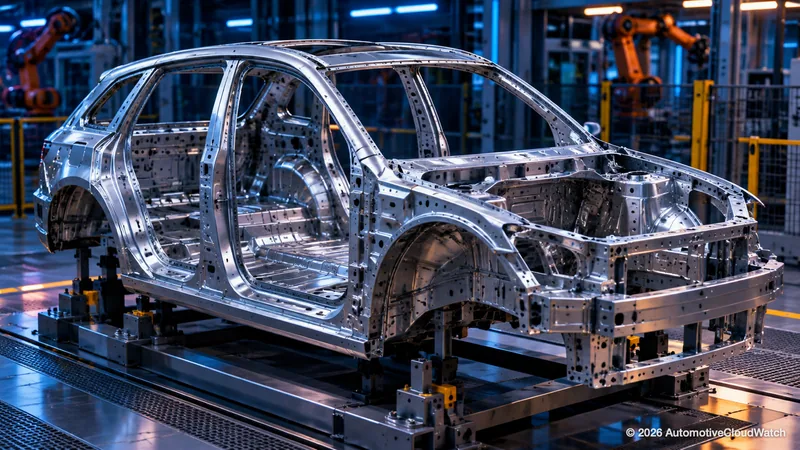 Body in White BIW The bare welded shell of a car before painting and before any parts are fitted, which gives it shape, strength and crash protection.
- Body Side Outer The large one-piece panel forming the whole visible side of the car body, including door openings and pillar skins.
- Body Style The overall shape and layout of a car body, such as sedan, hatchback, wagon, SUV or pickup.
- Body-on-Frame Construction in which a separate body is bolted onto a strong ladder frame that carries the suspension, powertrain and wheels.
- Breakover Angle The steepest crest a vehicle can drive over without its underside between the axles scraping.
- Bumper Beam The strong steel or aluminum bar behind the bumper cover that spreads crash forces and protects parts in minor impacts.
- Bumper Fascia The painted plastic cover at the front or rear of a car that people usually call the bumper.
- Buzz, Squeak and Rattle BSR Small annoying noises from interior or body parts rubbing or knocking together, a leading source of quality complaints.
- C-Pillar The roof post behind the rear doors or rear side windows, which strongly shapes styling and rear visibility.
- C-Segment The European compact car class, typically around 4.2 to 4.6 meters long.
- Cab-Over COE Truck or van layout with the driver above or ahead of the front axle and no hood, maximizing cargo length.
- Carbon Fiber Reinforced Polymer CFRP A very light, strong material of carbon fibers in plastic resin, used mainly in supercars, racing and selected parts.
- Cargo Volume The measured luggage space in a car's trunk or load area, quoted in liters or cubic feet under different methods.
- Center Console The area between the front seats holding the gear selector, cup holders, storage, armrest and some controls.
- Class A Surface A visible surface held to the highest smoothness standard so reflections flow across it without distortion.
- Clay Model A full-size or scale model of a new car design sculpted from industrial clay so designers can judge it in three dimensions.
- Closures The body parts that open and close, meaning the doors, hood, liftgate or trunk lid and fuel or charge door.
- Cockpit Module The whole dashboard area built as one preassembled unit with the instrument panel, its beam, HVAC unit, wiring and controls.
- Couple Distance The fore-and-aft distance between the hip points of front and rear seat occupants, a key measure of rear seat roominess.
- Cowl The area at the base of the windshield between the hood and the glass, usually under a plastic grille.
- Crash Box A short metal box section between the bumper beam and the main rails, designed to crumple neatly in low-speed impacts.
- Cross-Car Beam CCB A strong tube or casting running behind the dashboard between the front pillars, carrying the steering column and instrument panel.
- Crossover Utility Vehicle CUV An SUV-style vehicle built on a car-type unibody platform rather than a truck frame.
- Crumple Zone A front or rear part of the body built to crush in a controlled way and absorb crash energy.
- Curb Weight The weight of a car ready to drive with fluids and standard equipment but no occupants or cargo.
- D-Pillar The rearmost roof post on wagons, SUVs and minivans, behind the rear side windows.
- D-Segment The European class of midsize family cars and their premium equivalents.
- Dash Panel The steel wall separating the engine or front compartment from the passenger cabin.
- Dash-to-Axle Ratio The distance from the base of the windshield to the front wheel centers, a key proportion in car design.
- Daytime Running Lights DRL Front lamps that switch on automatically whenever the car runs to make it more visible in daylight.
- Dedicated EV Platform A vehicle base designed only for battery-electric cars, with a flat floor battery and no space for an engine.
- Design Freeze The program milestone after which the exterior and interior design may no longer change.
- Door Module A preassembled carrier plate inside a car door holding the window lifter, speaker, lock motors and wiring.
- Drag Coefficient Cd A number describing how easily a vehicle's shape slips through the air regardless of its size.
- Dual-Phase Steel DP An advanced high-strength steel mixing soft ferrite and hard martensite grains for high strength with good formability.
- E-Segment The European class of executive cars above the midsize D-segment, typically about 4.9 to 5.1 meters long.
- Effective Headroom The standardized measurement of space above a seated occupant's hip point to the headliner.
- Effective Legroom The standardized measurement of space for an occupant's legs from the hip point toward the pedals or seat in front.
- EPA Size Class The official US car category, such as compact or midsize, assigned by combined passenger and cargo volume.
- Eyellipse An ellipse-shaped zone that statistically covers where most drivers' eyes will be, used to design visibility.
- F-Segment The European class of full-size luxury cars at the top of the size scale.
- Floor Pan The large pressed panel or set of panels that forms the floor of the passenger compartment.
- Flush Door Handle A door handle that sits level with the door skin and pops out or pivots when needed, mainly for looks and slight drag reduction.
- Front-End Module FEM A preassembled nose assembly combining the radiator support, cooling module, headlamps, bumper beam and sometimes the grille.
- Frontal Area The size of a vehicle's silhouette seen from directly in front, which multiplies with drag coefficient to set air resistance.
- Frunk Front trunk, the storage space under the hood of an EV or rear-engine car where no engine sits.
- Galvanized Steel Steel sheet coated with a thin layer of zinc to stop it rusting, standard for car body panels.
- Gap and Flush How evenly body panels fit together, meaning gap width between them and whether their surfaces sit level.
- Gear Whine A high-pitched tonal hum from meshing gears in a transmission or EV drive unit or from motor magnetic forces.
- Gigacasting Casting very large one-piece sections of a car body in a single shot of molten aluminum, replacing dozens of stamped parts.
- Greenhouse Designer slang for the glassy upper part of a car body above the beltline, including windows, pillars and roof.
- Gross Combined Weight Rating GCWR The maximum allowed weight of a loaded vehicle and its loaded trailer together, set by the manufacturer.
- Gross Vehicle Weight Rating GVWR The maximum total weight a vehicle may reach with passengers, cargo and trailer tongue load, set by the manufacturer.
- Ground Clearance The distance between the ground and the lowest point of a vehicle's underside, not counting the tires.
- H-Point The theoretical hip joint of a seated person, the main reference for where occupants sit in a car.
- Hard Points Fixed reference positions that define a vehicle's layout, such as wheel, suspension mount, seat and powertrain locations.
- Headliner The fabric-covered panel lining the inside of the roof, which also carries lights, handles and head-impact padding.
- Heating, Ventilation and Air Conditioning HVAC The system that heats, cools, dehumidifies and moves air around the cabin.
- Instrument Panel IP The dashboard facing the front occupants, carrying the displays, air vents, controls and passenger airbag.
- Interior Trim All the visible finishing parts of the cabin, such as door panels, pillar covers, carpets and seat backs.
- Japanese Compact Vehicle Class The Japanese class of ordinary cars within set size and engine limits, identified by license plates beginning with 5.
- Kei Car The Japanese light vehicle class limited to 3.4 meters long, 1.48 meters wide and 660 cc, with tax and parking advantages.
- Kei Truck A tiny Japanese cab-over pickup built to kei car size and engine limits, with a flat cargo bed.
- Light Commercial Vehicle LCV A van, pickup or chassis cab used mainly to carry goods, which in the EU is category N1 up to 3.5 metric tons.
- Light Truck A US regulatory and sales category covering pickups, SUVs, most crossovers and vans below 8,500 pounds GVWR.
- Lightweighting The effort to make vehicles lighter through better materials, design and joining methods.
- Load Path The route that forces travel through a vehicle's structure, such as from the bumper through the rails into the floor in a crash.
- Longitudinal Rail One of the main front-to-back beams at the front or rear of the body that absorbs crash energy and carries the suspension.
- Magnesium Alloy The lightest structural metal used in cars, about a third lighter than aluminum, mainly in die-cast parts.
- Mass in Running Order MiRO The official EU vehicle weight ready to drive, including fluids, a nearly full tank and a 75 kilogram driver allowance.
- Matrix LED Headlight A headlight whose high beam is split into many LED segments that switch off individually to avoid dazzling other road users.
- Modular Platform A vehicle base designed as a kit of scalable building blocks so dimensions can vary while key interfaces stay fixed.
- Monocoque A structure in which the outer skin carries most of the loads, like an egg shell, as in supercar carbon tubs.
- Multi-Energy Platform A vehicle base engineered to take gasoline, hybrid, plug-in hybrid and battery-electric powertrains, often on one assembly line.
- Multi-Material Body A car structure that mixes steels, aluminum, magnesium and composites, choosing each where it balances cost, weight and strength best.
- Multi-Purpose Vehicle MPV A passenger vehicle designed for maximum interior space and flexible seating, often with sliding doors and three rows.
- Noise, Vibration and Harshness NVH The engineering discipline concerned with the sounds and shakes occupants hear and feel, from road roar to rattles.
- Overhang The length of a car's body that extends ahead of the front wheels or behind the rear wheels.
- Panoramic Roof A large fixed or opening glass roof that extends over both front and rear seats.
- Payload The maximum weight of people and cargo a vehicle can carry.
- Pickup Truck A light truck with an enclosed passenger cab and an open cargo bed at the back.
- Press-Hardened Steel PHS An ultra-strong steel made by heating boron steel, pressing it in a cooled die and quenching it, used for pillars and rails.
- R-1234yf The low global-warming refrigerant gas used in most new car air conditioners in place of R-134a.
- Road Noise The rumble and roar from tires rolling over the road surface, which reaches the cabin through the air and the structure.
- Rocker Panel The beam running along the bottom of the body beneath the doors, which carries side crash loads and protects EV batteries.
- Roof Rail The structural beam along each side of the roof connecting the front, center and rear pillars.
- SAE J1100 The SAE recommended practice that defines how to measure a vehicle's interior, exterior and cargo dimensions.
- Safety Cage The rigid passenger compartment built to keep its shape in a crash and preserve survival space.
- Seating System The complete car seat including frame, mechanisms, foam, cover, heating, motors and built-in airbags and sensors.
- Sheet Molding Compound SMC A moldable sheet of chopped glass fiber in thermoset resin, pressed into body panels in heated molds.
- Shock Tower The reinforced structure at each corner of the body where the top of the strut or shock absorber is bolted.
- Skateboard Platform A flat EV chassis that holds the battery in the floor and motors at the axles, onto which different bodies are mounted.
- Space Frame A body built as a three-dimensional cage of tubes or beams joined at nodes, with panels that carry little load.
- Sport Utility Vehicle SUV A vehicle with raised ride height, upright body and often all-wheel or four-wheel drive.
- Top Hat Industry shorthand for the visible upper body and interior that sit on a shared platform and carry most styling differentiation.
- Torsional Rigidity How strongly a car body resists twisting, usually expressed in newton-meters per degree.
- Towing Capacity The maximum trailer weight a vehicle is rated to pull, set by the manufacturer.
- Track Width The distance between the centers of the left and right wheels on the same axle.
- Transfer Path Analysis TPA An engineering method that traces how noise and vibration travel from sources through mounts and the body to occupants.
- Trim Level A named version of a model, such as base, mid or top grade, each with different standard equipment and options.
- Two-Box and Three-Box Designer terms for a car's basic side profile, counting the volumes for hood, cabin and trunk.
- Ultra-High-Strength Steel UHSS The strongest group of car body steels, usually about 980 megapascals and above, including martensitic and press-hardened grades.
- Unibody A car body in which floor, pillars, roof and panels form one load-bearing welded shell with no separate frame.
- Vehicle Packaging The engineering task of fitting occupants, luggage, powertrain, battery, crash structure and components within the vehicle's outer dimensions.
- Vehicle Platform The shared base of underbody structure, key dimensions, suspension mounts and core systems on which several models are built.
- Vehicle Segment A class used to group cars by size and market position, such as the European A to F letters.
- Wading Depth The deepest water a vehicle is rated to drive through slowly without damage.
- Weatherstrip A rubber or plastic seal around doors, opening panels and windows that keeps out water, dust and wind noise.
- Wheelbase The distance between the centers of the front and rear wheels, which shapes interior space, ride and maneuverability.
- Wind Tunnel A test facility that blows air over a stationary vehicle to measure aerodynamic drag, wind noise or climate effects.
Full entry for members
Every term has a full entry for members: the plain-words definition, the practitioner note and the typed links between terms.
ACW Automotive Glossary, edition 2026.11.1. The headword and one line are open to everyone.