Glossary · Manufacturing
Architectures, Standards and Networks
70 terms in the Manufacturing glossary, each with its one-line definition.
70 terms, A to Z
- 5G RedCap A cheaper, lower-power class of 5G device for sensors, cameras and wearables that do not need full 5G speed or bandwidth.
- Advanced Message Queuing Protocol AMQP An open messaging standard that routes and queues messages between applications through a broker so data is not lost when a receiver is busy.
- AS-Interface AS-i A very simple two-wire network that carries both power and data to basic on and off sensors and actuators such as proximity switches and valves.
- AutomationML AML An open XML-based file format for passing plant layout, geometry, robot motion and control logic between engineering tools without retyping.
- Business to Manufacturing Markup Language B2MML Standard XML message formats that let ERP and MES exchange orders, schedules, material use and results using the ISA-95 vocabulary.
- CANopen A protocol on top of the CAN bus that defines how embedded controllers, drives, sensors and I/O exchange data and configuration.
- CC-Link IE A family of gigabit industrial Ethernet networks from the CC-Link Partner Association, linked to Mitsubishi Electric and widely used in Japan and Asia.
- CIP Safety A safety extension of CIP that carries emergency stop and light curtain signals on the same EtherNet/IP network as normal control data.
- Common Industrial Protocol CIP The shared object-based application layer used by EtherNet/IP and DeviceNet, so a device presents its data the same way on any of these networks.
- Data Distribution Service DDS A brokerless publish and subscribe standard for real-time systems such as robots and autonomous vehicles, and the communication layer under ROS 2.
- Deterministic Networking Networking that guarantees each message arrives within a known, fixed time with almost no variation or loss, as coordinated motion control needs.
- Device Description File A vendor-supplied file that tells PLC engineering software what a device is, its I/O, settings and diagnostics, so it can be added to a network.
- Device Level Ring DLR A way of wiring EtherNet/IP devices in a ring so traffic reroutes around a single cut cable or failed device within milliseconds.
- DeviceNet An older CAN-based factory network carrying power and data to sensors, valve banks and drives, still common though new designs use EtherNet/IP.
- ECLASS A large shared dictionary giving every product class and property a unique code and definition so companies can exchange product data unambiguously.
- Equipment Hierarchy The ISA-95 way of arranging factories into nested levels from enterprise and site down to areas, lines and work units so every machine has a place.
- EtherCAT A very fast industrial Ethernet developed by Beckhoff in which devices process data on the fly, used for precisely synchronized servo axes.
- Ethernet for Plant Automation EPA A Chinese real-time industrial Ethernet protocol for plant automation, included in the IEC fieldbus standards and used mainly in Chinese process plants.
- Ethernet-APL APL A rugged two-wire Ethernet that brings fast networking and power to process instruments, including in explosive areas, launched in 2022.
- EtherNet/IP An industrial network running the Common Industrial Protocol over standard Ethernet, managed by ODVA and dominant in North American plants.
- Fail Safe over EtherCAT FSoE The safety protocol for EtherCAT that carries emergency stop and other safety signals on the same cable as normal machine data, up to SIL 3.
- Field Device Integration FDI A standard package holding everything a host needs to configure and diagnose a field instrument, so any compliant system can set it up.
- Field Device Tool FDT An open standard in which instrument makers supply a software driver, called a DTM, that plugs into any compatible engineering tool, like a printer driver.
- Fieldbus A digital network linking a controller to many field devices over one shared cable instead of separate wires per signal, such as PROFIBUS or DeviceNet.
- Foundation Fieldbus FF A fully digital network for process plants that connects instruments and valves and can run control loops inside the field devices themselves.
- HART A protocol that overlays a small digital signal on the 4 to 20 mA wire of process instruments, letting technicians read settings and diagnostics.
- IEC 61158 The international standard that collects the many fieldbus and real-time Ethernet networks, such as PROFINET and EtherCAT, as numbered types.
- Industrial Demilitarized Zone IDMZ A buffer network between plant control and corporate networks, holding shared services so the two never communicate directly, often called Level 3.5.
- Industrial Ethernet Using Ethernet with rugged hardware and real-time features to connect controllers, drives, robots and I/O, largely replacing older fieldbuses.
- IO-Link A point-to-point digital link letting one sensor or actuator send values, settings and diagnostics over a normal three-wire cable to a master.
- ISA-88 A standard for batch process control that separates the recipe from equipment logic, so the same vessels can make different products without reprogramming.
- ISA-95 The main international standard for connecting business systems such as ERP with factory floor systems, and the usual reference for MES scope.
- ISO 22400 An international standard series giving exact definitions and formulas for factory KPIs such as OEE, so numbers are comparable across plants.
- ISO 23247 An international standard series setting a common framework and vocabulary for building digital twins of manufacturing equipment, products and processes.
- Level 0 L0 The bottom level of the Purdue model, made up of the physical process and the sensors, actuators, motors and valves that act on it.
- Level 1 L1 The basic control level of the Purdue model, where PLCs, safety controllers and drives run machines in real time.
- Level 2 L2 The supervisory level of the Purdue model, where operators monitor lines through HMIs and SCADA and engineers program controllers.
- Level 3 L3 The site operations level of the Purdue model and ISA-95, covering plant-wide systems such as MES, historians, quality and maintenance.
- Level 4 L4 The business planning and logistics level of the Purdue model and ISA-95, where ERP and scheduling plan production, materials and shipping.
- Level 5 L5 The enterprise level of the extended Purdue model, covering corporate data centers, internet access and cloud, treated as least trusted by the plant.
- Local 5G Japan's scheme letting companies and local governments run their own private 5G network on their premises using dedicated licensed spectrum.
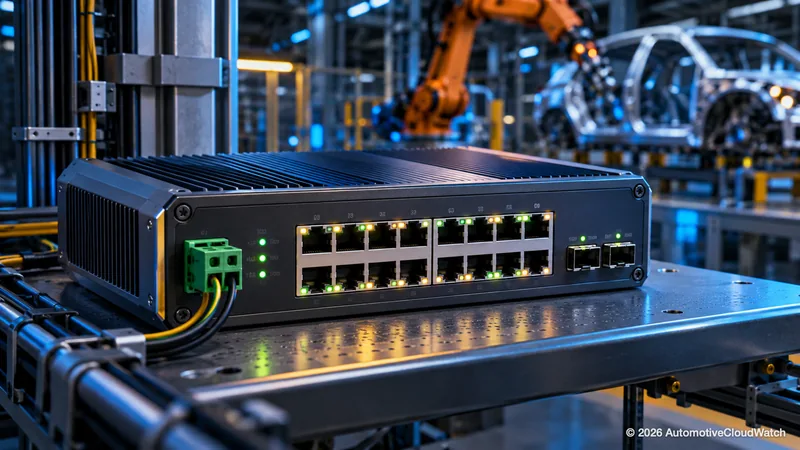 Managed Switch A configurable network switch supporting VLANs, traffic priority, redundancy rings, port security and diagnostics, unlike a plug-in unmanaged switch.
- MECHATROLINK A family of motion control networks first developed by Yaskawa Electric, linking controllers with servo drives and I/O, common in Asian machine building.
- Media Redundancy Protocol A ring redundancy protocol, widely used with PROFINET, that reroutes traffic the other way when a cable or switch fails, managed by one ring manager.
- Modbus One of the oldest and simplest industrial protocols, in which a client reads or writes numbered registers in a device, with no built-in security.
- Modbus RTU The serial version of Modbus, sending compact binary messages over RS-485 or RS-232 between one master and up to 247 devices.
- Modbus TCP The Ethernet version of Modbus, carrying the same register requests over TCP/IP on port 502, with no authentication.
- Module Type Package MTP A standard description of what a process module can do and how to control it, so skids plug into a larger plant without custom programming.
- MTConnect An open, free standard that lets software read status, speed and alarm data from machine tools in a common vocabulary regardless of brand.
- NAMUR A Germany-based user association of process industry plant operators whose NE recommendations, such as NE 107 diagnostics, suppliers widely follow.
- NAMUR Open Architecture NOA A NAMUR concept adding a secure second channel beside core process control so data can flow to IT and cloud without disturbing control.
- ODVA The standards organization managing the Common Industrial Protocol, EtherNet/IP and DeviceNet, which writes the specifications and runs conformance tests.
- OPC UA FX OPC Foundation specifications extending OPC UA down to controllers and field devices, using PubSub over TSN for vendor-neutral real-time exchange.
- Open Process Automation Standard O-PAS A standard for building process control systems from interchangeable multi-vendor parts, developed by the Open Process Automation Forum of The Open Group.
- PackML A standard that makes machines from different builders behave and report alike using common states such as idle, execute, held and stopped.
- Parallel Redundancy Protocol PRP A redundancy method that sends every message over two separate networks at once, so a network failure causes no loss and no switchover delay.
- Precision Time Protocol PTP A protocol that keeps device clocks on a network within a microsecond of each other, letting drives move in step and TSN schedule traffic.
- Private 5G A 5G network built for one organization's exclusive use, giving reliable wireless coverage for mobile equipment such as AGVs and AMRs.
- PROFIBUS A fieldbus introduced in Germany in 1989 linking controllers with drives, I/O and process instruments, now largely succeeded by PROFINET.
- PROFINET The industrial Ethernet standard of PROFIBUS and PROFINET International, linked to Siemens, connecting PLCs with I/O, drives and robots.
- PROFIsafe A safety protocol that carries emergency stop and guard signals over PROFINET or PROFIBUS alongside normal control data, up to SIL 3 and PLe.
- Purdue Model A reference map dividing industrial systems into numbered levels from field devices to enterprise, used as the basis for network segmentation.
- Rapid Spanning Tree Protocol RSTP A switch protocol that allows redundant Ethernet loops by blocking spare paths and unblocking them when a link fails, too slow for many control uses.
- Seamless Message Protocol SLMP A simple Ethernet messaging protocol letting PCs and vision systems read and write data in Mitsubishi Electric and CC-Link compatible controllers.
- Single Pair Ethernet SPE Ethernet over a single twisted pair, often with power on the same pair, making it practical to bring Ethernet to small sensors and actuators.
- Time-Sensitive Networking TSN IEEE Ethernet standards that let time-critical control traffic and ordinary IT traffic share one network while guaranteeing on-time delivery.
- Universal Machine Technology Interface umati A VDMA initiative promoting one common OPC UA based interface so machines from different builders connect to factory IT without custom work.
- Virtual Local Area Network VLAN Splitting one physical network into several logical networks through switch settings, so control, video and office traffic stay apart.
- Wi-Fi 6 The IEEE 802.11ax Wi-Fi generation, better at serving many devices at once, used in factories for tablets, scanners and mobile robots.
- WirelessHART A wireless mesh version of HART that connects process instruments and monitoring sensors without cables where wiring is costly.
Full entry for members
Every term has a full entry for members: the plain-words definition, the practitioner note and the typed links between terms.
ACW Manufacturing Glossary, edition 2026.11.1. The headword and one line are open to everyone.