Glossary · Manufacturing
Industrial IoT, Data and AI
97 terms in the Manufacturing glossary, each with its one-line definition.
97 terms, A to Z
- 3D Machine Vision Camera systems that measure the depth and shape of objects so robots and inspection stations know how far away each point is.
- Agent2Agent Protocol A2A Open protocol that lets AI agents from different vendors find each other, hand off tasks and share results in a standard way.
- Agentic AI AI that plans and carries out multistep tasks on its own by calling software tools, usually with a person approving changes.
- AI Visual Inspection Quality inspection in which cameras photograph parts and a trained AI model decides whether each one has a defect.
- Anomaly Detection Finding data that departs from normal machine or process behavior so problems are caught before a breakdown or defect.
- Apache Kafka Kafka Open-source event streaming platform that moves large, durable streams of data between producing and consuming systems.
- Application Programming Interface API Defined way for one program to request data or actions from another, today usually a web interface over HTTP.
- Asset Model Organized hierarchy of a plant's equipment, from site down to component, that gives every data point a known home.
- Closed-Loop Optimization AI or analytics models writing new setpoints back to the control system automatically instead of only advising operators.
- Cloud Computing Renting computing, storage and software over a network from providers instead of owning all the hardware yourself.
- Containerization Packaging software with everything it needs into an isolated container so it runs the same on any compatible computer.
- Data Contextualization Attaching background such as machine, product, batch, unit and shift to raw data so it can explain what happened.
- Data Governance Rules, roles and processes that set who owns and may use data and how its quality and definitions stay consistent.
- Data Labeling Marking data with the correct answers, such as boxing defects in part photos, so a supervised AI model can learn from it.
- Data Matrix Code Compact square 2D barcode, often laser-marked onto metal parts, that stores a serial number and stays readable when partly damaged.
- Data Pipeline Automated chain of steps that collects data, cleans and reshapes it, and delivers it to where it is used.
- Deadband Small band around the last value within which changes are ignored so noise does not trigger action or data transmission.
- Deep Learning Machine learning using many-layered neural networks that learn patterns directly from raw images, signals and text.
- Edge AI Running AI models on plant equipment such as industrial PCs or smart cameras instead of in the cloud for fast, local decisions.
- Edge Computing Processing data close to where it is created, on plant floor PCs, gateways or controllers, rather than sending it all to the cloud.
- Edgecross Japanese consortium and software platform for collecting and processing factory machine data at the edge regardless of equipment brand.
- EU AI Act EU law that sorts AI systems by risk level and places stricter obligations on higher-risk uses, including in manufacturing.
- Event-Driven Architecture EDA Software design in which systems react to events announced on a shared messaging platform instead of polling each other.
- Explainable AI XAI Methods that show people why an AI model made a decision, such as which process variables drove a quality prediction.
- Extract, Transform, Load ETL Process of pulling data from source systems, reshaping it consistently and loading it into a warehouse or lakehouse.
- Federated Learning Training one machine learning model across several sites by sharing model updates instead of raw data.
- Fog Computing Older term for a computing layer between edge devices and the cloud, now usually folded into edge computing.
- Generative AI GenAI AI that creates new text, code, images or designs, used in plants for troubleshooting assistants, work instructions and PLC code.
- Global Discovery Server GDS OPC UA service where servers and clients register, find each other and receive security certificates from one central place.
- Golden Batch Recorded profile of the best quality batch, used as a reference that new batches are compared against in real time.
- Human in the Loop HITL Design in which a person reviews or approves an automated or AI decision before it takes effect.
- Hybrid Cloud IT setup combining on-site or edge computers with public cloud services managed as one system.
- Hybrid Modeling Combining physics equations with machine learning in one model so it needs less data and behaves more reliably.
- Industrial Analytics Analyzing manufacturing data to understand and improve operations, from describing what happened to prescribing what to do.
- Industrial Copilot AI assistant built into industrial software that helps engineers write PLC code, explain alarms or guide maintenance.
- Industrial DataOps Practice and tools for collecting, contextualizing, governing and delivering industrial data in a managed, repeatable way.
- Industrial Foundation Model Large AI model pretrained on industrial data such as documents, sensor series, CAD or code and adapted to many factory tasks.
- Industrial Internet of Things IIoT Connecting machines, robots, utilities and vehicles to networks so their data can be collected and used, the factory version of IoT.
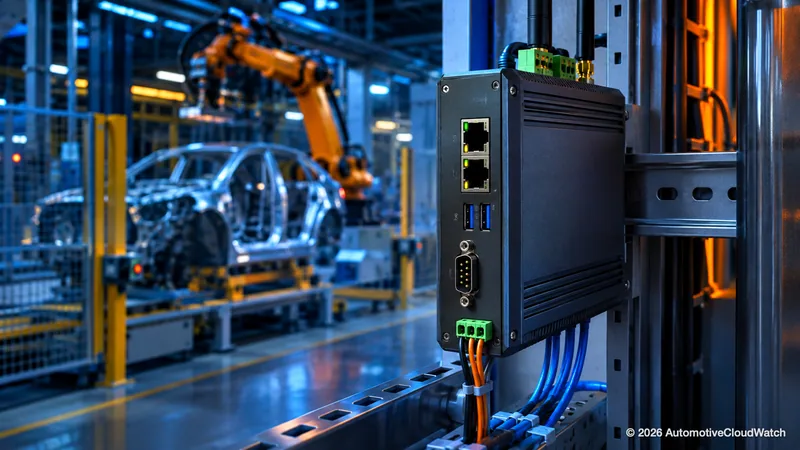 Industrial Internet of Things Gateway Device that translates older industrial protocols into IT-friendly ones such as MQTT or OPC UA to connect machines to software.
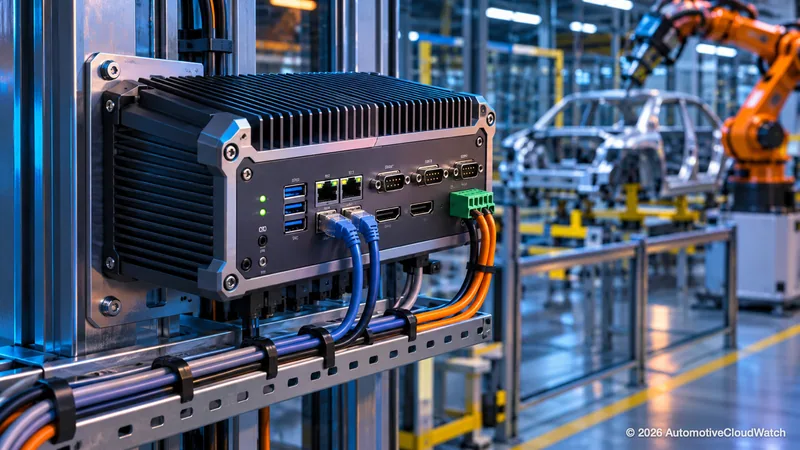 Industrial PC IPC Ruggedized computer built for factory conditions that runs operator screens, SCADA, vision, edge software and soft PLCs.
- Information Model Structured, machine-readable description of a system's data, its objects, properties, relations and meaning.
- Internet of Things IoT Network of objects fitted with sensors, processors and connectivity so they can collect and share data.
- Knowledge Graph Network of things such as machines, parts and defects plus their relationships, used to link data and ground AI assistants.
- Large Language Model LLM AI model trained on vast amounts of text that can understand and write language and code.
- LoRaWAN Long-range, very low-power wireless network for sensors that send small amounts of data every few minutes.
- Low-Power Wide-Area Network LPWAN Wireless technologies that send small amounts of data far on so little power that battery sensors last for years.
- Machine Data Collection MDC Automatically capturing a machine's state, counts, cycle times, alarms and downtime from its controller and sensors.
- Machine Learning ML Software that learns patterns from historical data to make predictions or decisions instead of following hand-written rules.
- Machine Vision Cameras, lighting and image processing that let machines inspect, measure, read codes and locate parts.
- MLOps Practices and tools for deploying, monitoring, versioning and retraining machine learning models in production.
- Model Context Protocol MCP Open standard that connects AI models and agents to outside tools and data through one common interface.
- Model Drift Gradual loss of a machine learning model's accuracy because the data it sees has changed since training.
- MQTT Lightweight publish and subscribe messaging protocol widely used to move IIoT data through a central broker.
- MQTT Broker Server in an MQTT system that receives every published message and passes it to clients subscribed to that topic.
- Narrowband IoT NB-IoT Cellular technology on licensed operator spectrum for low-power devices sending small amounts of data.
- NodeSet File OPC Foundation XML format for distributing an OPC UA information model so tools can import its types and nodes.
- OPC Classic Original Windows-based family of OPC specifications, including Data Access, still common in older plants.
- OPC Data Access OPC DA Original OPC specification that lets Windows software read and write live controller values through a vendor OPC server.
- OPC Foundation Industry organization that develops and maintains the OPC standards, including OPC UA, and certifies compliant products.
- OPC UA Address Space Organized set of objects, variables, methods and types an OPC UA server exposes for clients to browse.
- OPC UA Alarms and Conditions A&C Part of OPC UA defining how servers report alarms and abnormal conditions and how clients acknowledge them.
- OPC UA Client/Server Original OPC UA pattern in which a client opens a secure session with a server to browse, read, write and subscribe.
- OPC UA Companion Specification Industry-specific OPC UA data model so every machine of one type describes itself the same way.
- OPC UA for Machinery OPC UA companion specification defining common building blocks every machine exposes, such as identification and state.
- OPC UA Historical Access HA Part of OPC UA that lets clients read past values and events from a server rather than only live data.
- OPC UA PubSub OPC UA extension adding publish and subscribe messaging so one device can send data to many receivers or the cloud.
- OPC UA Security Mode OPC UA setting that chooses whether a connection is unprotected, signed, or signed and encrypted.
- OPC UA Subscription OPC UA mechanism that sends a client data changes and events automatically instead of it polling for values.
- OPC Unified Architecture OPC UA Platform-independent industrial communication standard that lets machines and software exchange data securely with its meaning.
- Physical AI AI that perceives, reasons and acts in the physical world through robots, vehicles and machines.
- Point-to-Point Integration Linking systems with custom direct connections between each pair, which multiplies into a fragile tangle as systems grow.
- Predictive Quality Using process and machine data to predict whether a part or batch will meet specifications before it is inspected.
- Protocol Conversion Translating data between communication protocols, such as Modbus to OPC UA, so systems can exchange information.
- Publish and Subscribe Pub/Sub Messaging pattern where senders publish to named topics and receivers subscribe to what they need, decoupling systems.
- Radio-Frequency Identification RFID Identifying objects with tags read by radio without line of sight, used to carry vehicle orders and track containers.
- Real-Time Location System RTLS Technology that continuously tracks where tagged objects or people are inside a building using UWB, Bluetooth or Wi-Fi.
- Reinforcement Learning RL Machine learning in which an agent learns actions by trial and error, earning rewards for good results.
- Report by Exception RBE Sending a value only when it changes by more than a set amount instead of polling every device at fixed intervals.
- Retrieval-Augmented Generation RAG Technique that searches relevant documents or data first and gives them to an AI model so answers stay grounded.
- Sampling Rate How often a signal is measured, in samples per second or hertz, which sets how much detail is captured.
- Small Language Model Language model small enough to run on a laptop, industrial PC or edge device instead of a data center.
- Smart Camera Self-contained vision device with sensor, processor and software in one housing that inspects parts and outputs results.
- Smart Manufacturing Innovation Platform SMIP CESMII cloud data platform for connecting factory data, structuring it with profiles and building applications on it.
- Smart Manufacturing Profile CESMII specification describing a machine or process as a standard information model built on OPC UA modeling.
- Smart Sensor Sensor with built-in electronics that provides digital values, diagnostics and identification, often over IO-Link.
- Soft Sensor Software model that estimates a hard-to-measure quantity in real time from other available measurements.
- Sparkplug B Open specification adding standard topics, payloads and device state tracking to MQTT so vendors interoperate.
- Store and Forward Buffering data on an edge device during a network outage and sending it in order with original timestamps once reconnected.
- Swinging Door Compression Historian compression method that keeps only the points needed to redraw a signal within a set tolerance.
- Synthetic Data Artificially generated images or signals used to train or test AI models when real examples are scarce or sensitive.
- Tag Named data point holding one value, such as a reading, setpoint or status bit, in a PLC, SCADA or historian.
- Time-Series Data Measurements stored with timestamps, the dominant form of plant floor data, needing special storage and analysis.
- Time-Series Database TSDB Database built to store and query large volumes of timestamped data at high write rates.
- Ultra-Wideband UWB Short-range radio sending very short pulses across a wide band to measure distance precisely for indoor tracking.
- Unified Namespace UNS Architecture where every system publishes current data and events into one hierarchical real-time hub, usually an MQTT broker.
- Vision Language Model VLM AI model that processes both images and text so it can describe pictures or answer questions about them.
- Wireless Sensor Network WSN Network of battery or energy-harvesting sensors communicating wirelessly, often in a mesh, to monitor an area.
Full entry for members
Every term has a full entry for members: the plain-words definition, the practitioner note and the typed links between terms.
ACW Manufacturing Glossary, edition 2026.11.1. The headword and one line are open to everyone.