Glossary · Manufacturing
Planning and Supply Chain
183 terms in the Manufacturing glossary, each with its one-line definition.
183 terms, A to Z
- ABC Analysis Sorting inventory items into A, B and C classes by annual usage value so planners focus control effort on the few items that matter most.
- Advance Shipping Notice ASN Electronic message a supplier sends before delivery listing contents, quantities and packing so the receiving dock can plan and book goods in.
- Annual Price Reduction Contracted yearly cut in a supplied part's price that automakers expect as suppliers gain efficiency over a program's life.
- Anti-Involution Chinese policy campaign against destructive price wars and overcapacity in industries such as EVs, solar panels, batteries and steel.
- Antidumping and Countervailing Duties AD/CVD Extra import duties imposed after a finding that dumped or subsidized imports are injuring a domestic industry.
- Approved Vendor List AVL Official list of suppliers that have been qualified and cleared to supply specific parts or materials.
- Assemble-to-Order ATO Production strategy that stocks common modules ahead and assembles the final product only after a customer order arrives.
- Association for Supply Chain Management ASCM Professional body for supply chain practitioners that publishes the SCOR model and runs the CPIM, CSCP and CLTD certifications.
- Authorized Economic Operator AEO Trusted trader status granted by customs to companies with secure, compliant supply chains, bringing fewer inspections and faster clearance.
- Available to Promise ATP Uncommitted quantity of a product that can still be promised to new customer orders by a given date.
- Backflushing Automatic deduction of components from inventory, based on the bill of materials, when finished output is reported.
- Bill of Lading BOL Carrier's document for goods taken for transport that serves as receipt, contract of carriage and, for ocean cargo, title to the goods.
- Bill of Materials BOM Structured list of every component, subassembly and raw material, with quantities, needed to make a product.
- Blanket Purchase Order Long-running purchase order covering many deliveries at agreed prices, with quantities called off through separate releases.
- Bonded Warehouse Customs-approved storage where imported goods wait with duty suspended until they enter the domestic market or are exported again.
- Buffer Management Protecting due dates with planned time or stock buffers and giving priority to work as those buffers get used up.
- Build-to-Print Supply arrangement in which the supplier makes parts exactly to customer drawings and carries no design responsibility.
- Bullwhip Effect Amplification of order swings as small changes in end customer demand travel upstream through a supply chain.
- Business Continuity Plan BCP Written plan for keeping essential operations running or restoring them fast after disasters, cyberattacks or supplier failures.
- Campaign Production Running several back-to-back batches of one product on shared equipment before changing over, to cut cleaning and setup losses.
- Capable to Promise CTP Order promising that checks capacity and materials and schedules new production, not just existing stock, to set a delivery date.
- Capacity Planning Deciding how much a factory must be able to produce over time and how to provide it through equipment, shifts or outsourcing.
- Capacity Requirements Planning CRP Calculating the labor and machine hours each work center needs to execute the material plan and comparing them with what is available.
- Certificate of Origin Document stating the country where goods were made, used to set the tariff and to claim trade agreement preferences.
- China Plus One Sourcing strategy that keeps a manufacturing base in China while adding at least one other country to spread tariff and geopolitical risk.
- Collaborative Planning, Forecasting and Replenishment CPFR Practice in which a supplier and its customer share forecasts, agree on one joint forecast and coordinate replenishment.
- Configure-to-Order CTO Production approach in which customers pick from a fixed menu of options and the product is built to that combination.
- Conflict Minerals 3TG Tin, tantalum, tungsten and gold from conflict areas such as the DRC, whose origin manufacturers must trace through their suppliers.
- Consignment Inventory Stock held at the customer's site that stays the supplier's property until the customer uses it and is invoiced.
- Contract Manufacturer CM Company that manufactures products that another firm designs and sells under its own brand.
- Critical Minerals Minerals essential to batteries, motors and chips whose supply is at risk, such as lithium, cobalt, graphite and rare earths.
- Cross-Docking Unloading inbound goods and loading them straight onto outbound trucks with little or no time in storage.
- Cumulative Lead Time Longest total time to make a product from scratch, summed along the slowest chain of parts in its bill of materials.
- Customs Broker Licensed specialist who files declarations, classifies goods and pays duties so shipments can clear customs.
- Customs Clearance Declaring goods to customs, paying duties and taxes and obtaining release when they enter or leave a country.
- Cycle Counting Counting a small rotating share of inventory regularly so every item gets checked over the year without a full shutdown.
- Decoupling Point Place in a supply chain where stock is held so upstream work follows forecasts and downstream work follows real orders.
- Demand Planning Forecasting how much customers will buy and agreeing on that number as the basis for production and purchasing.
- Demand Sensing Short-range forecasting that uses the latest orders, shipments and store sales to adjust predictions for the coming days or weeks.
- Demand-Driven Material Requirements Planning DDMRP Planning method that places stock buffers at chosen points and replenishes them from actual demand instead of forecasts.
- Demurrage and Detention Fees charged when a shipping container stays at the port or away from the carrier longer than the allowed free time.
- Directed Buy Arrangement in which the automaker picks a component source and price, then requires its Tier 1 supplier to buy from it.
- Distribution Requirements Planning DRP Planning stock needs for each warehouse in a distribution network and rolling them up into requirements on the supplying plant.
- Dual Sourcing Buying the same item from two qualified suppliers so one can keep parts flowing if the other fails.
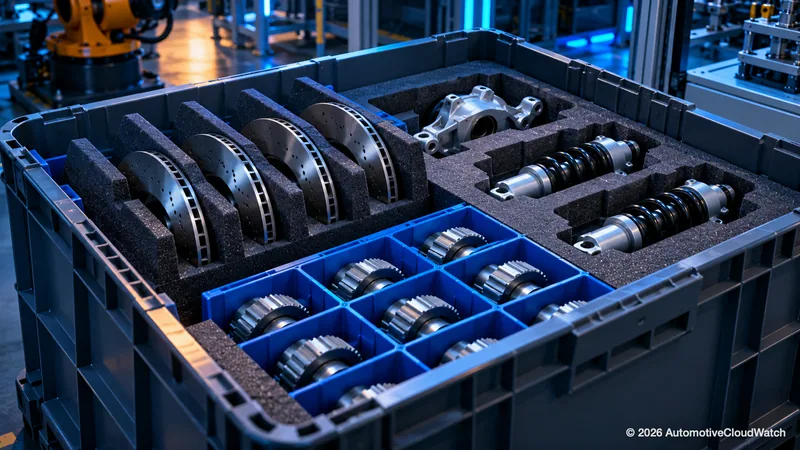 Dunnage Packing material inside containers, such as foam, dividers and trays, that protects parts and holds them in a set position.
- Duty Drawback Refund of import duty paid on goods that are later exported, either unchanged or built into an exported product.
- Economic Order Quantity EOQ Classic formula for the order size that minimizes the combined cost of placing orders and holding stock.
- Economic Security Promotion Act Japanese 2022 law to secure supply of critical goods such as chips and batteries and to protect key infrastructure and technology.
- Electronic Data Interchange EDI Direct computer-to-computer exchange of business documents such as orders, schedules and invoices in agreed standard formats.
- Electronics Manufacturing Services EMS Companies that build circuit boards and electronic products for other firms that design and sell them.
- End of Production EOP Date when regular series production of a model or part ends, after which only service parts may still be built.
- Engineer-to-Order ETO Way of working in which each product is designed or heavily customized for a specific customer before it is built.
- EU Forced Labour Regulation EU law banning products made with forced labor from the EU market and from export, applying from December 2027.
- Evaluated Receipt Settlement ERS Paying suppliers from recorded goods receipts and agreed prices without the supplier sending an invoice.
- Excess and Obsolete Inventory E&O Stock beyond foreseeable need or with no future use, often left over after design changes, program ends or oversized buys.
- Expediting Actions to speed up a late or urgently needed order, such as chasing suppliers, resequencing jobs or using rush freight.
- Export Administration Regulations EAR US rules controlling exports of commercial and dual-use goods, software and technology.
- Export Control Classification Number ECCN Five-character code that classifies an item on the US Commerce Control List to determine whether an export license is needed.
- Fill Rate Share of customer demand shipped right away from stock without delay.
- Finite Capacity Scheduling Scheduling work so machines and people are never loaded beyond what they can actually do.
- Firm Planned Order FPO Planned order that a planner has locked so the planning system cannot change its quantity or date automatically.
- First-Expired, First-Out FEFO Stock rule that uses the batch expiring soonest first, regardless of when it arrived.
- First-In, First-Out FIFO Rule that the oldest stock is used or shipped first, also used as an inventory valuation method.
- Force Majeure Contract clause excusing a party from its obligations when extraordinary events beyond its control make performance impossible.
- Forecast Accuracy Measure of how close forecasts came to actual demand, tracked to judge and improve the forecasting process.
- Forecast Bias Persistent tendency of forecasts to come out too high or too low rather than missing at random.
- Foreign-Trade Zone FTZ Designated US area treated as outside customs territory, where goods can be stored or processed with duties deferred or reduced.
- Fourth-Party Logistics 4PL Provider that manages a client's whole logistics operation, coordinating several carriers and warehouses, usually without owning assets.
- Freight Forwarder Company that arranges international shipping for others, booking carrier space and preparing the paperwork.
- Friendshoring Moving supply chains to allied or trusted countries to reduce geopolitical risk, rather than simply to the cheapest location.
- Frozen Zone Near-term part of a production schedule where nothing may change without special approval.
- Full Container Load FCL Ocean shipment that fills a whole container for one shipper, sealed at origin and delivered to one receiver.
- Full Truckload FTL Shipment that uses an entire trailer for one shipper, moving directly from origin to destination.
- Goods Receipt GR System entry recording that delivered goods have arrived and been accepted into stock.
- Harmonized System Code HS Code International numeric code that classifies a product for customs and decides which import tariff applies.
- Incoterms ICC trade terms that set who pays for transport, insurance and customs and where risk passes from seller to buyer.
- Independent and Dependent Demand Distinction between customer demand that must be forecast and component demand that can be calculated from the build plan.
- Integrated Business Planning IBP Monthly management process that ties financial plans, portfolio and strategy to demand and supply planning.
- Inventory Materials and goods a business holds, from raw materials and purchased parts to work in process and finished products.
- Inventory Carrying Cost Yearly cost of holding stock beyond its purchase price, covering capital, storage, handling, insurance and obsolescence.
- Inventory Record Accuracy IRA Percentage of items or locations where the system quantity matches the physical count within tolerance.
- Inventory Turns How many times a year inventory is used up and replaced, found by dividing cost of goods sold by average inventory.
- Japan Proper Transactions Act Japanese law in force from January 2026, replacing the Subcontract Act, that shields smaller suppliers from late payment and unfair price cuts.
- Just-in-Sequence JIS Delivering parts to the line in the exact order of the vehicles being built, not just at the right time.
- Keiretsu Japanese group of companies linked by long-term business ties and often cross-shareholdings, notably an automaker's supplier network.
- Kitting Gathering all the parts for one unit or job into a set before work begins and delivering it to the station.
- Kraljic Matrix Four-box model that classifies purchased items by profit impact and supply risk to guide the sourcing strategy for each.
- Landed Cost Total cost of getting a product to the buyer's door, adding freight, insurance, duties and handling to the purchase price.
- Last Time Buy LTB Final purchase of a component before its maker stops producing it, sized for remaining production and service needs.
- Less Than Truckload LTL Shipment too small to fill a trailer, carried with other shippers' freight and sorted through terminals.
- Local-for-Local Production Making products in or near the market where they are sold, using local suppliers where possible.
- Logistics 2024 Problem Japanese trucking capacity crunch after an April 2024 cap on driver overtime met an aging, shrinking driver workforce.
- Long-Term Agreement LTA Multiyear supply contract fixing prices, volumes, yearly price reductions and other terms between a buyer and a supplier.
- Lot Size Quantity of an item ordered or produced at one time.
- Lot-for-Lot Order sizing rule in which each planned order equals exactly the net requirement for that period.
- Make-or-Buy Decision Choice between producing a part or service in house and buying it from a supplier.
- Make-to-Order MTO Production approach that starts manufacturing only after a customer places an order.
- Make-to-Stock MTS Production approach that builds to forecast and holds finished goods so customers can buy immediately.
- Manufacturing Resource Planning MRP II Closed-loop planning system linking material planning with capacity, shop floor control and finance, and the forerunner of ERP.
- Maquiladora Mexican factory that imports inputs with duty and VAT deferred, processes or assembles them and exports the output.
- Master Production Schedule MPS Plan stating which finished products or key subassemblies will be built, in what quantities and in which weeks.
- Material Release Schedule a customer sends against a blanket order stating how many parts it needs and when.
- Material Requirements Planning MRP Method, usually run in software, that calculates which materials are needed, how many and when to meet a production plan.
- Materials Management Operations Guideline/Logistics Evaluation MMOG/LE AIAG and Odette self-assessment that suppliers use to rate and improve their materials management and logistics processes.
- Mean Absolute Percentage Error MAPE Forecast error measure that averages each absolute error as a percentage of actual demand.
- Milk Run Fixed delivery loop in which one truck visits several suppliers or stations on a set timetable.
- Minimum Order Quantity MOQ Smallest amount a supplier will accept on a single order.
- Mother Plant Home-country plant that develops processes, trains staff and supports overseas sister plants that build the same products.
- Multi-Echelon Inventory Optimization MEIO Setting stock targets for every stage of a supply network together rather than one location at a time.
- Multi-Tier Supply Chain Visibility Knowing who supplies your suppliers, down through tier 2, tier 3 and raw material sources.
- Nearshoring Moving production or sourcing to a country near the main market, such as Mexico for the US.
- Net Requirements Quantity still needed after subtracting stock on hand and scheduled receipts from gross demand.
- New Quality Productive Forces Chinese policy slogan introduced in 2023 for growth driven by advanced technology and innovation rather than cheap labor.
- Nomination Letter Formal notice from an automaker telling a supplier it has won the business for a part on a vehicle program.
- Obsolescence Management Planning ahead for parts, components or software going out of supply so production and service can continue.
- ODETTE European automotive body that sets standards for electronic business data exchange between automakers and suppliers.
- Order Winners and Order Qualifiers Framework separating the features needed just to be considered from those that win business against rivals.
- Original Design Manufacturer ODM Company that both designs and makes a product that another firm sells under its own brand.
- Original Equipment Manufacturer OEM In the auto industry, the vehicle maker that designs, assembles and sells cars under its own brand.
- Pegging Planning feature that traces each requirement for a part back to the orders or forecasts that created it.
- Perfect Order Fulfillment Percentage of orders that arrive complete, on time, undamaged and with correct paperwork.
- Phantom Bill of Materials Bill of materials level for a subassembly that is built and used immediately without ever going into stock.
- Pipeline Inventory Goods in transit between locations that are owned and paid for but not yet usable.
- Planned Order Suggestion from the planning system to buy or make a quantity of an item by a given date, before it is confirmed.
- Planning Bill of Materials Artificial bill of materials grouping a product family's options with expected percentages for forecasting.
- Postponement Strategy of delaying a product's final form, such as labels or options, until real orders arrive.
- Premium Freight Costly rush shipping, such as air freight or dedicated trucks, used to recover from late deliveries or shortages.
- Price Pass-Through Passing a supplier's higher material, energy and labor costs on to its customers, a national policy push in Japan in the 2020s.
- Procurement Lead Time Total time from recognizing a need for a purchased item until it is received and ready to use.
- Product Change Notification PCN Formal supplier notice that a product's design, materials, process or site will change, or that it will be discontinued.
- Product Wheel Scheduling method for process plants that runs products in a fixed, optimized sequence on a repeating cycle.
- Production Order Instruction to make a specified quantity of an item by a due date, released from planning to the shop floor.
- Projected Available Balance PAB Inventory a planning system expects at the end of each future period after adding receipts and subtracting demand.
- Purchase Order PO Formal document a buyer sends a supplier to order goods or services, stating quantities, prices, dates and terms.
- Purchase Price Variance PPV Difference between the actual purchase price and the standard cost, multiplied by the quantity bought.
- Purchase Requisition PR Internal request asking purchasing to buy something, stating what, how much, when and which budget pays.
- Rare Earth Export Controls Chinese licensing rules on exporting certain rare earth elements, compounds and magnets, a major risk for motor and EV supply.
- Raw Material Indexation Contract clause that adjusts part prices at set intervals according to published indices for steel, aluminum and other materials.
- Regional Value Content RVC Share of a product's value that originates within a free trade area, used to decide whether it qualifies for tariff preference.
- Reorder Point ROP Stock level at which a new replenishment order should be placed.
- Request for Information RFI Early document asking potential suppliers to describe their capabilities, products and experience.
- Request for Quotation RFQ Formal invitation for suppliers to quote price, tooling, lead time and capacity for clearly defined parts.
- Reshoring Bringing manufacturing back to a company's home country after it had been moved abroad.
- Returnable Packaging Durable containers, racks and dunnage that cycle between supplier and customer instead of single-use cardboard.
- Reverse Logistics Moving products, packaging and materials backward from customers or production lines toward suppliers or recyclers.
- Rough-Cut Capacity Planning RCCP Quick high-level check of whether the master production schedule fits the key resources available.
- Routing Ordered list of steps to make a part, with the work center, setup time, run time and tooling for each step.
- Rules of Origin Criteria for deciding which country a product legally comes from for tariffs and trade agreement preferences.
- Safety Stock Extra inventory held to cover demand spikes or late deliveries.
- Sales and Operations Planning S&OP Monthly process in which sales, operations, finance and leadership agree on one plan that balances demand with supply.
- Section 232 Tariffs US national security tariffs under the Trade Expansion Act of 1962, applied to steel, aluminum, vehicles and auto parts.
- Section 301 Tariffs US tariffs under the Trade Act of 1974 responding to unfair trade practices, applied mainly to imports from China.
- Seiban System Japanese production control method that ties every part, material and job to a specific order number.
- Service Level Target probability that stock will cover demand without running out during a replenishment cycle.
- Should-Cost Bottom-up estimate of what a part ought to cost, built from material, process, labor, overhead and a fair margin.
- Single Sourcing Choosing to buy an item from only one supplier even though others could provide it.
- Sogo Shosha Large Japanese general trading companies that trade, invest, finance and run logistics across almost every industry.
- Sole Sourcing Situation in which only one supplier in the market can provide a part, for example because of patents or unique technology.
- Sourcing Finding, evaluating and selecting suppliers and awarding them business through quotations, negotiation and contracts.
- Specialized and Sophisticated SMEs Chinese program that identifies and supports highly specialized, technologically strong small and medium manufacturers.
- Start of Production SOP Date when regular series production of a new product begins at the planned rate.
- Supplier Association Club of a manufacturer's main suppliers that meets regularly to share plans, quality information and improvement methods.
- Supplier Development A buyer actively helping its suppliers improve through training, on-site improvement work, technical support or investment.
- Supplier Park Cluster of supplier plants on or right beside a vehicle assembly plant so modules can reach the line quickly.
- Supplier Payment Terms Agreed time a buyer has to pay a supplier after delivery or invoice, such as 60 days.
- Supply Allocation Rationing scarce supply among customers, plants or products when demand exceeds what is available.
- Supply Chain Control Tower Central team backed by software that gives one live view of orders, inventory and shipments across the supply chain.
- Supply Chain Operations Reference Model SCOR ASCM reference framework that describes supply chain processes, metrics and practices in common terms.
- Supply Chain Resilience Ability of a supply chain to anticipate, absorb and recover from disruptions.
- Supply Chain Risk Management SCRM Ongoing work of identifying, assessing and reducing risks that could disrupt supply.
- Third-Party Logistics 3PL Outside company that performs logistics work such as warehousing, transport and customs clearance for a shipper.
- Three-Way Match Payment check that releases a supplier invoice only when it agrees with the purchase order and the goods receipt.
- Tier 1 Supplier Supplier that sells parts or systems directly to a vehicle maker, such as Denso, Bosch or Magna.
- Time Fence Point in the planning horizon where the rules for changing the plan switch from restricted to free.
- Time to Recover TTR How long a supplier, plant or logistics hub would need to return to full capability after a disruption.
- Total Cost of Ownership TCO Full cost of buying and using an item over its life, including freight, duties, quality and downtime, not just its price.
- Transportation Management System TMS Software for planning, running and paying for freight shipments, including carrier choice, load building and routing.
- Transshipment Routing goods through an intermediate country or port, which becomes illegal when used to disguise origin and evade duties.
- Twenty-Foot Equivalent Unit TEU Standard unit of container shipping capacity equal to one 20-foot container.
- United States-Mexico-Canada Agreement USMCA North American trade agreement that replaced NAFTA in 2020 and sets the origin rules cars and parts must meet.
- Unreliable Entity List UEL List kept by China's Ministry of Commerce of foreign firms judged to harm China's interests, which can be barred from trade.
- Uyghur Forced Labor Prevention Act UFLPA US law presuming goods made wholly or partly in Xinjiang or by listed firms involve forced labor and barring their import.
- Vendor-Managed Inventory VMI Arrangement in which the supplier monitors the customer's stock and decides when and how much to replenish.
Full entry for members
Every term has a full entry for members: the plain-words definition, the practitioner note and the typed links between terms.
ACW Manufacturing Glossary, edition 2026.11.1. The headword and one line are open to everyone.