Glossary · Manufacturing
Production Processes
184 terms in the Manufacturing glossary, each with its one-line definition.
184 terms, A to Z
- Abrasive Blasting Cleaning or roughening a surface by firing hard particles such as steel shot, grit or sand at it, often to prepare steel for paint.
- Additive Manufacturing AM Building a part layer by layer directly from a digital 3D model, with no mold or cutting tool required.
- Adhesive Bonding Joining parts with structural adhesive, often alongside welds, to add stiffness, seal joints and connect dissimilar materials.
- Advanced Packaging Combining several chips or chiplets in one package with very dense connections so they act almost like a single larger chip.
- Annealing Heat treatment that softens metal and relieves internal stress by heating it, holding it at temperature and cooling it slowly.
- Anodizing Electrochemical treatment that thickens the natural oxide layer on aluminum for better corrosion and wear resistance and dyeable color.
- Assembly Line Production layout in which the product moves through a sequence of stations, each adding parts or doing a set task.
- Automated Optical Inspection AOI Camera and software inspection of circuit boards that finds missing, misplaced or wrong parts and poor solder joints.
- Automated X-ray Inspection AXI X-ray inspection of circuit board assemblies that checks solder joints hidden under packages such as ball grid arrays.
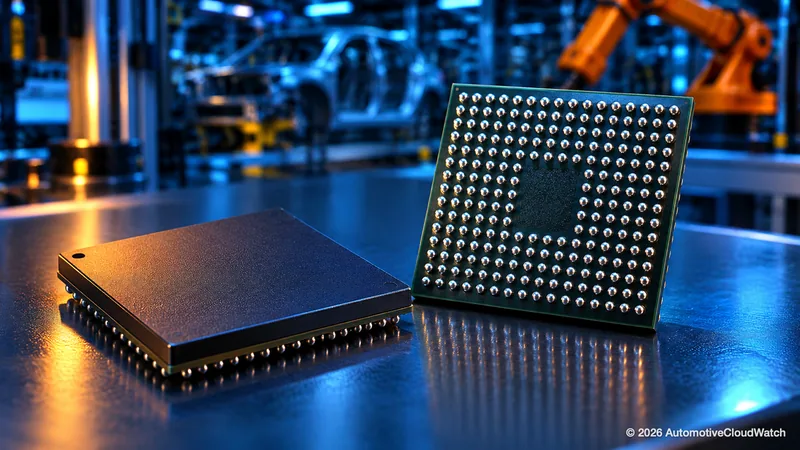 Ball Grid Array BGA Chip package that connects to the board through a grid of solder balls on its underside rather than leads around its edges.
- Basecoat-Clearcoat Standard two-layer car paint finish, a colored basecoat under a transparent clearcoat that gives gloss and protection.
- Batch Production Making products in lots that move through each process step together before the next lot starts.
- Batch Reactor Vessel in which a chemical reaction is run on one fixed load at a time under controlled temperature and pressure.
- Binder Jetting 3D printing process that jets liquid binder onto layers of powder, with metal parts gaining strength later through sintering.
- Blanking Cutting a flat shape out of sheet or coil metal in a press so it can then be formed into a part.
- Blow Molding Making hollow plastic parts such as bottles, fuel tanks and ducts by inflating a heated plastic tube inside a mold.
- Body in White BIW Bare welded metal shell of a car body before paint, trim and powertrain, which largely sets crash safety, stiffness and weight.
- Boring Enlarging and finishing an existing hole with a cutting tool so it is accurately sized, round and straight.
- Brazing Joining metal parts with a molten filler metal that flows into the joint above 450 degrees Celsius while the parts stay solid.
- Broaching Machining with a long toothed tool pushed or pulled through a part, each tooth cutting slightly deeper, to make splines and keyways.
- Calendering Pressing a material between heavy rollers to a precise thickness and density, a key step in making battery electrodes.
- Carburizing Hardening a steel surface by diffusing carbon into it at high temperature and quenching, leaving a hard case over a tough core.
- Casting Making a part by pouring or injecting molten metal into a mold shaped like the part and letting it solidify.
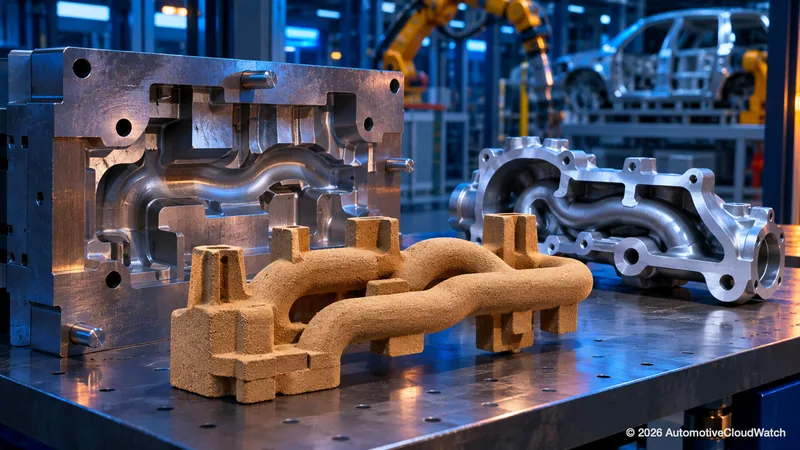 Casting Core Sand insert placed inside a casting mold to form hollow internal passages, broken out after the metal solidifies.
- Cell Formation and Aging First charge and discharge of a new lithium-ion cell plus a storage period that screens out weak cells before shipment.
- Chemical Mechanical Planarization CMP Polishing a wafer surface perfectly flat with a rotating pad and chemical slurry so the next chip layer can be patterned.
- Chemical Vapor Deposition CVD Depositing a thin solid film on a heated surface through chemical reactions of gases, used in chipmaking and tool coating.
- Chip-on-Wafer-on-Substrate CoWoS TSMC's 2.5D packaging that places processors and high-bandwidth memory side by side on an interposer, used in leading AI accelerators.
- Clean-in-Place Automated cleaning of tanks, pipes and process equipment by circulating rinses and detergents through them without taking them apart.
- Cleanroom Enclosed space with tightly controlled airborne particles, temperature and humidity, used for making chips, medical devices and optics.
- Clinching Joining stacked metal sheets by pressing them into a die so they form an interlocking button, without fasteners or heat.
- Closed-Die Forging Shaping hot metal by pressing or hammering it between two shaped dies, with the excess flash trimmed off afterward.
- CNC Machining Cutting metal or plastic on machine tools whose movements are controlled by a computer program for repeatable accuracy.
- Composites Materials that combine strong fibers such as carbon or glass with a resin binder to be stronger and lighter than either alone.
- Compression Molding Pressing a measured charge of material in a heated mold so it flows to fill the cavity and cures, used for composite panels.
- Conformal Coating Thin protective film applied over a finished circuit board to shield it from moisture, dust and corrosive chemicals.
- Continuous Casting Mill process that solidifies molten steel or aluminum into an endless strand that is cut into slabs, blooms or billets.
- Continuous Production Production that runs nonstop with material flowing steadily through the process, as in refineries, steel mills and paper mills.
- Continuous Stirred-Tank Reactor CSTR Tank reactor in which feed flows in and product flows out continuously while mixing keeps the contents uniform.
- Crimping Attaching a wire to a terminal by squeezing the terminal barrel tightly around the bare wire, without solder or heat.
- Deburring Removing the small sharp ridges of metal left on part edges after machining, stamping or casting.
- Decking Final assembly station where the powertrain and chassis set is raised from below and joined to the painted body.
- Deep Drawing Forming a flat blank into a cup or box deeper than its diameter by pushing it into a die with a punch.
- Design for Manufacturing and Assembly DFMA Designing a product from the start so it is easy and cheap to make and assemble, largely by cutting the number of parts.
- Die Casting Forcing molten aluminum, zinc or magnesium into a reusable steel die to make accurate parts quickly and in volume.
- Die Tryout Running and adjusting a newly built stamping die in a test press until it produces parts of the right shape and surface quality.
- Directed Energy Deposition DED 3D printing process that melts metal powder or wire with a focused laser, electron beam or arc as it is deposited.
- Distillation Separating liquid mixtures by boiling point through repeated vaporization and condensation, usually in a tall column.
- Drilling Making round holes with a rotating cutting tool called a drill, the most common machining operation.
- Dry Electrode Coating Making battery electrodes from a dry powder film pressed onto foil, avoiding solvent slurries and long drying ovens.
- Electrical Discharge Machining EDM Removing metal with controlled electrical sparks between an electrode and the workpiece, used for hardened dies and fine shapes.
- Electrocoating E-coat Dipping a car body in a paint bath and applying current so paint deposits evenly everywhere, the standard corrosion primer.
- Electrode Coating Spreading a slurry of active material onto metal foil and drying it to make lithium-ion battery electrodes.
- Electron Beam Welding EBW Fusion welding with a focused electron beam in a vacuum, giving very deep, narrow welds with little distortion.
- Electroplating Coating a part with a thin layer of metal such as zinc, nickel or chrome by passing electric current through a chemical bath.
- Electrostatic Discharge ESD Sudden flow of static electricity that can damage electronic parts, controlled with grounding, wrist straps and ionizers.
- End-of-Line Testing EOL Final checks of a finished vehicle or product at the end of the line, such as alignment, brake, electrical and leak tests.
- Etching Removing material chemically or with plasma to transfer a pattern into a wafer layer or the copper of a circuit board.
- Extreme Ultraviolet Lithography EUV Chip lithography using 13.5 nanometer light to print the finest circuit patterns on the most advanced logic and memory chips.
- Extrusion Pushing heated metal or plastic through a shaped die to make long parts with a constant cross section.
- Filament Winding Winding resin-soaked fibers around a rotating mandrel to make pipes, shafts and hydrogen pressure tanks.
- Final Assembly Vehicle plant shop where trim, chassis parts, powertrain, interior and fluids are fitted to the painted body.
- Five-Axis Machining Machining in which tool and part move along three linear and two rotary axes so complex shapes are cut in one setup.
- Fixture Device that locates and holds a part securely in the correct position during machining, welding, assembly or inspection.
- Float Glass Flat glass made by floating molten glass on a bath of molten tin, the starting material for windows and car glass.
- Flow Drill Screw FDS Screw that softens sheets by frictional heat, pierces them and forms its own thread, joining aluminum bodies from one side.
- Forging Shaping metal by hammering or pressing it, usually hot, which aligns its grain and gives strong parts.
- Foundry Factory that produces metal castings by melting metal and pouring it into molds.
- Friction Stir Welding FSW Solid-state joining in which a spinning tool stirs softened metal along a seam, ideal for aluminum battery trays and panels.
- Functional Test FCT Powering an assembled board or product and checking that it actually performs its intended functions.
- Fused Deposition Modeling FDM Material extrusion 3D printing that melts plastic filament and lays it down in layers through a moving nozzle.
- Gear Hobbing Cutting gear teeth by rolling a rotating worm-shaped tool, the hob, against a rotating gear blank.
- Gigacasting Casting a large section of a car body as one aluminum part instead of welding together dozens of stamped pieces.
- Gravity Die Casting Pouring molten metal under gravity alone into a reusable metal mold, used for aluminum cylinder heads and pistons.
- Grinding Removing small amounts of material with a rotating abrasive wheel to reach tight tolerances and fine finishes.
- Hairpin Winding Motor stator winding made of inserted and welded rectangular copper bars, giving more copper per slot and higher power density.
- Heat Treatment Controlled heating and cooling of metal to change its hardness, strength or toughness without changing its shape.
- Heat-Affected Zone HAZ Band of base metal next to a weld or thermal cut whose structure and properties were altered by heat without melting.
- Hemming Folding the edge of an outer panel over an inner panel to join closures such as doors, hoods and trunk lids.
- High-Pressure Die Casting HPDC Injecting molten metal into a steel die at high speed and pressure to make thin-walled aluminum and magnesium parts.
- Honing Finishing a bore with abrasive stones that rotate and stroke back and forth, giving precise size and an oil-holding crosshatch.
- Hot Isostatic Pressing HIP Applying high gas pressure and heat together to close internal pores in castings and 3D printed metal parts.
- Hot Runner Heated channel system inside an injection mold that keeps plastic molten up to each gate, cutting waste and cycle time.
- Hot Stamping Heating boron steel blanks, forming them and quenching them in the die to make ultra-high-strength body parts.
- Hot-Dip Galvanizing Coating steel with zinc by dipping it in a bath of molten zinc at about 450 degrees Celsius to prevent rust.
- Hybrid Bonding Directly bonding the copper pads and surrounding insulator of stacked chips without solder bumps, for very dense connections.
- Hydroforming Shaping metal tubes or sheets with high-pressure fluid inside a die, used for frame rails and engine cradles.
- In-Circuit Test ICT Testing an assembled circuit board through probes on test points to find shorts, opens and wrong component values.
- Induction Hardening Hardening a steel surface by heating it quickly with an induction coil and quenching it, leaving the core tough.
- Injection Molding Injecting molten plastic into a closed mold where it cools into a part, the main way plastic parts are mass produced.
- Investment Casting Casting metal in a ceramic shell built around a wax pattern that is melted out, giving precise and complex parts.
- Jig Device that holds a part and guides the cutting tool, also loosely used for any holding fixture on the shop floor.
- Job Shop Plant organized by function that makes many different custom products in small quantities, each following its own route.
- Laminated Glass Two or more glass layers bonded by a plastic interlayer so broken pieces stay in place, required for windshields.
- Lapping Polishing with a loose abrasive between the part and a flat plate to reach extreme flatness and a fine finish.
- Laser Brazing Joining galvanized steel panels with a laser-melted filler wire, giving a smooth paintable seam such as on roof joints.
- Laser Cutting Cutting sheet and plate with a focused laser beam for narrow, precise cuts and complex profiles.
- Laser Powder Bed Fusion LPBF Metal 3D printing that melts thin layers of powder with a laser, used for aerospace brackets, mold inserts and implants.
- Laser Welding Joining metal with a focused laser beam for fast, narrow, low-distortion welds in car bodies, batteries and motors.
- Low-Pressure Die Casting LPDC Pushing molten aluminum up into a die with low gas pressure, the dominant way aluminum alloy wheels are cast.
- Machining Shaping a part by cutting material away with tools, as in turning, milling, drilling and grinding.
- Machining Center CNC machine tool that mills, drills and taps with automatic tool changing, built in vertical or horizontal layouts.
- Mass Production Making large volumes of standardized products on dedicated lines where each worker or machine repeats a narrow task.
- Material Jetting MJT 3D printing that jets droplets of photopolymer and cures them with light, used for multicolor appearance prototypes.
- Metal Injection Molding MIM Molding fine metal powder mixed with binder, then removing the binder and sintering to make small, intricate metal parts.
- Metalworking Fluid Liquid applied during machining and grinding to cool and lubricate the cut and flush away chips.
- MIG Welding GMAW Arc welding that feeds a consumable wire electrode through a gas-shielded torch, widely used by robots on steel and aluminum.
- Milling Machining with a rotating multi-tooth cutter that removes material to make flat faces, slots and pockets.
- Moisture Sensitivity Level MSL Rating of how sensitive a chip package is to absorbed moisture, which sets how long it may sit out before soldering.
- Nitriding Hardening a steel surface by diffusing nitrogen into it at moderate temperature, with little distortion and no quench.
- Normalizing Heating steel above its critical temperature and cooling it in still air to refine the grain and even out its structure.
- Outsourced Semiconductor Assembly and Test OSAT Company that packages and tests chips made by others, handling dicing, die attach, bonding, molding and final test.
- Overmolding Molding one material over another part or material, such as soft grips on rigid plastic or plastic around metal inserts.
- Paint Shop Vehicle plant shop that cleans, pretreats, electrocoats, seals and paints bodies, usually the most energy-intensive area.
- Phosphating Chemical pretreatment that forms a thin phosphate crystal layer on steel to help paint adhere and resist corrosion.
- Photolithography Printing circuit patterns onto a wafer by shining light through a mask onto a light-sensitive resist.
- Physical Vapor Deposition PVD Depositing thin hard or metallic coatings in a vacuum by sputtering or evaporating a solid source material.
- Pick-and-Place SMT machine that picks electronic components from feeders and places them precisely on circuit boards at high speed.
- Piercing Punching holes in sheet metal with a punch and die, where the removed slug is scrap.
- Plasma Cutting Cutting electrically conductive metal with a very hot jet of ionized gas, common for thick steel plate.
- Plug Flow Reactor PFR Tube reactor in which material flows through like a plug with little back mixing, giving high conversion per volume.
- Porosity Small voids trapped inside a casting or weld by gas or shrinkage, a leading cause of leaks and weak parts.
- Powder Bed Fusion PBF 3D printing family that fuses selected areas of each powder layer with a laser or electron beam.
- Powder Coating Spraying electrostatically charged dry paint powder onto a part and baking it into a tough, thick finish without solvents.
- Powder Metallurgy PM Making parts by compacting metal powder in a die and sintering it, common for gears, bushings and bearings.
- Power Skiving Fast gear cutting method that combines hobbing and shaping motions, well suited to internal gears such as ring gears.
- Prepreg Fiber reinforcement presoaked with partly cured resin, stored cold and laid up before curing into composite parts.
- Press Brake Bending Bending sheet metal along a straight line by pressing it between a punch and a V-shaped die.
- Printed Circuit Board Assembly PCBA Mounting and soldering components onto a bare printed circuit board to make a working electronic assembly.
- Progressive Die Stamping die with several stations that each perform an operation as the strip advances, finishing a part every stroke.
- Projection Welding Resistance welding in which raised bumps on one part concentrate the current, often used to weld nuts and studs to sheet.
- Quenching Rapidly cooling hot metal in water, oil, polymer or gas to harden it, usually followed by tempering.
- Reaction Injection Molding RIM Mixing two reactive liquids and injecting them into a mold where they react and cure, used for bumpers and large panels.
- Reflow Soldering Melting printed solder paste in a controlled oven temperature profile to solder surface-mount components to a board.
- Resin Transfer Molding RTM Injecting resin into a closed mold holding a dry fiber preform to make strong, net-shape composite parts.
- Resistance Seam Welding Resistance welding with rotating wheel electrodes that make overlapping welds along a seam, used for leak-tight tanks.
- Riveting Joining parts with a metal pin whose end is deformed to clamp them together, standard in aircraft structures.
- Roll Forming Bending a continuous metal strip through a series of roller stands into a long profile with a constant cross section.
- Rolling Passing metal between rotating rolls to reduce its thickness, producing plate, sheet and coil.
- Sand Casting Pouring molten metal into a sand mold packed around a pattern, with a new mold made for every casting.
- Selective Laser Sintering SLS Polymer 3D printing that fuses nylon powder with a laser, making strong functional parts without support structures.
- Selective Soldering Soldering only chosen through-hole joints with a small programmable solder fountain, sparing nearby surface-mount parts.
- Self-Piercing Rivet SPR Rivet driven through the top sheet and flared into the bottom sheet against a die, joining aluminum without a predrilled hole.
- Sheet Molding Compound SMC Sheet of glass fiber and thermoset resin that is compression molded into panels, enclosures and battery covers.
- Shot Peening Blasting a metal surface with small round shot to create compressive stress that greatly improves fatigue life.
- Sintering Heating compacted powder below its melting point so the particles bond into a solid part, as in powder metallurgy.
- Soft Tooling Cheaper, quicker tooling of aluminum, epoxy or printed materials for prototypes and early parts before hardened steel tools exist.
- Solder Paste Inspection SPI 3D measurement of printed solder paste deposits on a board to catch printing faults before components are placed.
- Solder Paste Printing Pressing solder paste through a stencil onto board pads with a squeegee, the first step of an SMT line.
- Soldering Joining metal parts, mainly in electronics, with a filler metal that melts below 450 degrees Celsius while the parts stay solid.
- Spot Welding RSW Joining overlapping sheets by clamping them between electrodes and passing a high current that melts a small nugget.
- Springback Partial elastic return of formed sheet metal toward its original shape after the forming load is released.
- Stamping Shaping sheet metal between dies in a press by cutting, drawing, bending and piercing it into parts such as body panels.
- Stereolithography SLA Resin 3D printing that cures liquid photopolymer layer by layer with an ultraviolet laser, giving fine detail.
- Support Structure Temporary structures printed with a 3D printed part to hold overhangs, anchor it and carry heat away, removed afterward.
- Surface Finishing Family of processes that change a part's surface for protection, appearance or function, such as plating and painting.
- Surface-Mount Technology SMT Building circuit boards by soldering components directly onto the board surface instead of through drilled holes.
- Tailor-Welded Blank TWB Sheet blank made by welding steels of different thickness or grade before stamping, putting strength only where needed.
- Tandem Press Line Row of separate presses, each holding one die, through which body panels are moved automatically from press to press.
- Tapping Cutting or forming internal screw threads in a hole with a tool called a tap.
- Tempered Glass Glass heated and rapidly cooled so it is much stronger and breaks into small blunt pieces, used for side and rear windows.
- Tempering Reheating hardened steel to a moderate temperature to reduce brittleness and gain toughness.
- Thermoforming Heating a plastic sheet until soft and drawing it over a mold with vacuum or pressure to form trays, liners and panels.
- Through-Hole Technology THT Mounting components by inserting their leads through holes in the board and soldering them on the opposite side.
- TIG Welding GTAW Arc welding with a non-consumable tungsten electrode and inert gas, giving precise, clean welds on thin metals.
- Tool and Die Skilled trade and industry that designs and builds the dies, molds, jigs and fixtures factories use to make parts.
- Tooling Part-specific equipment such as dies, molds, fixtures and gauges needed to make one particular part.
- Transfer Press Large press holding several die stations in one machine, with automatic fingers or crossbars moving parts between them.
- Turning Machining a rotating part with a stationary cutting tool on a lathe to make round shapes such as shafts.
- Ultrasonic Welding Joining plastics or thin metals with high-frequency vibration under pressure, used for wire splices and battery tabs.
- Unboxed Process Tesla's assembly method that builds and outfits major vehicle sections in parallel and joins them near the end.
- Underfill Epoxy that flows under a flip chip or BGA package and hardens to protect solder joints from thermal and drop stress.
- Unit Operation Basic physical processing step such as mixing, heat exchange, distillation or drying, designed as a reusable building block.
- Vat Photopolymerization VPP 3D printing that cures liquid resin in a vat with light, including stereolithography and digital light processing.
- Wafer Fabrication Front-end stage of chipmaking that builds circuits on silicon wafers through hundreds of deposition, patterning and etching steps.
- Waterjet Cutting Cutting with a very high-pressure water jet, often carrying abrasive, which leaves no heat-affected zone.
- Wave Soldering Soldering through-hole parts by passing the underside of a board over a wave of molten solder.
- Weaving Interlacing lengthwise and crosswise yarns on a loom to make fabric for seat covers, airbags and composite reinforcement.
- Welding Joining materials, usually metals, by melting them together or by heat and pressure so they fuse into one piece.
- Welding Procedure Specification WPS Written, qualified recipe for making a specific weld, listing the process, materials, joint design and parameters.
- Wire Arc Additive Manufacturing WAAM Metal 3D printing that builds large parts by depositing welding wire with an electric arc, then machining them to shape.
- Wire Bonding Connecting a chip to its package or substrate with fine metal wires bonded at each end.
- Wire Harness Manufacturing Building the bundles of wires, terminals and connectors that carry power and signals around a vehicle or machine.
- Zinc Flake Coating Baked coating of zinc and aluminum flakes in a binder that protects bolts from rust without hydrogen embrittlement.
Full entry for members
Every term has a full entry for members: the plain-words definition, the practitioner note and the typed links between terms.
ACW Manufacturing Glossary, edition 2026.11.1. The headword and one line are open to everyone.