Glossary · Robotics and Physical AI
Actuators and Drivetrain
115 terms in the Robotics and Physical AI glossary, each with its one-line definition.
115 terms, A to Z
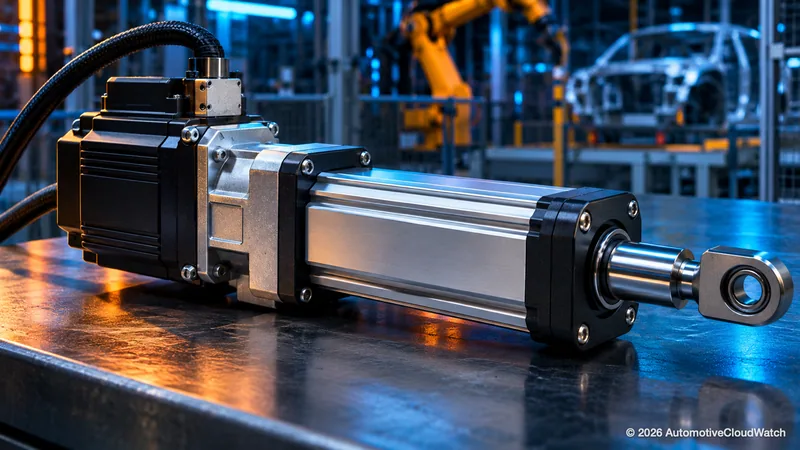 Actuator The part of a robot that creates motion or force, usually an electric motor with gearing, acting like a muscle at each joint.
- Arcminute arcmin A unit of angle equal to one sixtieth of a degree, used on gearbox datasheets to state backlash and positioning error.
- Artificial Muscle Any soft actuator designed to contract or expand like a biological muscle, pursued for light, quiet and springy motion.
- Axial Flux Motor A flat, pancake shaped electric motor whose magnetic field runs along the shaft, packing high torque into a short package.
- Back Electromotive Force back EMF The voltage a spinning motor generates that opposes its supply, rising with speed and setting the motor's top speed.
- Backdrivability How easily a robot joint can be turned backward by an outside force, which helps robots absorb impacts and be guided by hand.
- Backlash The small free play between gear teeth that lets a joint wobble slightly when it reverses, reducing precision.
- Ball Screw A screw and nut drive with rolling steel balls that efficiently and precisely turns rotation into straight line motion.
- Ball Screw Spline A single shaft combining a ball screw and a ball spline so it can move up and down and rotate, as in SCARA robots.
- Battery Management System BMS The electronics that monitor a robot's battery cells for voltage, current and temperature, balance them and shut the pack off on faults.
- Battery Pack The rechargeable lithium ion battery that powers a mobile robot, trading runtime against added weight.
- Bearing Preload A deliberate internal squeeze in a bearing, screw or gear mesh that removes play and adds stiffness at the cost of friction.
- Belt Drive A transmission using a toothed timing belt over pulleys to pass motion from a motor to a joint or carriage cheaply and quietly.
- Bowden Cable A cable sliding inside a flexible sheath, like a bicycle brake cable, that lets robots and exosuits place motors far from joints.
- Brushless DC Motor BLDC An electric motor that switches its coil current electronically instead of with brushes, giving long life and high torque for its size.
- Cable Carrier A flexible chain of linked segments that guides and protects moving cables and hoses on linear axes and robot tracks.
- Cable Harness The bundle of power, signal and communication wires routed through a robot to every motor and sensor.
- Charging Dock A fixed station where a mobile robot drives to recharge its battery through contacts, a connector or induction.
- Circular Spline The rigid outer ring with internal teeth in a strain wave gear, which the flexing inner cup meshes with at two points.
- Cogging Torque A notchy torque ripple in some motors caused by rotor magnets pulling toward the stator's iron teeth.
- Commutation Switching current between a motor's coils in step with rotor position so the motor keeps producing torque.
- Continuous Torque The torque a motor or actuator can deliver indefinitely without overheating, as opposed to short bursts of peak torque.
- Coreless Motor A small DC motor with a self supporting copper winding and no iron, giving very fast and smooth motion for fingers and tools.
- Counterbalance A spring, gas strut or cylinder that offsets gravity on a heavy robot arm so smaller motors and gearboxes suffice.
- Cross Roller Bearing A thin bearing with rollers set at alternating right angles so it carries loads from every direction, typical at robot joint outputs.
- Cycloidal Drive A compact, shock tolerant gearbox in which a lobed disc wobbles around a ring of pins to give a large speed reduction.
- Dielectric Elastomer Actuator DEA A soft actuator of thin rubbery film between stretchy electrodes that squeezes and spreads under high voltage like a muscle.
- Direct Drive DD Connecting a motor straight to the load with no gears, giving smooth, play free and easily backdriven motion.
- Dynamic Braking Slowing a motor by shorting its coils, often through resistors, so its own generated voltage brakes it even without power.
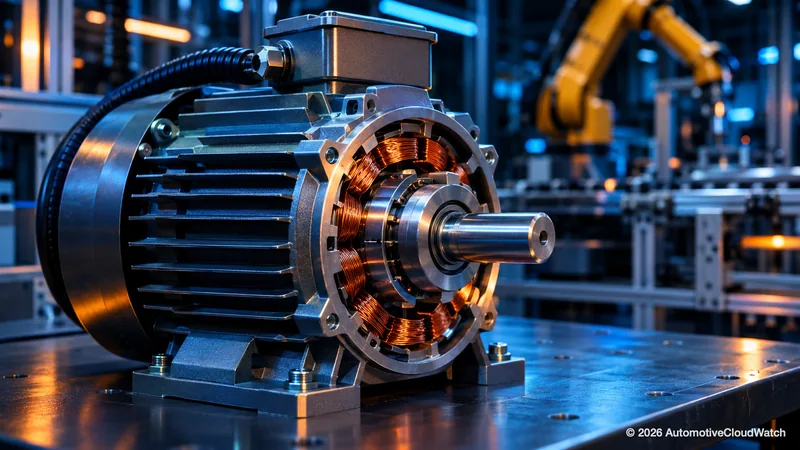 Electric Motor A machine that turns electricity into spinning motion using magnetism, the starting point of nearly all robot hardware.
- Electrohydrostatic Actuator EHA A self contained hydraulic actuator with its own electric motor, pump and oil reservoir at the joint, needing only a power cable.
- Electromechanical Actuator An actuator that uses an electric motor with a screw or gearbox to produce motion instead of hydraulic or air power.
- Field-Oriented Control FOC A motor control method that treats a three phase motor like a simple DC motor to produce smooth, precise torque.
- Flexspline The thin flexible toothed cup at the heart of a strain wave gear, squeezed into an oval so it meshes at two points.
- Frameless Torque Motor A motor sold as just its rotor and stator, with no housing or bearings, so designers build it directly into a joint.
- Gallium Nitride Transistor GaN A fast, efficient power switch for motor electronics that lets drives shrink enough to fit inside a robot joint.
- Gate Driver The small circuit that switches a motor drive's power transistors on and off quickly and safely.
- Gear Ratio How many times a motor turns for each turn of the joint it drives, which multiplies torque while reducing speed.
- Gearhead A ready made gearbox that bolts onto the front of a motor, chosen from a catalog by size and ratio.
- Hall Effect Sensor A small magnetic field sensor that tells a brushless motor drive where the rotor magnets are, also used in current sensors.
- Harmonic Drive A Harmonic Drive Systems brand name for strain wave gears that is often used generically for these compact, play free gearboxes.
- Heavy Rare Earth Elements HREE Rare metals such as dysprosium and terbium added to neodymium magnets so motors keep their strength when hot.
- Holding Brake A brake on a robot joint that clamps on automatically when power is cut so the arm does not drop under gravity.
- Hollow Shaft A motor, gearbox or joint with a hole through its center so cables and hoses can pass straight through.
- Hot-Swappable Battery A battery that can be replaced while the robot stays on, letting it keep working beyond a single charge.
- Hydraulic Actuator An actuator driven by pressurized oil, extremely strong and rugged, used in excavators and the heaviest robots.
- Inverted Roller Screw A roller screw turned inside out, with threads inside a rotating nut, giving a very compact and strong linear actuator.
- Inverter The power electronics that convert DC power into the controlled alternating current a motor needs, inside every servo drive.
- Joint Module A complete robot joint in one package with motor, gearbox, encoders, drive and brake, ready to bolt into an arm.
- Lead Screw A simple sliding screw and nut drive that turns rotation into straight line motion cheaply but with high friction.
- Leaderdrive A Suzhou based maker of strain wave gears that is China's main domestic alternative to Harmonic Drive Systems.
- Linear Actuator An actuator that pushes and pulls in a straight line, usually a motor driving a ball or roller screw.
- Linear Guide A rail with a rolling carriage that keeps a load moving smoothly and stiffly along a straight line.
- Linear Motor An electric motor laid out flat so it pushes directly in a straight line, giving very fast and precise motion.
- Linkage A set of rigid bars connected by pivots that transmits and reshapes motion, such as turning a push into knee rotation.
- Lost Motion The total free movement at a gearbox output when load reverses near zero, combining play and part springiness.
- Manual Brake Release A button, lever or tool that releases a joint brake without power so the arm can be moved by hand, for example to free a person.
- McKibben Muscle An air powered artificial muscle of a rubber tube inside a woven sleeve that shortens and pulls when inflated.
- Motor Constant Km A figure of how much torque a motor makes per unit of winding heat, the best single measure for comparing joint motors.
- Nabtesco A Japanese motion control company whose RV precision gearboxes sit in the base, shoulder and elbow of most large industrial robots.
- Neodymium Magnet NdFeB The strongest commercial permanent magnet, made of neodymium, iron and boron, which makes small powerful robot motors possible.
- Outrunner Motor A brushless motor with the spinning part outside the fixed coils, giving more torque for its size, as on drone propellers.
- Peak Torque The highest torque a motor or actuator can deliver for a short burst, used for jumps and recovering balance.
- Permanent Magnet Synchronous Motor PMSM A brushless motor with magnets on its rotor, fed with smooth sine wave currents, the standard in robot joints and EVs.
- Piezoelectric Actuator An actuator of special ceramic that changes shape slightly under voltage, moving micrometers with extreme precision and speed.
- Planetary Gearbox A compact gearbox where planet gears circle a central sun gear inside a ring gear, sharing load for high torque.
- Planetary Roller Screw A heavy duty screw drive using threaded rollers instead of balls, carrying far more load than a same size ball screw.
- Pneumatic Actuator An actuator driven by compressed air, such as a cylinder, that is cheap, fast and runs most simple factory grippers.
- Pole Pairs The number of north and south magnet pairs on a motor's rotor, which shapes low speed torque and must be set in the drive.
- Positioner A motorized fixture that turns and tilts a workpiece so a welding robot can reach every seam at the best angle.
- Power Density How much mechanical power an actuator delivers for its weight or size, key for running and jumping robots.
- Proprioceptive Actuator An actuator that senses its own output force from motor current and position, without a separate force sensor.
- Pulse Width Modulation PWM Controlling power by switching a supply on and off rapidly and varying the on time, which sets the average voltage a motor sees.
- Quasi-Direct Drive QDD An actuator with a strong motor and only light gearing, under about 10 to 1, so the joint stays easy to push and feels forces.
- Rack and Pinion A drive where a turning gear meshes with a straight toothed bar to make straight line motion over very long travel.
- Radial Flux Motor The conventional cylinder shaped motor layout whose magnetic field crosses outward from the shaft, used in most robot servos.
- Rare-Earth Elements REE A group of 17 metals including neodymium and dysprosium that are critical for strong motor magnets, with supply dominated by China.
- Rare-Earth Export Controls Chinese licensing rules imposed in 2025 on exports of certain rare earths and magnets, causing shortages for motor makers abroad.
- Ratcheting A strain wave gear failure where excess torque makes teeth jump over each other, damaging the gear and losing joint position.
- Rated Torque The torque at which a motor or gearbox is specified to run for its full rated life at a set speed.
- Reflected Inertia The motor's rotating mass as felt at the joint after gearing, which grows with the gear ratio squared and makes joints hit harder.
- Regenerative Braking Recovering energy when a motor slows or lowers a load so it works as a generator and returns power.
- Robot Track A floor or overhead rail a robot rides along so one robot can serve several machines or work along a long part.
- Rotary Actuator An actuator that produces turning motion, usually a motor with gearbox and sensor, and the most common robot actuator.
- RV Reducer Nabtesco's stiff, shock tolerant precision gearbox for the base, shoulder and elbow of large industrial robots.
- Screw Lead How far a screw's nut travels in one full turn, the screw drive equivalent of gear ratio.
- Self-Locking A property of some gear and screw drives that cannot be turned backward by the load, so they hold position unpowered.
- Series Elastic Actuator SEA An actuator with a spring placed between gearbox and load, so measuring spring stretch gives force and cushions shocks.
- Servo Drive The electronics that power a motor and control its torque, speed or position precisely using sensor feedback.
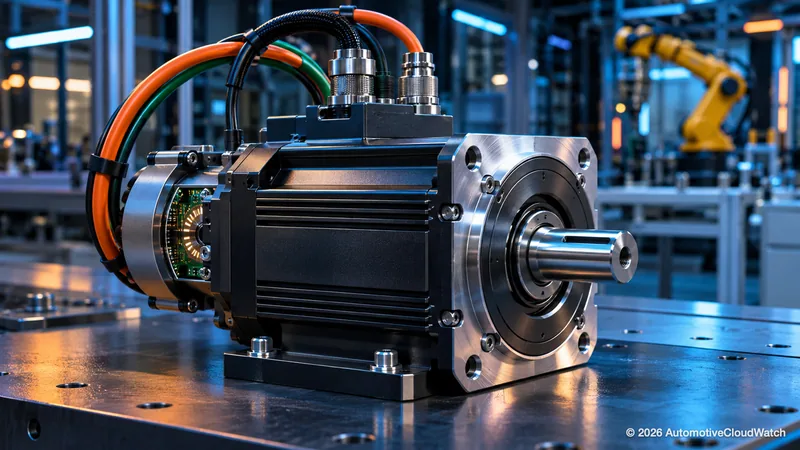 Servo Motor A motor under closed loop control with an encoder reporting its position so it can hold precise positions, speeds or forces.
- Servo Valve A precision valve that meters hydraulic fluid in proportion to an electrical signal, letting hydraulic actuators position accurately.
- Shape Memory Alloy SMA A metal, usually nickel titanium, that returns to a remembered shape when heated so a wire can pull like a tiny muscle.
- Slip Ring A rotating electrical connector that passes power and signals across a joint that spins continuously.
- Slotless Motor A brushless motor with windings in the air gap instead of iron slots, removing cogging for very smooth motion.
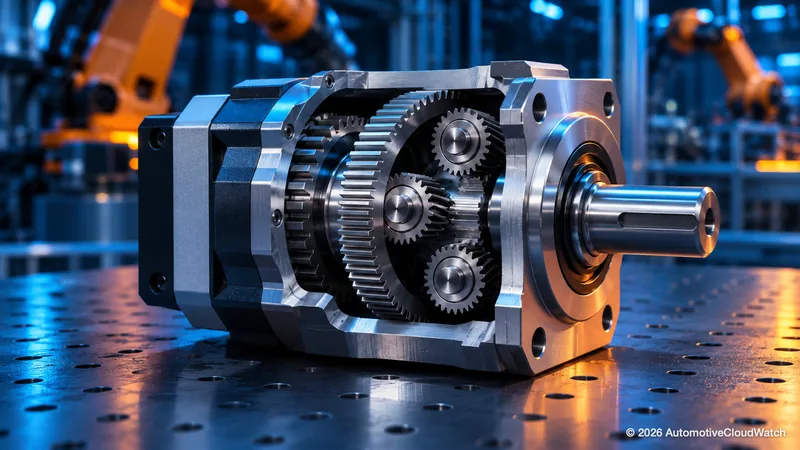 Speed Reducer A gearbox that slows a motor's fast rotation and multiplies its torque, found in almost every robot joint.
- State of Charge SoC How full a battery is as a percentage of its capacity, estimated by the BMS and used to decide when a robot recharges.
- Stepper Motor A motor that turns in small fixed steps, often 200 per turn, so it can be positioned by counting steps without a sensor.
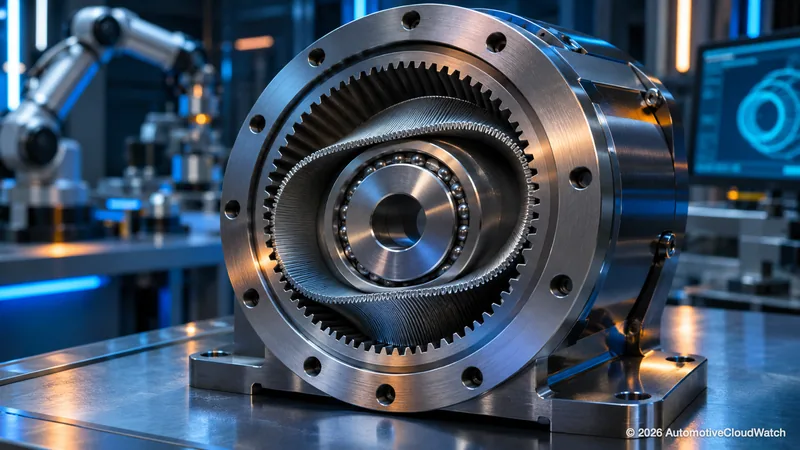 Strain Wave Gear A compact, nearly play free gearbox where a flexible toothed cup is squeezed into an oval inside a rigid toothed ring.
- Tendon Drive A drive where cables act like tendons, pulling joints from motors placed elsewhere to keep fingers and limbs light.
- Thermal Derating Reducing the torque or power an actuator may deliver so it does not overheat during sustained work.
- Thermal Time Constant The time a motor's winding or housing takes to reach about 63 percent of its final temperature rise under steady load.
- Three Core Components The precision reducer, servo system and controller, the three most valuable parts of an industrial robot in Chinese and Japanese reports.
- Torque Constant Kt How much torque a motor produces per amp of current, so measuring current indicates how hard a joint pushes.
- Torque Density How much torque an actuator or motor produces for its weight or size, a headline figure for walking robots.
- Torque Limiter A mechanical device that slips or disconnects when torque gets too high, protecting gears from collisions and overloads.
- Torque Motor A large diameter motor giving very high torque at low speed so it can drive a load directly without a gearbox.
- Torque Ripple A small repeating fluctuation in a motor's output torque as it turns, felt as faint vibration in slow, delicate motions.
- Torque-Speed Curve A chart of how much torque a motor or actuator can deliver at each speed, used to check that a joint can do its job.
- Torsional Stiffness How strongly a joint or gearbox resists twisting under torque, which sets accuracy and achievable control bandwidth.
- Transmission Error The gap between where a gearbox output actually is and where it should be for a given input rotation.
- Variable Stiffness Actuator VSA An actuator that can change how stiff or springy it is while running, firm for precision and soft for safety.
- Velocity Constant Kv A rating on hobby and drone motors giving rpm per volt at no load, where a low number means a slower, torquier motor.
- Voice Coil Actuator An actuator built like a loudspeaker, with a coil in a magnet's field, giving smooth force proportional to current over a short stroke.
- Wave Generator The oval input part of a strain wave gear that keeps bending the flexible cup so its teeth walk around the outer ring.
- Worm Gear A gear set where a screw shaped worm turns a toothed wheel at right angles, giving big reduction and often self locking.
Full entry for members
Every term has a full entry for members: the plain-words definition, the practitioner note and the typed links between terms.
ACW Robotics and Physical AI Glossary, edition 2026.11.1. The headword and one line are open to everyone.