Glossary · Robotics and Physical AI
Data, Teleoperation and Datasets
78 terms in the Robotics and Physical AI glossary, each with its one-line definition.
78 terms, A to Z
- AgiBot World Large open dataset of real robot demonstrations recorded by AgiBot on its own robot fleet across household, retail, industrial and service tasks.
- ALOHA Low-cost open-source two-arm teleoperation rig where an operator moves leader arms and follower arms copy them while recording training data.
- ALOHA 2 Sturdier, more ergonomic version of the ALOHA two-arm teleoperation rig, released with a matching MuJoCo simulation model.
- Annotation Adding labels to recorded data, such as object boxes, success flags or step boundaries, so models can learn from it.
- Autonomous Data Collection Gathering robot training data by letting robots attempt and label tasks on their own instead of being teleoperated for every recording.
- AutoRT Google DeepMind system in which office robot fleets proposed and attempted their own tasks, screened by a written robot constitution of safety rules.
- Bilateral Teleoperation Remote robot control in which commands flow to the robot and the forces it feels flow back to the operator's hand controller.
- BridgeData V2 Public dataset of low-cost robot arm demonstrations of everyday tabletop tasks across many kitchen-like scenes, widely used for training and comparison.
- Co-Training Training one model on several kinds of data together, such as robot demonstrations mixed with web images, text or simulation data.
- Cybernetic Avatar CA Japanese government term for remotely operated robots and agents that let people act beyond limits of body, space and time.
- Data Augmentation Enlarging a training set by making altered copies of examples, such as crops, color shifts or new backgrounds.
- Data Collection Farm Dedicated facility where many operators teleoperate rows of robots all day to record training demonstrations.
- Data Curation Selecting, cleaning and balancing training data so a model learns the right behaviors.
- Data Diversity How varied a dataset is across places, objects, lighting, operators, tasks and robots, a key driver of generalization.
- Data Flywheel Self-reinforcing cycle where deployed robots record data that improves the model, which enables more deployments and more data.
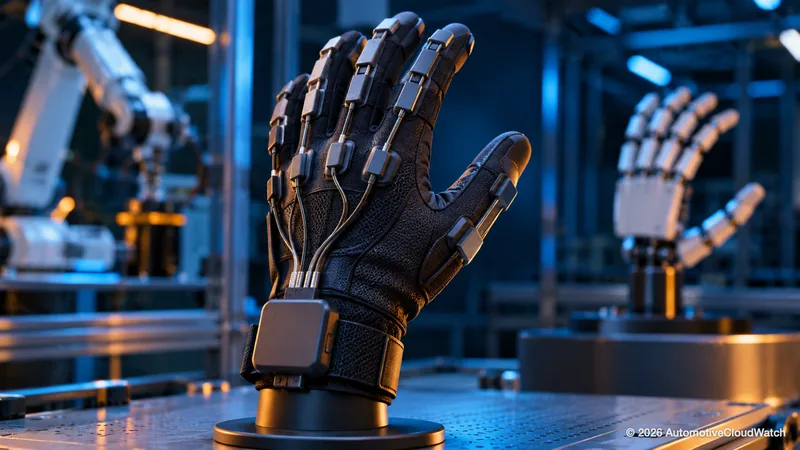 Data Glove Sensor glove that measures finger bending and hand motion to control robot hands or record hand demonstrations.
- Data Mixture Recipe for the proportions of each data source used in training, such as robot demonstrations versus web images and text.
- Data Privacy in Robotics Protecting personal information captured by robot cameras and microphones, such as faces, voices and home interiors.
- Data Pyramid Picture of robot training data with plentiful web and human video at the base, simulation in the middle and scarce real robot data at the top.
- Data Quality How clean, consistent and useful recorded robot data is, from smooth operator motion to correct timing and labels.
- Data Scaling Growing the amount and variety of robot training data, which is far scarcer and costlier than text or image data.
- Dataset Card Short document published with a dataset describing its contents, collection method, intended use, license and limits.
- Demonstration Demo Recorded example of a person performing a task, by teleoperation or on camera, used as training data for imitation.
- DexMimicGen Tool that expands a few simulated two-handed dexterous demonstrations into many varied ones for humanoid robots.
- DreamGen NVIDIA method that generates robot training data by imagining task videos with a video model and inferring the matching actions.
- DROID Large public robot arm dataset recorded by many labs in homes, offices and labs worldwide, valued for scene variety.
- Ego4D Huge public collection of first-person daily life videos used to pretrain models on everyday hand and object activity.
- Egocentric Data Video and sensor recordings captured from a person's own viewpoint with head cameras or smart glasses.
- EgoDex Apple dataset of first-person dexterous hand task videos with tracked finger joint poses from Vision Pro headsets.
- EgoMimic Research system that trains robots on smart glasses video of people alongside robot demonstrations, treating humans as another embodiment.
- Embodied AI Training Ground Government-backed Chinese facility where many robots work in mock homes, shops and factories to collect data and test at scale.
- Embodiment Gap Differences in body, joints, hands, sensors and viewpoint between whoever recorded training data and the robot that learns from it.
- Environment Reset Returning a scene to a starting arrangement between task attempts, instant in simulation but costly on real robots.
- Episode Metadata Descriptive information stored with each recorded episode, such as robot, cameras, operator, task, location and outcome.
- Exoskeleton Teleoperation Remote robot control through a wearable frame that measures the operator's joint angles and passes them to the robot.
- Failure Episodes Recordings of attempts that did not finish the task, useful for teaching systems to recognize failure and what not to do.
- Fleet Learning Improving one shared model from the experience of many deployed robots and redistributing the improved model to all of them.
- GELLO Cheap 3D-printed miniature leader arm for teleoperating robot arms and recording demonstrations.
- GraspNet-1Billion Public benchmark of cluttered tabletop scenes with over a billion labeled parallel gripper grasps, used for grasp detection.
- Hand Retargeting Translating tracked human hand and finger motion onto a robot hand with a different size, joints and shape.
- Hand Tracking Estimating 3D positions of a person's hand and finger joints in real time with cameras or wearable sensors.
- Hierarchical Data Format 5 HDF5 Open file format for storing large structured numeric arrays and labels in one file, widely used for robot demonstrations.
- Hindsight Language Relabeling Writing instructions after the fact that describe what a robot actually did, so any attempt becomes a valid example.
- Hugging Face Hub Online platform from Hugging Face for hosting and sharing AI models, datasets and demo apps, widely used for open robot data.
- Human Video Learning Training robot models on plentiful videos of people doing tasks, despite those videos lacking robot action labels.
- Intervention Data Recordings made when a human takes over from an autonomous robot to correct a mistake, highly valuable for improvement.
- Inverse Dynamics Model IDM Model that infers the action that caused the change between two video frames, used to label unlabeled video with actions.
- Language Annotation Attaching plain-language descriptions to recorded robot episodes so robots learn to follow instructions.
- Latent Action Model Model that learns its own compact code for the change between video frames, turning unlabeled video into pretraining data.
- Leader-Follower Teleoperation Remote control where a person moves a small leader arm and a real follower arm copies its joint positions.
- LeRobot Free open-source Hugging Face toolkit and community for robot learning, with common policies, a data format and low-cost arm support.
- LeRobotDataset Hugging Face LeRobot file format that stores robot states in table files and camera streams as compressed video.
- MimicGen Tool that turns a few simulated human demonstrations into thousands by adapting recorded motions to new object positions.
- Mobile ALOHA ALOHA two-arm teleoperation rig on a wheeled base, used to teach robots household chores like cooking and wiping spills.
- Motion Capture MoCap Recording how people or objects move with markers and cameras, sensor suits or video, often to teach humanoids human motion.
- Motion Retargeting Converting a movement recorded on one body, usually a human, so a robot with different proportions can perform it.
- Open X-Embodiment OXE Shared dataset pooling robot demonstrations from many labs and robot types in one format, a standard pretraining corpus.
- Open-TeleVision Open design for VR teleoperation of humanoids, where the operator sees through moving robot head cameras in 3D.
- Project Aria Meta research program built around sensor glasses that record the wearer's view, gaze, sound and motion.
- Recovery Demonstration Demonstration starting from a nearly failed state that shows how to get back on track, teaching robots to fix mistakes.
- Remote Assistance Running robots that work on their own but can call a remote human for hints or brief direct control in hard situations.
- RH20T Public contact-rich robot dataset with video, depth, force, audio and matching human videos across several robot setups.
- RLDS Google data format and tools for storing robot and agent decision episodes as sequences of time steps.
- robomimic Stanford open-source framework and benchmark for learning from human demonstrations, with datasets and reference methods.
- RoboMIND Large public teleoperation dataset across single-arm, two-arm and humanoid robots that also includes labeled failures.
- Shared Autonomy Control in which a human and the robot's automation decide actions together, easing operator workload.
- SpaceMouse Puck-shaped six-axis input device from 3Dconnexion that researchers use to steer robot grippers while recording demonstrations.
- Subtask Segmentation Splitting a recorded task into stages such as reach, grasp, lift and place to ease labeling, evaluation and reuse.
- Teleoperation Controlling a robot from a distance through joysticks, leader arms, VR or wearables, the main way to record robot AI training data.
- Teleoperation Latency Delay between an operator's motion and the robot's response, plus the delay before the operator sees the result.
- Teleoperator Person who remotely controls a robot or performs demonstrations through it, whose skill shapes data quality.
- Telexistence Tokyo robotics company whose remotely supervised robots restock drinks in convenience store refrigerators.
- Time Synchronization Aligning clocks across a robot's cameras, sensors and commands so each recorded frame matches the action at that moment.
- Trajectory Sequence of positions, sensor readings and actions over one attempt, often used interchangeably with episode in datasets.
- Universal Manipulation Interface UMI Handheld camera gripper for recording manipulation demonstrations anywhere without a robot, later used by robots with matching grippers.
- VR Teleoperation Remote robot control through a VR or mixed reality headset that tracks the operator's head and hands.
- Whole-Body Teleoperation Remote control of a humanoid with the operator's entire body, with a learned balance controller keeping the robot upright.
- YCB Object and Model Set YCB Standard set of everyday physical objects with 3D models that labs use to compare grasping and manipulation results.
Full entry for members
Every term has a full entry for members: the plain-words definition, the practitioner note and the typed links between terms.
ACW Robotics and Physical AI Glossary, edition 2026.11.1. The headword and one line are open to everyone.