Glossary · Robotics and Physical AI
Kinematics, Dynamics and Control
143 terms in the Robotics and Physical AI glossary, each with its one-line definition.
143 terms, A to Z
- Absolute Accuracy How close a robot lands to a numerically commanded position, which offline programs depend on and which calibration improves.
- Adaptive Control Control that tunes its own settings while running as the robot changes, such as when it picks up an unknown payload.
- Admittance Control Control that turns a measured push into a small motion command so a stiff position-controlled arm yields gently to contact.
- Analytical Inverse Kinematics Solving a robot's joint angles with exact formulas instead of iteration, giving every arm configuration at once and very fast.
- Arm Configuration Which of several possible arm shapes, such as elbow up or down, a robot uses to reach the same tool pose.
- Axis One joint or direction of motion that a robot controller can drive independently, numbered from the base outward.
- Balance Control Control that keeps a standing or walking robot from falling by managing its center of mass, body rotation and steps.
- Blending Rounding off the corner between two robot moves so the arm sweeps past a waypoint instead of stopping on it.
- Brain and Cerebellum Architecture Chinese framing of humanoid control as a planning brain, a real-time motion cerebellum and hardware limbs.
- Capture Point Ground spot where a walking robot must step to come to a complete stop, used to plan push recovery steps.
- Cartesian Space Describing a robot tool's position in X, Y and Z plus orientation, which straight-line moves and force control use.
- Cascade Control Nested control loops where an outer loop sets the target for a faster inner loop, as in position, speed and current loops.
- Center of Mass CoM The balance point where all of a robot's weight can be treated as concentrated, central to walking and balance control.
- Center of Pressure CoP Point under a robot's feet where the ground's push effectively acts, measured by foot sensors to judge tipping risk.
- Centroidal Dynamics Compact legged robot model tracking only total momentum about the center of mass, widely used for real-time walking plans.
- Circular Interpolation CIRC Robot move in which the tool follows a smooth arc defined by a via point and an end point.
- Collision Detection Function that spots unexpected contact by comparing actual and expected motor effort, then stops or backs off the robot.
- Command Pose The position and orientation a robot is told to reach, as distinct from the pose it actually attains.
- Compliance A robot's ability to give way like a spring when pushed, the opposite of stiffness, making contact safer.
- Computed Torque Control Model-based control that cancels gravity, inertia and joint coupling so simple feedback can track fast motions accurately.
- Control Bandwidth How fast a control loop can follow commands and reject disturbances, usually given in hertz.
- Control Loop Repeating cycle of measuring, comparing with a target and correcting, run many times per second in every robot joint.
- Controller Area Network CAN Rugged, low-cost two-wire network from Bosch that links motor drives, sensors and hands inside many robots.
- Conveyor Tracking Feature that lets a robot follow a moving conveyor using a belt encoder so it can work on parts without stopping the line.
- Coordinate Frame A reference origin and set of X, Y and Z directions used to describe where things are in a robot cell.
- Cornering Deviation How much a robot rounds off or overshoots a sharp programmed corner when it does not stop there.
- Current Loop Innermost, fastest motor drive loop that holds motor current, and therefore torque, at the requested level.
- Damped Least Squares DLS Inverse kinematics technique that trades a tiny position error for smooth, bounded joint speeds near singular poses.
- Degrees of Freedom DoF The number of independent ways a mechanism can move, such as six for a rigid object in free space.
- Denavit-Hartenberg Parameters DH parameters Four-number-per-joint convention for describing robot arm geometry and building its forward kinematics.
- Disturbance Observer DOB Estimator that infers unknown forces such as friction or loads acting on a motor and cancels them in the control loop.
- Divergent Component of Motion DCM Unstable part of a walking robot's motion that controllers regulate to keep it upright.
- Dynamic Stability Staying balanced while moving even though the robot would fall if it froze, as in human-like walking and running.
- Dynamics Study of how forces and torques produce a robot's motion, accounting for mass, inertia, gravity and friction.
- EtherCAT Real-time industrial Ethernet from Beckhoff that updates dozens of robot joints in well under a millisecond.
- EtherNet/IP Industrial Ethernet protocol managed by ODVA that connects robots, PLCs and I/O, dominant in North American plants.
- Euler Angles Three sequential rotation angles, such as roll, pitch and yaw, used to describe an object's orientation.
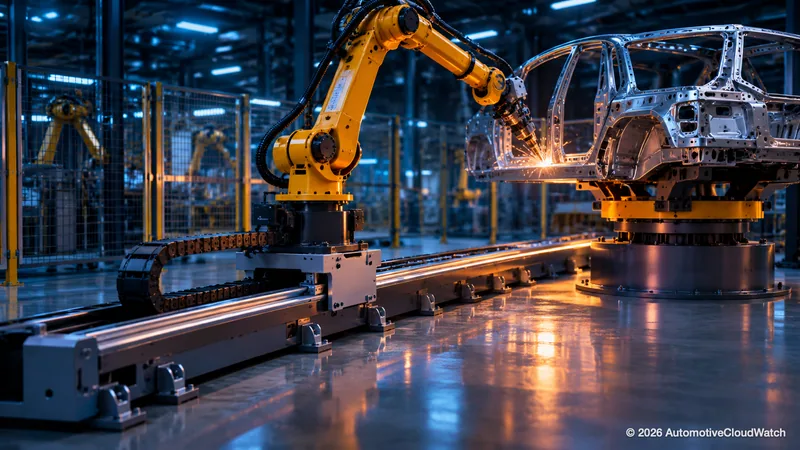 External Axis Extra motorized motion such as a floor track or part positioner that the robot controller drives in step with the arm.
- Fall Recovery Behaviors that let a robot fall safely, protect fragile parts and stand back up.
- Feedforward Control Control that adds the predicted needed input in advance, such as gravity torque, instead of waiting for an error.
- Fieldbus Digital network linking factory controllers to drives, sensors and I/O over one shared cable instead of many wires.
- Floating Base Modeling a robot whose body is not fixed to the ground, adding six unactuated degrees of freedom for the body.
- Following Error Gap between where a motor axis is commanded to be and where it actually is while moving.
- Foot Placement Choosing where and when each foot touches the ground to keep balance and handle uneven terrain.
- Force Control Control that regulates how hard a robot presses on something rather than only where its tool is.
- Forward Dynamics Computing how a robot will accelerate from the forces and torques acting on it, the core of every physics simulator.
- Forward Kinematics FK Computing where a robot's tool is and how it points from the angles of its joints.
- Friction Compensation Adding motor torque that cancels expected joint friction to improve slow-speed accuracy and hand-guiding feel.
- Friction Cone Range of push directions at a contact within which a foot or finger will not slip.
- Gait Pattern and timing of leg movements a robot or animal uses to walk or run.
- Gravity Compensation Motor torque that cancels the weight of the arm and its load so the arm floats and can be guided by hand.
- Ground Reaction Force GRF The force the ground pushes back on a robot's feet, which supports and propels a walking robot.
- Homogeneous Transformation Matrix Four by four matrix combining rotation and translation so one multiplication moves a point between coordinate frames.
- Hybrid Position/Force Control Scheme that controls position along some directions and force along others at the same time, as in polishing.
- Impedance Control Control that makes a robot behave like a programmable spring and damper when pushed, instead of holding position rigidly.
- Input Shaping Splitting a motion command into precisely timed pieces so the vibration from one cancels the next.
- Inverse Dynamics Computing the joint torques needed to make a robot follow a desired motion, given its mass model.
- Inverse Kinematics IK Computing the joint angles needed to place a robot's tool at a desired position and orientation.
- ISO 9283 International standard defining how to measure and report industrial robot performance such as accuracy and repeatability.
- ISO 9283 Test Cube Imaginary cube in a robot's workspace whose diagonal plane holds the standard points for accuracy testing.
- ISO 9787 International standard defining the coordinate systems and motion directions used to describe industrial robots.
- ISO 9946 International standard listing which characteristics a manufacturer must state on an industrial robot datasheet.
- Iterative Learning Control ILC Control that improves a repeated motion run after run by learning from the tracking error of earlier attempts.
- Jacobian Matrix relating joint speeds to tool speed at the arm's current pose, central to inverse kinematics and force control.
- Jerk The rate at which acceleration changes, which robots limit to move smoothly and reduce vibration and wear.
- Jogging Moving a robot manually with the teach pendant keys or joystick, joint by joint or along chosen directions.
- Joint A connection between two robot parts that lets them move relative to each other, like an elbow or knee.
- Joint Limits The furthest, fastest and hardest each robot joint may move, set by mechanics, cabling and safety needs.
- Joint Space Describing a robot's position as the list of its joint angles rather than its tool position.
- Kinematic Chain Series of rigid links connected by joints, open in a typical arm and closed in parallel robots.
- Kinematic Redundancy Having more joints than a task needs, so the arm can reach one tool pose in endless ways and avoid obstacles or limits.
- Kinematics Study of motion without regard to forces, relating a robot's joint angles to where its links and tool are.
- Latency Time delay between a robot sensing something and acting on it, which can destabilize fast control.
- Lead-Through Programming Teaching a robot by physically moving its arm through a motion while it records the positions.
- Linear Interpolation LIN Robot move in which the tool tip travels in a straight line to the target at controlled speed and orientation.
- Linear Inverted Pendulum Model LIPM Simple model of a walking robot as a point mass on a massless telescoping leg at constant height, used to plan steps.
- Linear Quadratic Regulator LQR Classic optimal feedback design that balances tracking error against control effort for a linear system.
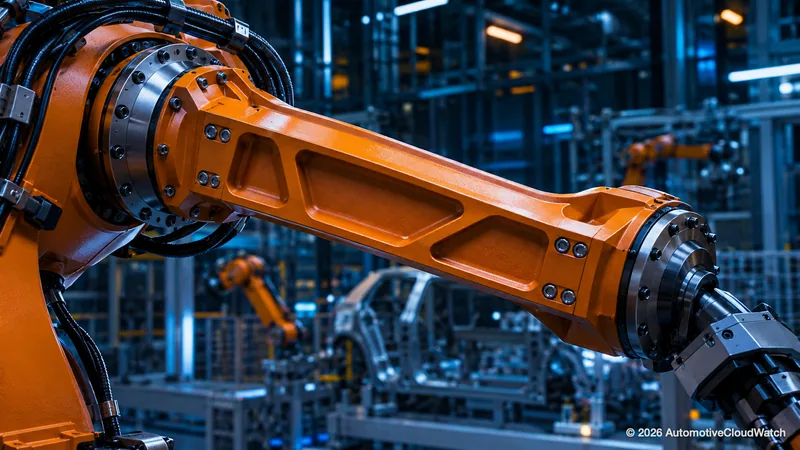 Link A rigid structural part of a robot connecting two joints, such as an upper arm or forearm.
- Load Diagram Datasheet chart showing how a robot's allowed payload falls as the load's center of gravity moves away from the flange.
- Major Axes First three joints of a robot arm, which position the wrist and set the robot's reach.
- Manipulability Score of how easily a robot arm can move its tool in every direction from its current pose.
- Mass Matrix Matrix describing how hard each joint is to accelerate at the current pose, the core of a robot's equations of motion.
- Mastering Setting each robot joint's zero point so the controller's joint angles match the real mechanical position.
- Model Predictive Control MPC Control that repeatedly plans the best actions over a short look-ahead window, applies the first and replans.
- Moment of Inertia How hard something is to start or stop spinning, depending on its mass and how far that mass sits from the axis.
- Momentum Observer Software method that detects collisions and estimates external forces by comparing measured and modeled robot momentum.
- Motion Profile The plan for how a robot's speed rises and falls between positions, such as trapezoidal or S-curve.
- Null Space Set of joint motions of a redundant robot that leave its tool exactly where it is, used for secondary goals.
- Offline Programming OLP Writing and testing robot programs on a computer with a 3D cell model, then loading them onto the real robot.
- Offset Wrist Robot wrist whose last three axes do not meet at one point, as on Universal Robots arms and many cobots.
- Operational Space Control Control that commands motion and force directly at the task, such as the hand, while accounting for full robot dynamics.
- Path Accuracy How closely a robot's tool follows the intended path while moving, not just at the endpoints.
- Path Repeatability How consistently a robot follows the same path when it repeats a programmed movement many times.
- Path Velocity Accuracy How closely a robot holds its programmed speed along a path, which affects painting, sealing and welding quality.
- Payload The heaviest load a robot can carry at its wrist within specification, including the gripper or tool itself.
- Payload Identification Routine where a robot moves its tool through test motions to estimate the load's mass, balance point and inertia.
- Payload-to-Weight Ratio How much a robot can carry compared with its own mass, important for mobile manipulators and humanoids.
- PD Control Feedback that pushes toward a target in proportion to error and resists in proportion to speed, like a spring and damper.
- PID Control PID The most common feedback controller, combining terms for current error, accumulated error and error rate.
- Point-to-Point Motion PTP Robot move in which all joints travel together to the target, fastest but with an uncontrolled tool path.
- Pose An object's position and orientation combined, needing six numbers in three dimensions.
- Pose Drift Slow change in where a robot ends up over hours of operation, mainly from motors, gears and arm warming up.
- Pose Overshoot How far a robot travels past its target before settling back.
- Position Control Control that drives joints or tool to commanded positions as stiffly as possible, the default for industrial robots.
- Prismatic Joint Joint that slides in a straight line instead of rotating, like a drawer on runners.
- PROFINET Industrial Ethernet standard from PROFIBUS and PROFINET International, closely tied to Siemens, widely used in European plants.
- Push Recovery A robot's ability to stay upright after an unexpected shove by adjusting posture or taking quick steps.
- Quadratic Program QP Fast-solving optimization with a squared cost and linear limits, used to choose joint torques each control cycle.
- Quaternion Four numbers describing a 3D rotation without breaking down at certain angles, standard in robot software.
- Reach How far a robot can stretch, typically from the base center to the wrist, quoted in millimeters on datasheets.
- Real-Time Control Control where every fixed-rate cycle of sensing and commanding must finish on time, or the system fails.
- Recursive Newton-Euler Algorithm RNEA Fast outward-and-back pass that computes the joint torques needed for a given robot motion.
- Repeatability How closely a robot returns to the same taught spot again and again, quoted as plus or minus a value.
- Revolute Joint Joint that rotates about one axis like a hinge or elbow, the most common joint in robot arms.
- Rigid Body Dynamics Modeling a robot as solid, unbending parts connected by joints and computing how they move under forces.
- Robot Calibration Measuring a robot's real link lengths and joint offsets and correcting the controller to improve absolute accuracy.
- Robot Controller The computer and power cabinet that runs an industrial robot's programs, motion, motors, I/O and safety.
- Robot Programming Language Vendor-specific language for programming a brand of industrial robot, such as RAPID, KRL or URScript.
- Screw Theory Mathematical framework describing any rigid-body motion as a rotation about and slide along one axis.
- Servo Loop Feedback loop in the motor drive that uses an encoder to drive a joint to its commanded position or speed.
- Servo Tuning Adjusting motor control loop gains and filters so an axis responds quickly without overshoot or vibration.
- Settling Time Time an axis takes to stop wobbling and stay within tolerance after reaching its target, which adds to cycle time.
- Singularity Arm pose where the robot loses the ability to move its tool in some direction and joint speeds would become unbounded.
- Spherical Wrist Robot wrist whose last three joint axes meet at one point, separating tool positioning from tool orientation.
- Stance Phase Part of a walking cycle when a foot is on the ground, supporting the body and pushing it forward.
- Static Compliance How far a robot's tool deflects per newton of steady force, a measure of arm stiffness.
- Static Stability Balance that holds even if the robot freezes, because its center of mass sits over the area enclosed by its feet.
- Support Polygon Ground area enclosed by all points where a robot touches the floor, within which its center of mass must stay to stand still.
- Swing Phase Part of a walking cycle when a foot is in the air moving forward to its next foothold.
- TCP Calibration Measuring exactly where a tool's working tip sits relative to the robot flange, by touching a point from several angles.
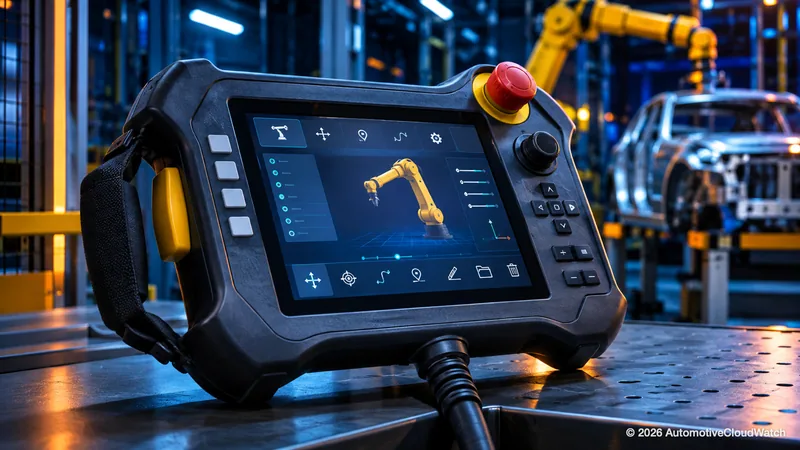 Teach Pendant Handheld unit with an emergency stop and enabling switch used to jog a robot, record positions and edit programs.
- Time-Optimal Path Parameterization TOPP Computing the fastest speed along a fixed path that respects joint speed, acceleration and torque limits.
- Tool Center Point TCP Reference point on a robot's tool, such as a gripper center or welding wire tip, that the robot controls and reports.
- Torque Control Commanding how hard each joint twists rather than where it should be, enabling soft contact and force-based control.
- Trot Four-legged gait in which diagonal leg pairs move together, the default for many robot dogs.
- User Frame Coordinate frame taught on a fixture or part so robot positions are stored relative to it rather than the robot.
- Vibration Suppression Methods that stop a robot wobbling after moves, shortening settling time and improving accuracy.
- Whole-Body Control WBC Control that computes every joint torque at once to balance, keep contacts and move limbs while respecting limits.
- Workspace The space a robot's tool can reach, shown on datasheets as side and top views of the work envelope.
- World Coordinate System Fixed reference frame for an entire robot cell, tied to the floor, shared by robots, fixtures and sensors.
- Wrench Combined force and torque acting on an object, written as six numbers, such as a force/torque sensor measures.
- Wrist Singularity Six-axis robot pose where the fourth and sixth axes line up, making the wrist spin very fast to hold the tool.
- Zero Moment Point ZMP Ground point where gravity and motion produce no tipping twist, the classic balance criterion for walking robots.
Full entry for members
Every term has a full entry for members: the plain-words definition, the practitioner note and the typed links between terms.
ACW Robotics and Physical AI Glossary, edition 2026.11.1. The headword and one line are open to everyone.