Glossary · Robotics and Physical AI
Robot Software and Compute
97 terms in the Robotics and Physical AI glossary, each with its one-line definition.
97 terms, A to Z
- AI Bridging Cloud Infrastructure ABCI Japanese government AI supercomputer run by AIST that companies and researchers rent to train AI and robot foundation models.
- Asynchronous Inference Computing a policy's next action chunk in the background while the robot keeps executing the current one, avoiding pauses and jerky motion.
- Autoware Open-source self-driving software stack built on ROS 2 and started in Japan, also used for autonomous carts, shuttles and delivery robots.
- BehaviorTree.CPP Open-source C++ library for building behavior trees defined in XML, used as the decision engine of the ROS 2 Nav2 stack.
- Callback Group ROS 2 setting that controls which callbacks of a node may run at the same time on a multi-threaded executor.
- Cloud Robotics Offloading some robot computing, storage, fleet coordination or training to remote data centers, trading power for network delay.
- colcon Standard command-line tool that builds and tests all ROS 2 packages in a workspace in dependency order.
- Composable Node ROS 2 component loaded into a shared container process at runtime so nodes can pass large data without copying.
- Containerization Packaging software with everything it needs into isolated containers so it runs the same on laptops, servers and robots.
- Control Frequency How many times per second a robot's controller or AI model issues new commands, measured in hertz.
- Coordinate Frame Transform tf2 ROS library that tracks how all of a robot's reference frames relate over time and converts measurements between them.
- CUDA NVIDIA's programming platform for running general software on its GPUs, the base of deep learning, GPU simulation and onboard robot AI.
- D-Robotics RDK RDK Robot computer boards with AI accelerators from Horizon Robotics spin-off D-Robotics, a Chinese alternative to NVIDIA Jetson.
- Data Distribution Service DDS Real-time publish-subscribe communication standard without a central server, used as the default message transport in ROS 2.
- Eclipse Cyclone DDS Open-source DDS implementation hosted by the Eclipse Foundation and fully supported as a ROS 2 middleware.
- Edge Compute Computing on or near the robot itself, which keeps responses fast and keeps the robot working when the network drops.
- eProsima Fast DDS Open-source DDS implementation from Spain's eProsima that is the default ROS 2 middleware in most releases.
- Executor ROS 2 component that schedules which callbacks run when and on which threads as messages and timers arrive.
- Fleet Management Software that assigns tasks, manages traffic and charging, and tracks health and updates across a group of robots.
- Foxglove Company and platform for visualizing live or recorded robot data as plots, 3D scenes and images to debug robots and fleets.
- Hardware Abstraction Layer HAL Software layer that hides specific hardware behind a common interface so components can be swapped without rewriting the rest.
- Heartbeat Regular message showing each part of a robot system is alive, with the robot stopping safely if it stops arriving.
- Inference Latency Time an AI model takes from receiving sensor input to producing output, which limits how fast and smoothly a robot reacts.
- Isaac Manipulator NVIDIA reference workflow bundling GPU motion planning, pose estimation and grasping models for ROS 2 robot arms.
- Isaac Perceptor NVIDIA reference workflow for camera-based 3D perception on mobile robots to reduce reliance on lidar.
- Isaac ROS NVIDIA's collection of GPU-accelerated ROS 2 packages for depth, visual SLAM, detection and pose estimation.
- JetPack NVIDIA software bundle for Jetson computers with the operating system, GPU tools and AI libraries in one install.
- Jetson Orin NVIDIA Jetson generation launched in 2022, from Orin Nano to AGX Orin, the standard onboard AI computer for many robots.
- Jetson Thor NVIDIA Jetson generation built to run large AI models such as VLAs on humanoids, with a developer kit released in August 2025.
- Launch File ROS file that starts a whole group of programs with their settings using one command.
- Lifecycle Node ROS 2 node with defined states it changes only on command, so a system can bring parts up in a controlled order.
- MCAP Open-source file format for recording timestamped multi-sensor robot data, created by Foxglove and now the ROS 2 default.
- micro-ROS Project that brings ROS 2 communication to microcontrollers so motor and sensor boards act as normal ROS 2 nodes.
- Middleware Software between the operating system and applications that carries data between perception, planning and control programs.
- Model Context Protocol MCP Open standard from Anthropic for connecting AI assistants to tools and data, used to let language models query or command robots.
- Model Serving Software that hosts trained AI models and answers inference requests, with versioning, monitoring and rollback.
- MoveIt Most widely used open-source ROS software for robot arm motion planning, kinematics and collision checking.
- MoveIt Servo MoveIt feature that moves an arm in real time from streaming velocity or pose commands, slowing near collisions.
- Mujin Tokyo robotics software company whose controller lets industrial robots plan motions from 3D vision for picking and depalletizing.
- MuJoCo XML Format MJCF File format MuJoCo uses to describe a robot and its world, including bodies, joints, motors, sensors and contacts.
- Navigation 2 Nav2 Standard ROS 2 system that lets mobile robots localize, plan routes, avoid obstacles and recover when stuck.
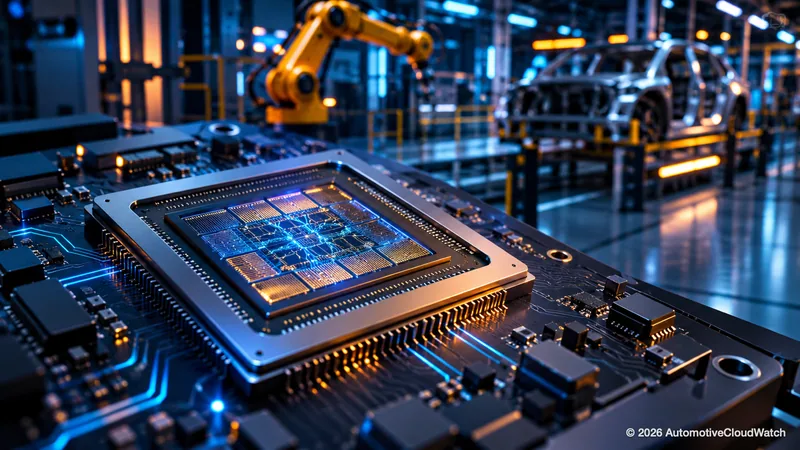 Neural Processing Unit NPU Chip block designed to run neural networks efficiently, letting robots run perception models with far less power.
- NVIDIA Isaac Transport for ROS NITROS NVIDIA method that keeps images and other large data on the GPU while passing them between ROS 2 nodes.
- NVIDIA Jetson NVIDIA's family of compact, power-efficient AI computer modules, the most common AI computers in robots and drones.
- NVIDIA OSMO OSMO NVIDIA cloud-native orchestration platform that runs synthetic data, training and simulation jobs as one pipeline.
- On-Device Inference Running AI models on the robot's own computer, cutting delay and network dependence at the cost of limited compute.
- OPC UA Vendor-neutral industrial communication standard with a self-describing data model, used to link robots to factory systems.
- Open Neural Network Exchange ONNX Open AI model file format that lets a model trained in one framework run on many different inference engines.
- Open Resource interface for the Network ORiN Japanese standard software interface, led by Denso Wave, that lets factory apps talk to robots and equipment from many makers.
- Open Robotics OSRF Nonprofit that stewards ROS, Gazebo and Open-RMF and coordinates releases and the annual ROSCon conference.
- Open-RMF Open-source framework that coordinates robots from different makers sharing a building and links them to doors and elevators.
- OpenRTM-aist Japan's open-source robot middleware from AIST that builds robot functions as reusable connected software components.
- Over-the-Air Update OTA Sending new software, firmware or AI models to fielded robots over the network without a technician visit.
- Precision Time Protocol PTP Network standard that syncs device clocks on Ethernet to under a microsecond so sensor data shares one timebase.
- PREEMPT_RT Linux kernel changes that make task response times short and predictable for real-time robot control loops.
- Publish-Subscribe Pub/Sub Messaging pattern where senders post to named channels and receivers subscribe, keeping components independent.
- Quality of Service QoS DDS and ROS 2 settings that control message reliability, history depth and whether late joiners get past data.
- Quantization Storing an AI model's numbers in fewer bits, such as 8 or 4, to make it smaller and faster with little accuracy loss.
- Real-Time Operating System RTOS Operating system that guarantees tasks respond within strict, predictable time limits, essential for motor control loops.
- Remote Policy Inference Running a large robot policy on a separate powerful computer that receives sensor data and streams actions back.
- Rerun Open-source toolkit and time-aware viewer for logging and visualizing images, 3D data, poses and model outputs.
- Robot Observability Ability to understand what a fielded robot was doing and why from its logs, metrics and recorded sensor data.
- Robot Operating System ROS Open-source framework of libraries, tools and conventions that connects a robot's programs, despite not being an OS.
- Robot Operating System 2 ROS 2 Redesigned successor to ROS for production robots, with real-time, multi-robot and security support.
- Robot SDK Robot maker's software development kit with libraries, APIs, docs and examples for programming its robots.
- Robot Software Stack All software layers on a robot, from firmware and motor control through middleware, perception and AI to fleet apps.
- robot_localization Widely used ROS package that fuses odometry, IMU, GPS and other sources into one smooth pose estimate.
- robot_state_publisher Standard ROS node that broadcasts every robot link's position from the description file and current joint angles.
- Rockchip RK3588 RK3588 Low-cost Chinese system-on-chip with eight CPU cores and an AI accelerator, common in Chinese service and educational robots.
- ROS 2 Distribution Named ROS 2 release published each May, such as Humble, Jazzy or Kilted, that teams adopt for a product's life.
- ROS Action ROS interface for long tasks that gives progress feedback and a final result and can be canceled midway.
- ROS Bag Timestamped recording of ROS messages that can be replayed later for debugging or building datasets.
- ROS Client Library RCL Language-specific API for writing ROS 2 programs, mainly rclcpp for C++ and rclpy for Python.
- ROS Domain ID Number that separates groups of ROS 2 programs on one network so only those with the same number communicate.
- ROS Message Defined data structure that ROS programs exchange, such as an image or velocity command, with fields listed in a text file.
- ROS Middleware Interface RMW ROS 2 layer that lets the same software run on different communication systems through a configuration change.
- ROS Namespace and Remapping ROS features that rename topics and services or add prefixes at startup so one codebase runs several identical robots.
- ROS Node Single ROS program or component that does one job, such as reading a camera or planning a path.
- ROS Package Basic unit for organizing and sharing ROS software, a folder of related programs, messages, launch files and settings.
- ROS Parameter Named setting on a ROS node, such as maximum speed, that can be set at startup or changed while running.
- ROS Service ROS request and reply exchange for quick operations such as reading a setting or resetting a map.
- ROS Topic Named ROS channel over which programs continuously send and receive one kind of message, such as camera images.
- ros2_control ROS 2 framework that runs the control loop between high-level software and motors through standard hardware interfaces.
- RViz Standard 3D viewer for ROS that shows robot models, maps, point clouds, images, frames and planned paths.
- Secure ROS 2 SROS2 Tools and settings that add authentication, encryption and access control to ROS 2 communication.
- Simulation Description Format SDF File format from Gazebo that describes whole worlds with robots, lights, terrain, sensors and physics settings.
- Simulation Time ROS mode where programs take their clock from a simulator or playback instead of the computer's real clock.
- Telemetry Data robots send back automatically, such as battery, location, errors and task progress, for dashboards and alerts.
- TensorRT NVIDIA software that optimizes trained AI models to run much faster on its GPUs, including Jetson.
- Tera Operations per Second TOPS Headline measure of trillions of AI calculations per second, useful for comparing chips but not real robot speed.
- Time-Sensitive Networking TSN Ethernet standards that guarantee bounded delivery times so motion control, cameras and IT data can share one network.
- Unified Robot Description Format URDF ROS XML file format describing a robot's links, joints, visuals, collision shapes and masses.
- VDA 5050 German industry standard interface letting AGVs and mobile robots from different makers run under one fleet controller.
- Watchdog Timer Timer that stops motors or triggers a safe response if software fails to reset it in time, guarding against frozen programs.
- Xacro ROS XML macro tool that adds variables, math and reusable blocks to keep robot description files short.
- Zenoh Open-source protocol for efficient data and queries between devices, robots and cloud, an official ROS 2 alternative to DDS.
- Zero-Copy Transport Passing large data such as images between programs through shared memory instead of copying it.
Full entry for members
Every term has a full entry for members: the plain-words definition, the practitioner note and the typed links between terms.
ACW Robotics and Physical AI Glossary, edition 2026.11.1. The headword and one line are open to everyone.