Glossary · Robotics and Physical AI
Sensors and Perception Hardware
68 terms in the Robotics and Physical AI glossary, each with its one-line definition.
68 terms, A to Z
- Absolute Encoder A position sensor that reports a unique value at every point, so a robot joint knows its exact position the moment power comes on.
- Accelerometer A small sensor that measures straight line acceleration and gravity, telling a robot which way is down and detecting impacts and vibration.
- Active Stereo Stereo depth sensing that projects its own infrared dot pattern so it can measure depth even on blank, textureless surfaces.
- BiSS-C An open, license free digital protocol that carries an absolute encoder's position and diagnostics to a motor drive.
- Capacitive Sensing Detecting a nearby object or touch by measuring how it disturbs a small electric field, as smartphone screens do.
- Cliff Sensor A downward facing sensor that notices when the floor drops away, such as at stairs, and stops a mobile robot before it falls.
- Current Sensing Measuring the current into a motor to estimate joint torque, the cheapest way for a robot to feel contact.
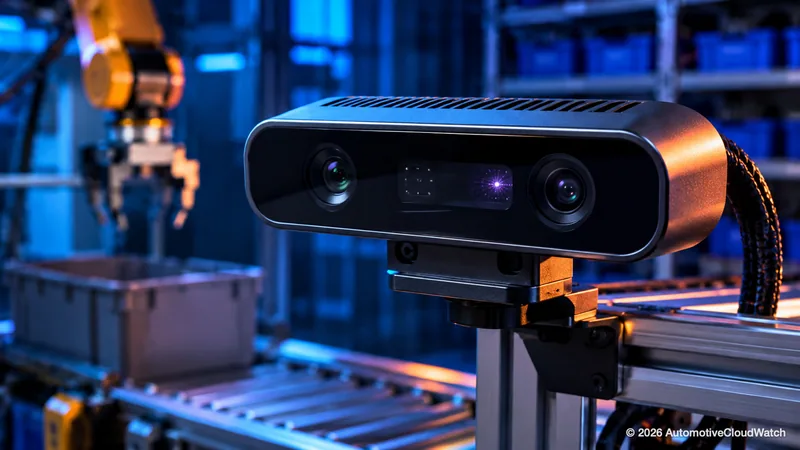 Depth Camera A camera that measures the distance to each point it sees, used to grasp objects, avoid obstacles and map scenes.
- Direct Time-of-Flight dToF Depth sensing that fires short light pulses and times their return to measure distance directly, as most lidars do.
- Dual Encoder A joint design with encoders on both the motor and the gearbox output, revealing twist under load for torque and safety checks.
- Electronic Skin e-skin A flexible sheet of touch sensors that wraps large parts of a robot to sense contact and pressure across its body.
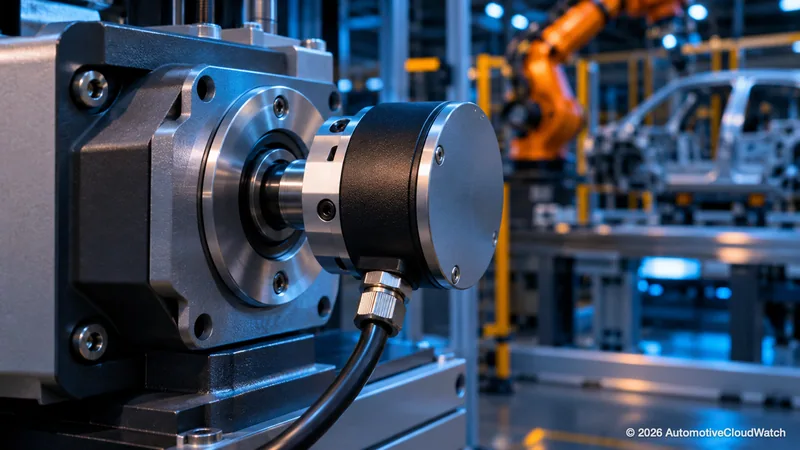 Encoder A sensor that measures how far a shaft has turned or a slide has moved, giving every robot joint its position.
- Encoder Backup Battery A battery that keeps a robot's multi turn encoders counting while main power is off so joint positions are not lost.
- Encoder Resolution The smallest movement an encoder can detect, given as counts per revolution or bits, such as about a million steps for 20 bits.
- EnDat HEIDENHAIN's digital interface that carries an encoder's absolute position and diagnostics to a motor drive, common on machine tools.
- Event Camera A camera whose pixels report only brightness changes, reacting within microseconds and handling extreme light for fast robots.
- Exteroception A robot's sensing of the world outside its body through cameras, lidar, microphones and touch, used to navigate and handle objects.
- Extrinsic Calibration Measuring exactly where each sensor sits and points relative to the robot or other sensors so their data lines up.
- Fiducial Marker A printed black and white pattern a camera can easily identify and locate, used as a landmark for calibration and docking.
- Foot Contact Sensor A sensor in a walking robot's foot that detects touchdown so the robot can time each step and shift its weight.
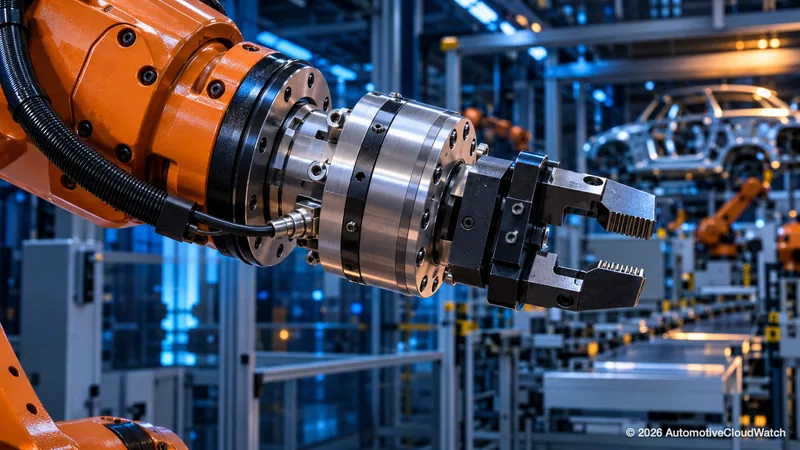 Force/Torque Sensor F/T sensor A sensor, usually at the wrist, that measures pushing and twisting forces in all six directions so a robot feels how hard it presses.
- GelSight A touch sensing technology where a camera films a soft coated pad pressed on an object, revealing surface detail finer than a fingertip.
- Global Shutter A camera sensor that captures all pixels at the same instant, avoiding skewed images when the robot or scene moves fast.
- Gyroscope A sensor that measures how fast something rotates, letting a robot track its heading and tilt over time.
- Hand-Eye Calibration Measuring exactly where a camera sits relative to a robot so points the camera sees become positions the arm can reach.
- Hiperface DSL A SICK encoder interface that sends motor position over the motor power cable, so a servo motor needs only one cable.
- Homing A startup routine where a machine moves an axis to a known reference point so the controller learns where the axis is.
- Incremental Encoder An encoder that pulses with each small step of rotation, so the controller counts movement but loses position at power off.
- Inductive Encoder An encoder that measures position with printed coils on circuit boards, tolerant of dirt and magnets and thin enough for hollow joints.
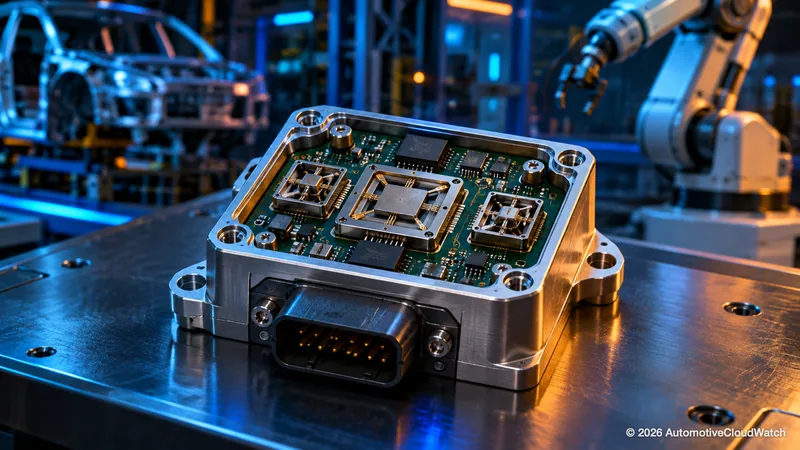 Inertial Measurement Unit IMU A sensor package of accelerometers and gyroscopes that tells a robot how it is tilting and accelerating, like an inner ear.
- Joint Torque Sensor A sensor inside a robot joint that directly measures its twisting force, letting the robot feel contact and detect collisions.
- Laser Triangulation Sensor A sensor that views a laser dot or line from an angle to compute height, used for weld seam guidance and gap inspection.
- Lidar A sensor that measures distance by timing laser light reflections to build a 2D or 3D map, used for robot navigation and safety.
- Load Cell A sensor that measures force in one direction, such as weight or press force, from how a metal element bends.
- Machine Vision Cameras, lighting and image software that let factory systems find, inspect, measure and read parts automatically.
- Magnetic Encoder An encoder that senses a magnet or magnetized ring with a small chip, cheap and tough for humanoid and cobot joints.
- Magnetic Tactile Sensor A touch sensor that embeds magnets in a soft skin and measures field changes when pressed, thin and cheap for fingertips.
- Magnetometer A sensor that measures magnetic field direction like a compass, giving a heading reference outdoors but unreliable near steel.
- Microphone Array Several microphones placed around a robot so it can pick out speech and tell which direction a sound came from.
- Millimeter-Wave Radar A high frequency radar that detects objects and their speed through dust, smoke and darkness, also used in safety sensors.
- Multi-Turn Encoder An absolute encoder that tracks both the angle within a turn and the number of full turns, even after power off.
- Off-Axis Encoder An encoder whose read head sits beside a ring around the shaft, leaving the joint center open for cables.
- Optical Encoder An encoder that reads a finely patterned disc with light, giving the highest resolution and accuracy of common types.
- Orbbec A Shenzhen based maker of 3D depth cameras widely used on service robots and humanoids, a major RealSense alternative.
- Photoelectric Sensor A sensor that detects an object by sending a light beam and checking if it is blocked or reflected, common on conveyors.
- Proprioception A robot's sense of its own body, where its joints are, how fast they move and how it tilts, from encoders and inertial sensors.
- Proximity Sensor A sensor that detects a nearby object without touching it, using electric or magnetic fields, sound or light.
- RealSense A family of depth cameras originally from Intel, among the most used 3D cameras in robotics, spun out as its own company in 2025.
- Resolver A rugged transformer like position sensor whose two analog signals give shaft angle, tolerant of heat, vibration and dirt.
- Rolling Shutter A camera readout that captures pixel rows one after another, so fast motion makes straight lines look bent or wobbly.
- Safety Laser Scanner A safety certified 2D laser scanner that watches zones around a machine or vehicle and triggers a stop when someone enters.
- Seam Tracking Real time correction of a welding robot's path so the torch follows the actual joint instead of a preset line.
- Sensor Fusion Combining readings from several sensors such as IMUs, encoders, cameras and lidar into a better estimate than any one alone.
- Slip Detection Sensing that a held object is starting to slide so the robot can tighten its grip just enough before dropping it.
- Solid-State Lidar A lidar without large spinning parts that steers its beam electronically, smaller and tougher but with a narrower view.
- State Estimation Working out a robot's current position, orientation and velocity from noisy and incomplete sensor data.
- Stereo Baseline The distance between a stereo camera's two lenses, where wider spacing improves far depth and narrower suits close range.
- Stereo Camera A pair of cameras a fixed distance apart whose images are compared to compute depth, the way human eyes do.
- Strain Gauge A thin foil strip whose resistance changes when stretched, glued to metal to reveal how much load it carries.
- Structured Light A 3D scanning method that projects known patterns such as stripes or dots and computes depth from how they bend over surfaces.
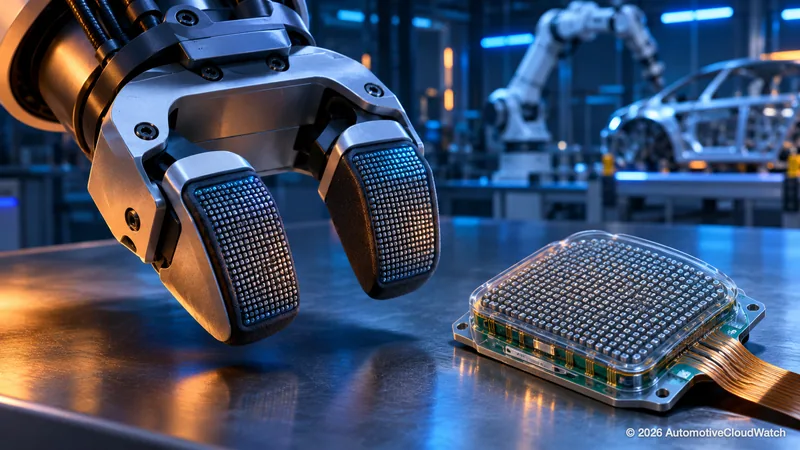 Tactile Sensor A sensor that gives a robot touch, detecting contact, pressure, vibration or slip through a grid of tiny sensing points.
- Taxel A single sensing point in a touch sensor array, the tactile equivalent of a pixel in a camera image.
- Thermal Camera A camera that images heat instead of visible light, used by inspection robots to find overheating equipment and leaks.
- Time-of-Flight Camera ToF A depth camera that times how long its own infrared light takes to return from each point, compact and good on plain surfaces.
- Ultrasonic Sensor A sensor that measures distance by timing echoes of high pitched sound pulses and can detect glass that fools light sensors.
- Vision-Based Tactile Sensor A touch sensor where a tiny internal camera films a soft gel surface pressing an object to reveal contact shape and slip.
- Wheel Odometry Estimating how far and in which direction a wheeled robot has moved by counting wheel turns with encoders.
- Wrist Camera A camera mounted on a robot's hand that moves with the gripper and gives a close view of what is being grasped.
Full entry for members
Every term has a full entry for members: the plain-words definition, the practitioner note and the typed links between terms.
ACW Robotics and Physical AI Glossary, edition 2026.11.1. The headword and one line are open to everyone.