Signals · Article · Automotiveシグナル · 記事 · 自動車
Aftersales and Service [Explained]
Service and parts carry a large share of dealer profit. EVs need less routine maintenance, while calibration, sensor-heavy parts and a technician gap change where the work and money go.

Picture a car that comes in for a new windshield. A driver assistance camera often sits behind the glass, and after the glass is replaced the camera has to be re-aimed and checked, a step called advanced driver assistance system (ADAS) calibration.
That step is now routine in collision repair. CCC’s Crash Course 2026, published on 31 March 2026, found calibrations on 28.3% of repairable estimates in 2025, up from 21.8% in 2024. An actuary.info summary of the report put the average fee at $485.56 and said 51.5% of calibrations arrived as supplements, work added after the first estimate.
Aftersales, everything that happens to a car after it is sold, carries a large share of dealer profit. This explainer covers the profit pool, dealer service economics, EV maintenance, remote and predictive service, the technician gap, parts, calibration and collision costs. Repair access law is covered in the right to repair explainer, software updates in the over-the-air updates explainer, battery health in the battery management systems explainer, vehicle data in the connected vehicle data explainer and the sensors themselves in the sensor fusion explainer.
What aftersales covers
Aftersales covers scheduled maintenance, wear and repair work, warranty and recall jobs paid by the carmaker, customer-pay repairs, collision repair, parts sales and service contracts. In US dealer accounting, service, parts and the body shop are called fixed operations, as distinct from new and used car sales.
McKinsey says service department gross margins are typically 45% to 55%. Deloitte’s 2025 benchmarks for Australian dealers put service gross margin at 62% to 64% for volume brands and 69% to 71% for luxury brands, against parts gross margins of about 21% to 25% and net profit of 3.4% to 4.3% of sales across segments.
In my reading, labor is where the profit sits, since parts earn roughly a quarter in gross margin and the whole dealership earns low single digits.
How big the profit pool is
NADA’s figures for 2025 put US franchised dealers’ service and parts sales at about $164.6 billion, or 13.3% of total dealership sales, from 276 million repair orders at 16,990 dealerships. Its mid-year 2026 figures show nearly $83 billion in the first half.
BCG put the European aftermarket at €99 billion in 2025 at the wholesale level, rising to €116 billion by 2035, only about 1.7% a year against 4.7% in 2021 to 2025. Its 2024 study said the independent aftermarket held 60% in 2022. A McKinsey study from 2018 sized the automotive aftermarket at about €800 billion, growing to about €1.2 trillion by 2030, a forecast now eight years old.
Fixed absorption, the dealer’s safety margin
Fixed absorption is the share of a dealership’s overhead covered by gross profit from service and parts. At 100%, a dealer could sell no cars at all and still break even.
McKinsey reports that public US dealer groups averaged 60%, 54%, 58%, 58% and 59% from 2020 to 2024. In 2024 the public groups ranged from 54% to 66%, one private group reached 80% and a best-in-class group reached 100%. By McKinsey’s estimate, each one-point gain is worth about $20 million to $40 million a year in gross profit for a public group.
Deloitte’s Australian benchmarks land in a similar range, with parts and service absorption of 50% to 54% at volume brands and 55% to 57% at prestige brands. The definitions differ, but I read both as saying typical large dealers cover half to two-thirds of overhead from service and parts.
Deloitte also puts service and parts at about 40% of gross profit for Australian volume dealers and 45% to 46% for prestige and luxury dealers. Set beside NADA’s US 13.3% of sales, I read that as fixed operations earning about 3 to 3.5 times their revenue share in gross profit, a rough comparison across different markets.
Keeping the customer as the car ages
McKinsey finds that dealers take 52% to 61% of vehicle spending in the first two years, 17% to 26% by year nine and 4% to 13% by year fifteen, and that dealers keep about 25% of service customers on average after roughly eight years.
CCC’s Crash Course 2026 puts the average US light vehicle at 12.8 years old in 2025, likely reaching 13 in 2026. McKinsey says the US car parc grows about 0.7% a year, or about 4 million vehicles.
In my reading, much of the service work sits in older cars that most owners no longer bring to the dealer.
Why EVs need less maintenance
The US Department of Energy, in a June 2021 Fact of the Week, put scheduled maintenance for a light-duty battery EV at 6.1 cents per mile against 10.1 cents for a combustion vehicle, about 40% less, because a battery EV needs no engine oil, spark plugs or timing belt, while hybrids and plug-in hybrids save on brake maintenance.
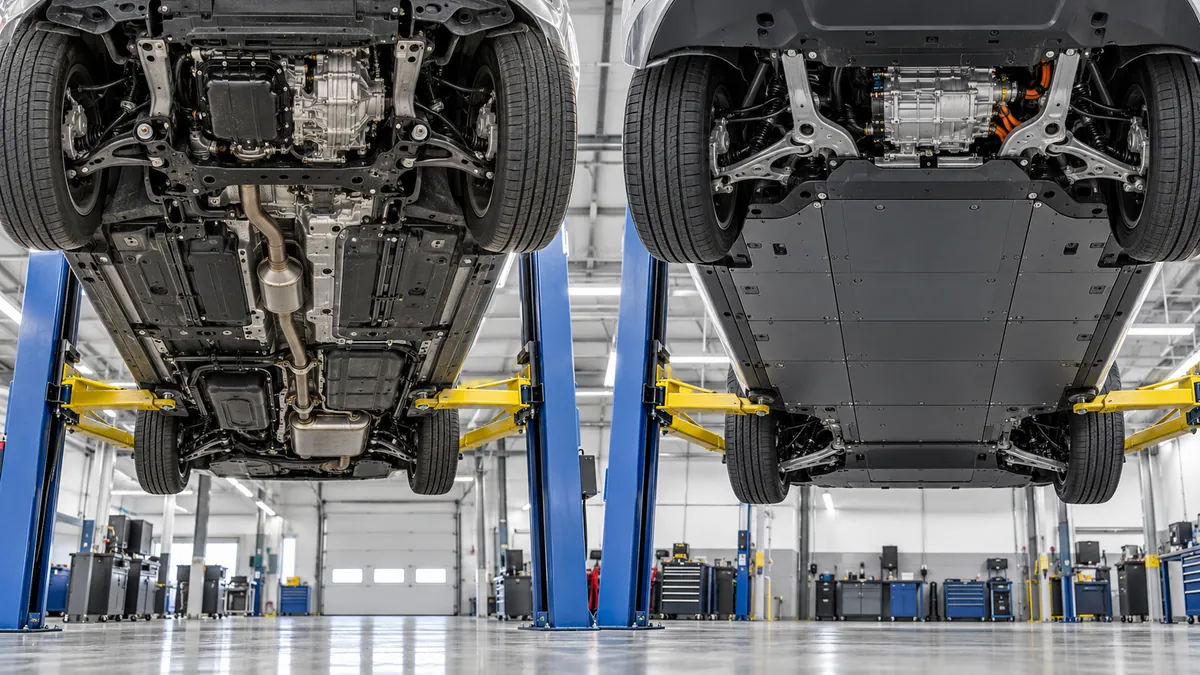
Consumer Reports reached a similar result in September 2020 from its 2019 and 2020 survey data, putting lifetime maintenance and repair over 200,000 miles at 3 cents per mile for battery EVs and plug-in hybrids against 6 cents for combustion cars. Both studies are now several years old, but together they point to EV maintenance savings of roughly 40% to 50%.
Service schedules have changed to match. Tesla dropped its annual service interval in March 2019 and kept a brake fluid check every two years, elektroauto-news reported, citing Automobilwoche.
The effect on dealers is slow. McKinsey says battery EVs need fewer routine visits but their repairs are more complex, so owners are more likely to take them to dealers, and the change takes years to reach the installed base. In my reading, the drag on service revenue follows the mix of cars on the road, not new car sales.
Remote diagnosis and predictive service
Tesla pushed hardest on remote service. In March 2019 the company said about 90% of vehicle problems could be diagnosed remotely and said the other tenth would need hands-on work, and its mobile service fleet then handled 30% of US orders, elektroauto-news reported. That is a 2019 company claim, and I could not find a current figure.
At GM, OnStar Proactive Alerts, launched on 2016 model year vehicles, monitored the starter motor, fuel pump and 12-volt battery, collecting small batches of data at each start and comparing them with fleet-wide data, NOLN reported in 2017. OnStar communications manager Phil Colley said the system could tell a battery with a low state of charge from one with high electrical resistance that needs replacing. I found no published accuracy figures.
McKinsey says personalized offers raise conversion by about 20%. In my reading, predictive alerts let the carmaker start the service visit.
The technician shortage
The TechForce Foundation’s technician supply report, covered by Repairer Driven News in June 2026, puts demand at 241,842 new technicians a year across 10 sectors through 2029 and a cumulative five-year shortfall of 1.2 million.
For automotive, TechForce counts about 70,000 openings a year against about 42,000 graduates, close to the Bureau of Labor Statistics projection of about 67,800 a year cited by McKinsey. Collision is tighter, needing 73,354 new entrants by 2029, roughly 14,700 a year, against 5,462 collision graduates last year and turnover of 60.7%, the highest of the 10 sectors, by TechForce’s count.
In my reading of TechForce’s figures, the automotive gap is mostly one of inflow, though Repairer Driven News’s coverage also partly blames retention, especially in collision. TechForce found that only 3.5% of automotive technicians exit, against 4.8% of all US workers, and that postsecondary completions across the 10 sectors rose 7.6% last year.
By my arithmetic from NADA’s figures, US dealers wrote roughly 990 repair orders per technician in 2025, about four per working day. CCC puts diagnostic equipment at $5,000 to $20,000 per shop, and its Crash Course 2026 reported mean labor rates up 2.9% in 2025, the smallest rise since 2021.
Parts prices and value lines
Parts earn less but cost more each year. Mitchell’s 2026 trends data, from Enlyte, show OEM part prices up 4.21% in 2025 after 3.52% in 2024 and aftermarket part prices up 3.89%, and the share of parts repaired rather than replaced rose from 14.8% to 15.5%, Repairer Driven News reported. CCC found that 38.6% of shops reported tariff impacts in 2025, including 73.7% of shops with eight or more bays against 16% of small shops.
EVs tilt toward the carmaker. In 2025, 86% of parts dollars on repairable battery EV estimates went to OEM parts, according to Mitchell.
Carmakers are also chasing the independent channel. Frost & Sullivan has pointed to branded lines such as Ford’s Omnicraft and to GM selling parts through Amazon. BCG’s 2024 study said private labels make up as much as 50% of basic parts sales in Europe, and its 2026 update puts private labels at about 20% across EMEA. The automated storage and retrieval explainer in the robotics series covers the warehouses that store and ship these parts.
Calibration as a service line
Calibration has become a line of business of its own. CCC’s Q3 2025 Crash Course, covering direct repair program appraisals in the first quarter of 2025, found calibrations on just over 32%, up from 23.9% a year earlier, with 56.5% added on a supplement. The base differs from the 28.3% for all repairable estimates, but both put calibration on roughly three in ten repairs, up from about one in five before. The sensor fusion explainer covers why the sensors need it. Mitchell found that the share of estimates with a calibration line grew 31.4% in 2025 and calibrations per repair rose about 10%. Mitchell’s February 2026 EV report put calibrations per estimate at 1.70 on battery EVs, 1.63 on hybrids and 1.54 on combustion cars.
Calibration also adds time. CCC’s Q3 2025 report shows keys-to-keys cycle time of about 13 days with no calibration, 15.5 days with one and more than 17 days with several. In my reading, that makes calibration equipment and trained staff a limit on how many cars a shop can turn, as well as a source of revenue.
Collision costs, EVs and sensors
CCC’s Q3 2025 report put the average total cost of repair at over $4,730 in 2024, up 3.8%, and CCC puts 2025 at a preliminary $4,818, up 1.7%, the smallest rise since 2017.
The small repair is vanishing. Repairable appraisals of $2,000 or less fell from 41.5% in 2019 to 25.5% through June 2025, CCC found. In my reading, bumpers with radar, windshields with cameras and complex headlamps are a large part of why even low-speed impacts cost more.
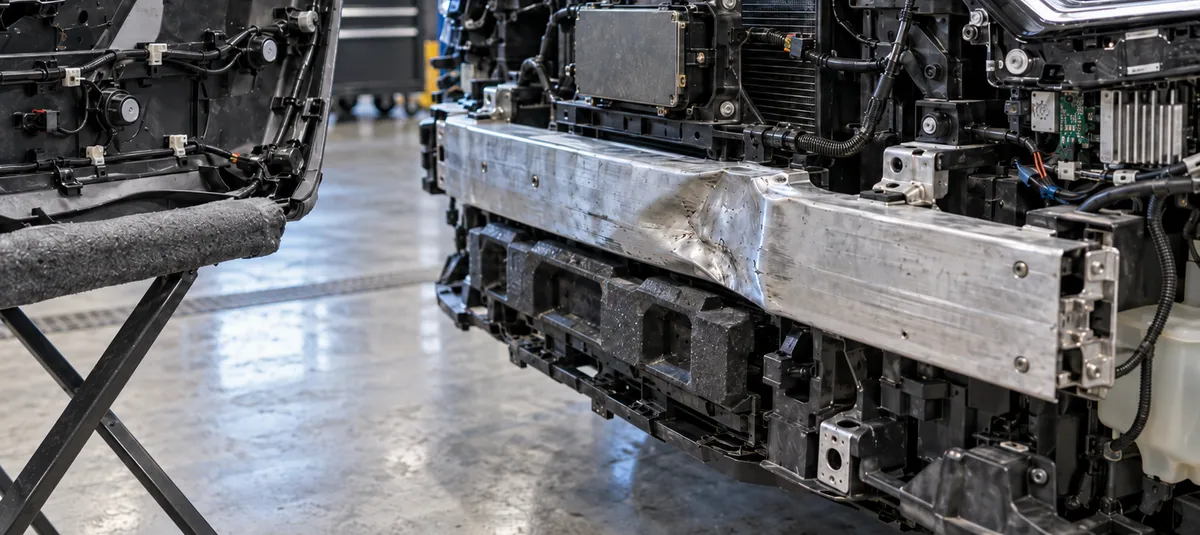
Total loss frequency hit a record 23.1% of claims in 2025, up from about 20% in 2020, and 72% of 2025 total loss valuations were for cars seven years or older, actuary.info reported from CCC data.
EVs cost more to fix after a crash, though in my reading the gap may be narrowing. Mitchell’s 2024 review put average battery EV repairable severity in the US at $6,236 against $5,066 for combustion cars, about 23% higher, and EV total loss frequency rose from 8% to 10.2%, Carscoops reported. In 2025 battery EV repairable severity fell 5% in the US, Mitchell data show.
What carmakers and dealers should do
Plan service revenue on the cars on the road, not on new sales. EV maintenance savings arrive only as EVs build up in the parc, and McKinsey says their more complex repairs are more likely to go to dealers.
Build calibration and collision capacity. Calibration now appears on roughly three in ten repairs in CCC’s data, more than half of it added on a supplement rather than the first estimate, and repairs with calibrations take days longer, so in my reading shops that scan early and calibrate in-house stand to gain most. In collision, where TechForce puts turnover at 60.7%, treat keeping technicians as seriously as hiring them.
Win back older cars. In my reading, value lines like Ford’s Omnicraft aim at the years when dealer share of spending falls to 17% to 26%, and OnStar-style alerts can bring owners in before a breakdown. Treat remote diagnosis rates as unproven until a current figure appears, since Tesla’s 90% is a 2019 company claim.
What aftersales and service really means
Aftersales is where dealers earn much of their gross profit, with service gross margins of 45% to 71% across the McKinsey and Deloitte figures. EVs need less routine maintenance, but calibration, sensor-heavy parts and collision complexity are adding work that needs equipment and trained staff.
The useful questions are how fast EVs change the mix of cars on the road, whether shops can hire and keep technicians, how much of the calibration work dealers capture and whether carmakers can win back older cars.
Words you will hear
Fixed operations. The service, parts and body shop departments of a dealership, as opposed to vehicle sales.
Fixed absorption. The percentage of dealership overhead covered by service and parts gross profit.
Repair order. The document that opens a service job, the basic unit of service volume.
Customer-pay and warranty work. Repairs paid by the owner, as opposed to those reimbursed by the carmaker under warranty or recall.
ADAS calibration. Aligning and checking driver assistance sensors after a repair, using static targets in a bay or a dynamic road procedure.
Supplement. Work added to an insurance estimate after the first estimate, usually when teardown reveals extra required work.
Repairable severity. The average cost of a collision claim that is repaired rather than totaled.
This article is par
If this helped, subscribe free at automotivecloudwatch.com to get each new explainer when it publishes.
All opinions are my own and do not reflect those of my employer.
Related research


Get the next Executive Briefing by email
Each new briefing, in your inbox.
Subscribe
