Signals · Article · Automotiveシグナル · 記事 · 自動車
Central Vehicle Compute [Explained]
The computer is becoming the most consequential component in a car. The numbers on its spec sheet are among the least reliable in the industry.

In October 2016, Tesla said every car it built from then on had the hardware needed for full self-driving. Buyers paid up to $15,000 for the software that was supposed to follow. Elon Musk first conceded in January 2025 that the computer many of those cars had received, Hardware 3, would need an upgrade. In April 2026 he told investors that Hardware 3 cars simply do not have the capability to achieve unsupervised self-driving, blaming memory bandwidth he put at one eighth of Hardware 4’s. Electrek has estimated that roughly four million cars could be affected.
That episode is the clearest warning about the part of the car that automakers now care most about. Central vehicle computers are replacing dozens of small electronic control units with a few powerful systems-on-chip, the same kind of silicon that runs phones and data centers. They decide what software a car can run for the next fifteen years, and they are sold with performance figures that are hard to compare. This article explains what a vehicle central computer is, what sits inside the chip, who makes them, why automakers are designing their own, why the headline numbers mislead, and what safety, heat and supply mean for the hardware.
From a hundred boxes to a few brains
A traditional car spreads its electronics across many single-purpose controllers, often more than a hundred in a modern vehicle, each built around a small microcontroller running one function. Domain controllers were the first step toward consolidation, putting all of one area, such as driver assistance or the cockpit, onto a more powerful processor.
Central compute goes further. A small number of high-performance computers host software from several domains at once, while zone controllers around the car handle the wiring to sensors, lights and motors nearby. The zonal architecture explainer in this series covers that physical side. Here the focus is the computer at the middle.
Automakers are already building cars this way, and the zonal architecture explainer walks through how BMW, GM and others have laid out their vehicles. What matters here is that the computers at the center increasingly use the same kinds of chips as phones and data centers, bought from a small number of suppliers or designed in-house. Qualcomm markets chips that can run the digital cockpit and automated driving functions on the same piece of silicon, separated by a hypervisor.
What is inside the chip
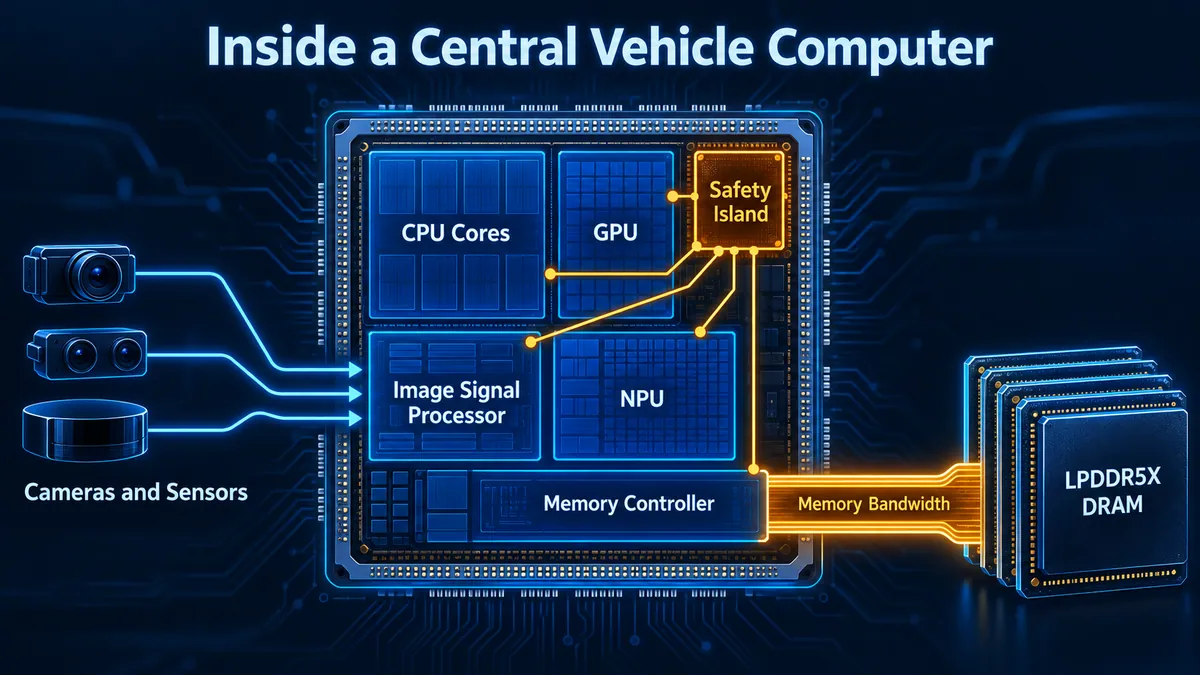
A central computer is built around a system-on-chip that combines several kinds of processors. General-purpose CPU cores run the operating systems and most applications. NVIDIA’s DRIVE Thor, for example, uses 14 Arm Neoverse V3AE cores, a version of Arm’s server design adapted for automotive safety. A GPU and dedicated neural processing units, often called NPUs, handle the parallel math behind AI models for perception and driving.
An image signal processor prepares raw camera data. Qualcomm says its Snapdragon Ride Elite platform supports more than 40 sensors, including up to 20 high-resolution cameras. Memory controllers connect the chip to fast DRAM, the working memory the chip reads from, increasingly the low-power LPDDR5X type.
A safety island, a set of separate, simpler processor cores that run in lockstep and check each other, monitors the big processors and can bring the car to a safe state if something goes wrong. Qualcomm’s Elite platforms include a dedicated safety island, and NVIDIA says Thor supports systems designed to ISO 26262 ASIL D.
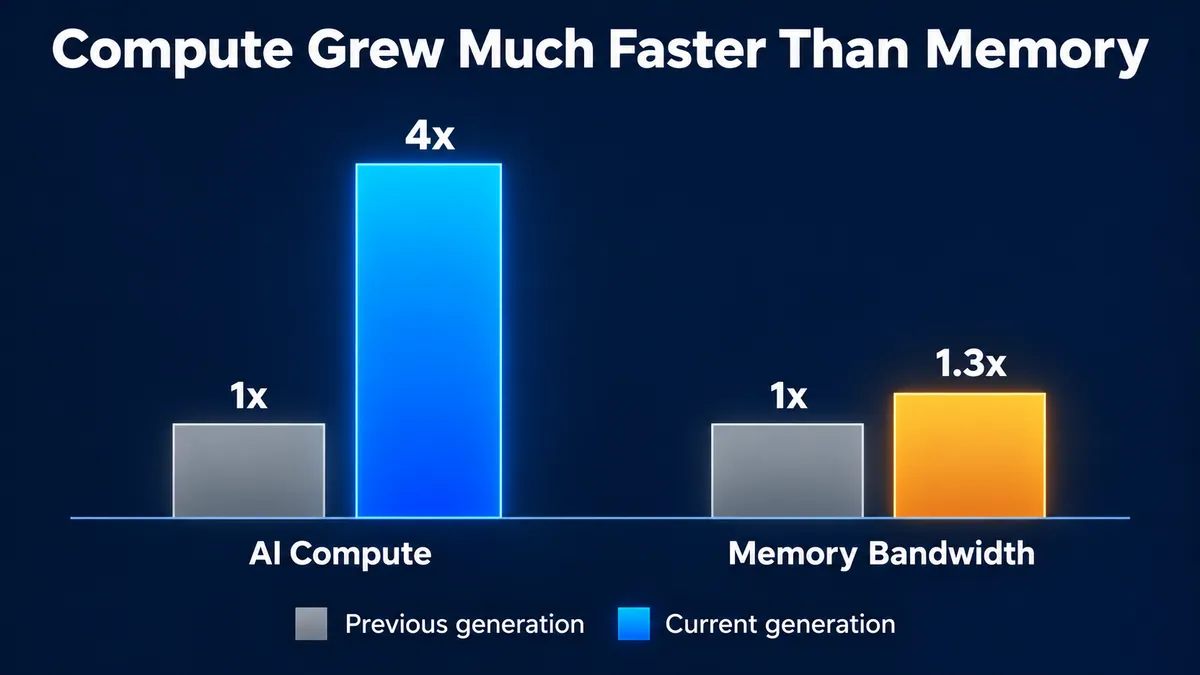
Memory bandwidth is the part buyers hear least about and engineers worry about most. NVIDIA’s own figures show Thor’s memory bandwidth at 273 gigabytes per second against 205 for the previous Orin, a rise of about a third, while its quoted AI throughput rose several times over. Large AI models spend much of their time waiting for data, so a chip with enormous math capacity and limited memory bandwidth can disappoint, which is exactly the problem Musk described with Hardware 3.
The suppliers
NVIDIA is the best-known name. Its DRIVE Orin, announced in December 2019 for vehicles from 2022, became the standard high-end chip for driver assistance in many Chinese and Western cars. DRIVE Thor, announced in September 2022, replaced a planned chip called Atlan in NVIDIA’s product plans. It began shipping in 2025, with announced customers including Zeekr, Li Auto, BYD, Xpeng, Volvo Cars, Lucid and GM. Lucid said in October 2025 that it would use two Thor computers in its upcoming midsize vehicles.
Qualcomm came from the cockpit. Its Snapdragon cockpit chips are widely used for infotainment, and Bosch says it has delivered more than 10 million cockpit computers built on them. In October 2024 Qualcomm announced Snapdragon Cockpit Elite and Ride Elite, built around its own Oryon CPU, with Li Auto and Mercedes-Benz among the first named customers. At its investor day in July 2026, Qualcomm said its automotive design-win pipeline had reached $65 billion and raised its fiscal 2029 automotive revenue target to $10 billion.
Mobileye takes the opposite approach. Its EyeQ chips are far smaller and cheaper, and the company says more than 230 million vehicles had been built with them through 2025. In the first quarter of 2026 it shipped 10.8 million EyeQ and SuperVision systems at an average price of about $49 each. Its EyeQ6 High, the basis for its next generation of hands-off driving systems, is rated at 34 trillion operations per second.
China has its own champion. Horizon Robotics’ Journey 6 family spans from about 10 to 560 trillion operations per second, the top figure assuming sparsity, and the company says its Journey chips passed 10 million cumulative units by August 2025. BYD’s chairman said in April 2024 that more than a million BYD vehicles used Horizon chips.
Taken together, those figures show a market split in two. Mobileye and Horizon sell large volumes of efficient, cheaper chips for driver assistance. NVIDIA and Qualcomm sell expensive, programmable platforms meant to run whatever software an automaker writes for the life of the car.
The Hardware 3 lesson
Tesla designed its own chip earlier than any other automaker. Its Full Self-Driving computer, shown in April 2019, carried two Tesla-designed chips made by Samsung, with the company quoting 144 trillion operations per second per board. Tesla said at the time that the chip was the best in the world by a large margin, and NVIDIA publicly disputed its comparison.
Hardware 4, known as AI4, followed in 2023. Musk first said in January 2025 that Hardware 3 owners who had paid for self-driving would need an upgrade, and in April 2026 he said Hardware 3 could not achieve unsupervised self-driving. On Tesla’s July 2026 call he said upgrading those cars would make sense but gave no timing or cost. Tesla has since changed the wording of its old hardware promise, and owners have filed class actions in several countries.
The lesson for every automaker is that a computer is a bet on software that has not been written yet. If the bet is wrong, the fix means opening millions of cars. Musk announced in April 2026 that the next chip, AI5, had taped out, and said in October 2025 that it would be made by both Samsung and TSMC, though later reports tie Samsung mainly to the following chip, AI6.
Automakers making their own chips
Chinese automakers have followed Tesla. Xpeng developed its own Turing chip and began using it in its cars in 2025. Its G7, unveiled in June 2025, offers three Turing chips in its top trim, which Xpeng says delivers more than 2,200 trillion operations per second, while a lower trim uses twin NVIDIA Orin chips.
NIO’s Shenji NX9031, a 5-nanometer chip, entered mass production in 2024, with the flagship ET9 among its first users. NIO says it saves about 10,000 yuan per car, and its chip unit raised more than 2.2 billion yuan from outside investors, announced in February 2026. Li Auto has said it planned to put its own M100 chip into its cars in 2026.
Rivian joined in December 2025, unveiling an in-house chip it calls RAP1, made on a 5-nanometer process and which Rivian says delivers 1,600 sparse trillion operations per second in its driving computer, aimed first at Level 3, eyes-off driving.
The economics only work at scale. Designing a leading automotive chip costs hundreds of millions of dollars and years of work, and it ties the automaker to its own product plan for years. In exchange it gets control over cost, features and timing, and freedom from a supplier’s pricing. NIO’s decision to bring outside investors into its chip unit suggests how heavy that bet is, even for a company that has already shipped the chip.
Why TOPS misleads
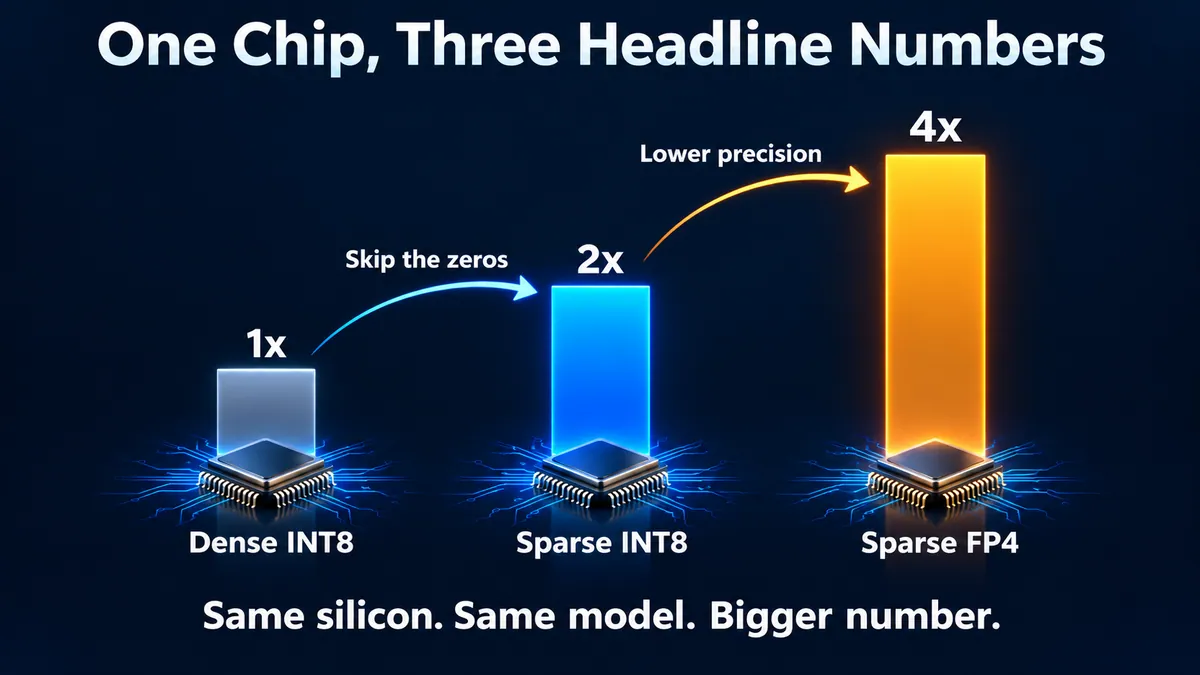
The headline figure for most automotive chips is TOPS, trillions of operations per second. It is close to meaningless on its own. The number depends on the numerical precision being counted. FP8, FP4 and INT8 are number formats, ways of storing each value in a model at higher or lower precision, and lower precision gives bigger headline figures. NVIDIA introduced DRIVE Thor in 2022 with a figure of 2,000 teraflops at a precision called FP8. Its 2025 developer materials quote 2,000 at FP4, a lower precision, and about 1,000 at the more common INT8. Like for like, the quoted figure fell, because the same 2,000 now refers to a less demanding format.
Sparsity inflates figures further. Many quoted numbers, Rivian’s and Horizon’s among them, assume that half the values in a model are zero and can be skipped, which doubles the figure compared with dense operation. Utilization matters too, because few real models keep every processing unit busy, and memory bandwidth often sets the real ceiling. Mobileye’s next hands-off driving systems are built on 34 TOPS chips, two of them in SuperVision, while rivals quote figures 30 times higher per chip, which says as much about software and system design as about silicon. Lower precision is not free either, because a model run at FP4 can lose accuracy unless it was trained or tuned for that format.
Better comparisons exist but are rarely published. They include the time a chip takes to run a specific model at a stated precision, frames processed per watt, and the cost of each safety-relevant function. Until automakers ask for them, the spec sheet will keep being written for investors rather than engineers.
Safety, heat, power and supply
Safety comes from the system, not the chip alone. ISO 26262 assigns integrity levels to vehicle functions, and the most demanding, ASIL D, is usually met by splitting a function across redundant, independent paths and adding a safety island that watches the main processors. Chips are described as supporting ASIL D systems, which is not the same as the chip itself being certified to ASIL D. Software has to be separated safely too. A hypervisor keeps the infotainment system from interfering with driving functions, and safety-relevant code often runs on a certified real-time operating system such as QNX.
Heat and power are real limits. NVIDIA’s DRIVE AGX Thor developer kit is rated at 350 watts, and high-end driving computers increasingly need liquid cooling. Every watt comes from the battery in an electric car, so a hungrier computer means less range.
Supply is the risk automakers learned about the hard way. The 2021 chip shortage halted production lines worldwide. In autumn 2025, after the Dutch government ordered Nexperia, a Dutch-based chipmaker owned by China’s Wingtech, not to make changes to its assets and operations, and a Dutch court suspended its chief executive, China blocked exports from Nexperia’s Chinese unit, and automakers warned of production disruption. The Dutch order was suspended in November 2025, but the dispute left Nexperia operating as two companies, as the mature-node chips explainer describes. Those were small, inexpensive chips, and they showed how a car can stop for want of a part worth cents. Central computers concentrate far more value in far fewer chips, which raises the stakes of every supplier choice.
Automotive chips also lag phones by design. They must work from deep cold to engine-bay heat, pass automotive qualification and stay in production for many years, which is why automotive chips typically trail phone chips by one or more manufacturing generations.
What central compute really means
A central computer is where an automaker decides how much of its future it will control. The chip sets the ceiling on what software the car can ever run, the safety architecture sets how that software can be trusted, and the supply chain sets whether the car can be built at all.
The useful questions for any program are what the computer can actually run at what precision and power, how much memory bandwidth headroom it has for models not yet written, how it will be upgraded if it falls short, and how many suppliers stand between the automaker and a stopped line. Hardware 3 showed what happens when those questions are answered too optimistically. The bill arrives years later, in the form of retrofits, lawsuits and lost trust.
Words you will hear
HPC. High-performance computer. A vehicle computer built around a powerful system-on-chip that hosts software from several domains at once.
SoC. System-on-chip. A single chip combining CPU cores, GPU, neural processors, image processing, memory controllers and safety logic.
NPU. Neural processing unit. A processor designed for the math behind AI models.
Safety island. A separate set of simpler processor cores on the chip that monitors the main processors and can force a safe state.
Domain controller. A controller that runs all the functions of one area, such as driver assistance or the cockpit, on one more powerful processor.
TOPS. Trillions of operations per second, a peak performance figure that depends heavily on precision and sparsity.
Memory bandwidth. How fast data moves between the chip and its memory, often the real limit on AI performance.
This article is part of the AutomotiveCloudWatch Explained series. Before it, read Software-Defined Vehicle [Explained] and Zonal Architecture [Explained].
If this helped, subscribe free at automotivecloudwatch.com to get each new explainer when it publishes.
All opinions are my own and do not reflect those of my employer.
Related research


Get the next Executive Briefing by email
Each new briefing, in your inbox.
Subscribe