Signals · Article · Automotiveシグナル · 記事 · 自動車
Driver Assistance Systems [Explained]
Driver assistance is now standard equipment and increasingly the law. The hardest engineering problem in it is not the car. It is the person behind the wheel.

In December 2023, Tesla recalled about two million cars in the United States, almost every vehicle it had sold with Autopilot. Nothing was physically replaced. The fix was an over-the-air software update that added more alerts and controls to keep drivers paying attention. It followed an investigation in which the National Highway Traffic Safety Administration found at least 13 crashes involving one or more deaths and what it called foreseeable driver misuse. Four months later NHTSA opened another inquiry into whether the fix worked, noting that part of it was optional and could be reversed.
That recall captures the central problem of driver assistance. These systems are designed to help a human drive, not to replace one, and they only work if the human stays engaged. As the features become more capable, keeping the driver involved becomes harder and more important.
This series' autonomous driving explainer covers the SAE levels and the step to Level 3. This article stays below that line. It explains the features that make up driver assistance, how driver monitoring and hands-off systems work, the rules making these features mandatory in Europe and the United States, what the crash evidence does and does not show, how testers grade the systems and how automakers make money from them.
What driver assistance covers
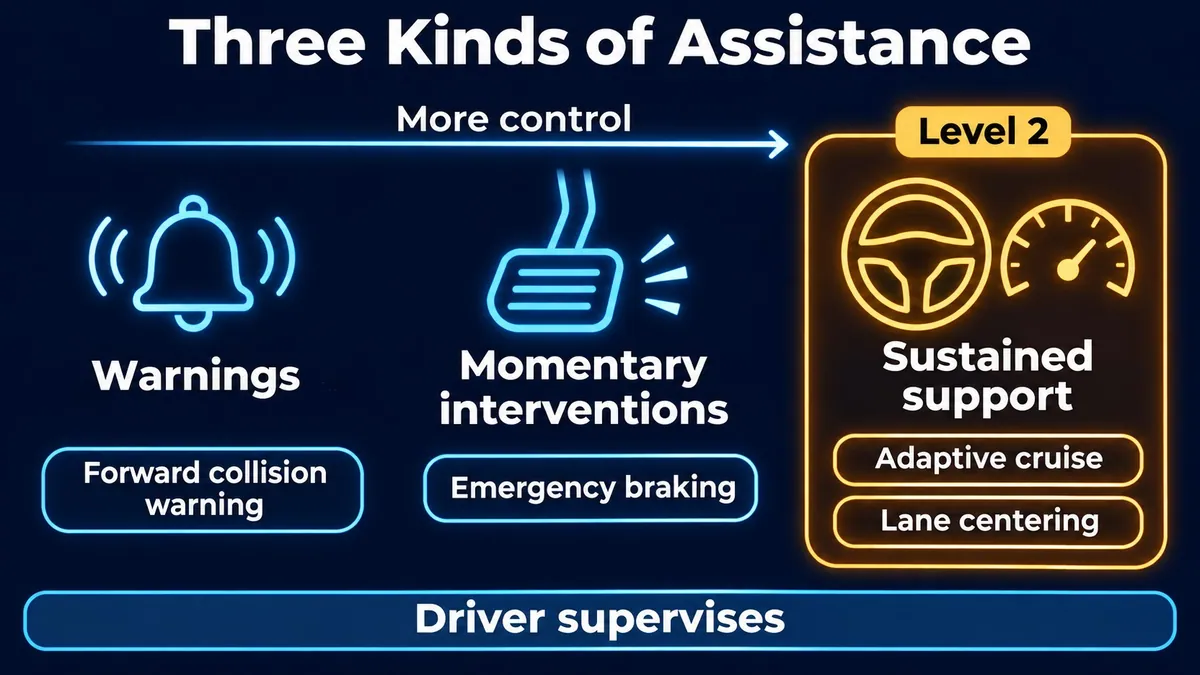
Advanced driver assistance systems, usually shortened to ADAS, are the features that warn the driver or briefly intervene, and the features that steer and control speed while the driver supervises. In SAE terms they span Levels 0 to 2. In every case the human remains the driver and remains responsible.
The useful split is between warnings, momentary interventions and sustained support. A forward collision warning sounds an alert. Automatic emergency braking briefly takes over to brake. Adaptive cruise control and lane centering work continuously, and together they form what is usually called a Level 2 system.
The category is now near universal. Counterpoint Research estimates that 66% of new cars sold worldwide in 2025 had some form of driver assistance or automated driving, and expects that share to reach 94% by 2035.
The core features
Automatic emergency braking, or AEB, uses a camera, radar or both to detect a likely collision and brake if the driver does not. Early systems handled only vehicles ahead at low speed. Newer ones also respond to pedestrians and cyclists, at night and at higher speeds. Emergency braking is the clearest safety case in driver assistance, because it acts in exactly the moments when a human has already failed to react.
Adaptive cruise control keeps a set speed and a set gap to the car ahead, slowing and accelerating with traffic. Many systems now work down to a stop and resume automatically in congestion. Combined with lane centering, adaptive cruise takes over most of the physical work of highway driving, which is also why it can lull drivers into paying less attention.
Lane support comes in steps. Lane departure warning alerts the driver when the car drifts. Lane keeping assist nudges the steering back. Lane centering steers continuously to keep the car in the middle of the lane. Emergency lane keeping intervenes more firmly when the car is about to leave the road or drift into oncoming traffic.
Other common features include blind spot monitoring, rear cross traffic alerts, traffic sign recognition and intelligent speed assistance, which reads the speed limit from signs or maps and warns the driver or limits acceleration.
The newest and most important is driver monitoring. A camera facing the driver tracks head position and eye gaze to judge whether the driver is watching the road, drowsy or distracted. It turns driver assistance from a set of features into a supervised system, because it gives the car a way to check that its human backup is actually there. Older systems inferred attention from small torque inputs on the steering wheel, which are easy to satisfy without really watching the road. A camera looking at the driver's eyes is much harder to fool.
Hands-off is still Level 2
Driver monitoring is what makes hands-off driving possible. GM's Super Cruise, launched in 2017, lets drivers take their hands off the wheel on approved roads because a camera confirms their eyes stay on the road. BMW's Highway Assistant, called Motorway Assistant in the UK, works hands-off at up to 130 kilometers per hour in Europe, and the driver can confirm a lane change with a glance.
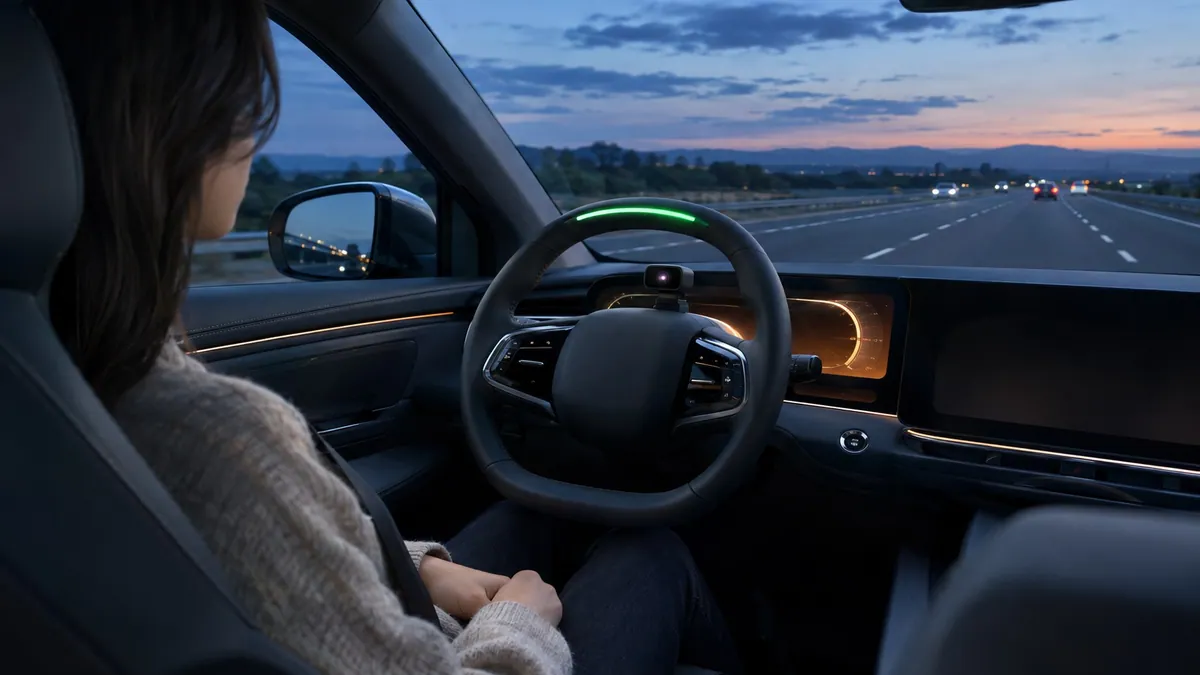
Hands-off does not change who is responsible. These remain Level 2 systems with the driver supervising and liable. Tesla's Full Self-Driving (Supervised) is also Level 2, whatever its name suggests.
Mercedes-Benz illustrates where the market is heading. In January 2026 Mercedes was reported to have dropped its Level 3 Drive Pilot from the facelifted S-Class, and reportedly the EQS, putting its effort into MB.Drive Assist Pro, a system it calls Level 2++, hands-off but eyes-on, with the driver responsible. In the United States it offers that system on the CLA for $3,950 for three years.
The industry is converging on capable Level 2 systems with strong driver monitoring, because they can be sold widely without the cost and liability of Level 3, which the autonomous driving explainer covers.
The rules making it mandatory
Europe moved furthest. Its General Safety Regulation, Regulation (EU) 2019/2144, made a package of driver assistance features mandatory for new vehicle types from July 2022 and for all newly registered cars from July 2024. The list includes intelligent speed assistance, driver drowsiness and attention warning, emergency lane keeping, automatic emergency braking and an event data recorder, with advanced driver distraction warning and pedestrian and cyclist emergency braking phased in later.
The United States is following with emergency braking. NHTSA's rule FMVSS 127, finalized in 2024, requires new light vehicles to avoid hitting a vehicle ahead at speeds up to 62 miles per hour and to detect pedestrians by day and at night, with compliance due in September 2029. Automakers petitioned a federal appeals court to review it, arguing the requirements were not practicable with current technology, and in March 2026 the Department of Transportation told the court it was preparing a proposal to give manufacturers two more years.
The direction is clear even where the dates move. Basic driver assistance is becoming regulated safety equipment, like seat belts and airbags before it.
A rule for Level 2 itself
Until recently, the steering and speed control at the heart of Level 2 had no dedicated international regulation. That changed in March 2024, when the UN's World Forum for Harmonization of Vehicle Regulations adopted UN Regulation 171 on driver control assistance systems, known as DCAS, which entered into force that September.
R171 classifies these systems as Level 2, with the driver responsible at all times. It requires systems to monitor driver engagement and escalate warnings when drivers disengage, and it obliges manufacturers to explain the systems' capabilities and limits to customers, including in advertising and at dealerships.
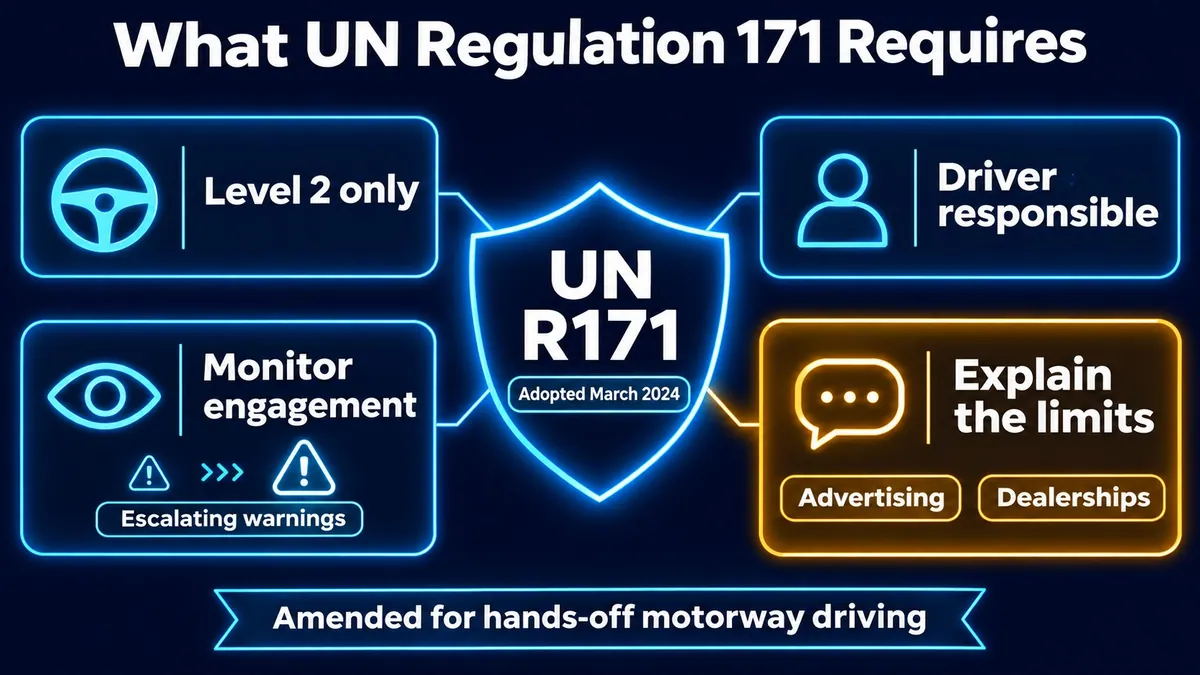
That last requirement targets a recurring problem. Product names and marketing can lead drivers to believe a system does more than it does, which is exactly the misuse regulators found in the Tesla investigation.
R171 has already been amended to allow system-initiated maneuvers and hands-off driving on motorways, and BMW's hands-off system was approved under it in October 2025. Work is now extending the rule beyond the motorway, and as it expands it will decide which features already sold in other markets can be offered in Europe and on what terms.
What the crash evidence shows
In the United States, the main public data comes from NHTSA's Standing General Order, first issued in 2021, which requires manufacturers to report certain crashes involving Level 2 systems and automated driving systems. After an amendment that took effect in June 2025, Level 2 crashes must be reported when they involve a death, a hospital visit, an airbag deployment or a vulnerable road user such as a pedestrian.
NHTSA itself warns against reading those reports as crash rates. The counts are not adjusted for fleet size, miles driven or operating conditions. Manufacturers with better vehicle telemetry may appear more often simply because they learn about more crashes, and Level 2 crashes may be underreported because automakers' data collection varies.
That means neither critics nor advocates can calculate a reliable Level 2 crash rate from the public data. Company claims fill the gap. GM said Super Cruise drivers had covered more than 700 million hands-free miles by late 2025 with no reported crashes attributed to the system, a claim that has not been independently audited. By April 2026 GM put the total at one billion miles.
The Tesla recall shows how regulators act without a clean rate. NHTSA's investigation looked at how the system was designed and used, found foreseeable misuse and pressed for stronger engagement controls. Its follow-up query examined crashes after the remedy, its own tests of updated cars and the fact that drivers could switch parts of the fix off.
The pattern is likely to repeat. As more cars carry capable Level 2 systems, regulators will increasingly judge them on how well they keep drivers engaged as well as on how well they drive.
How testers grade the systems
Consumer testing has moved the same way. Euro NCAP's assisted driving gradings score two things, assistance competence, which includes how the system manages the driver, and safety backup, which covers how it responds when things go wrong.
In June 2025 Euro NCAP rated the Porsche Macan, Toyota bZ4X, Kia EV3 and Renault 5 Very Good. It rated the Volvo EX30 Moderate, criticizing alerts shown on the touchscreen and the lack of a lockout after repeated hands-off warnings. It also rated the Tesla Model S Moderate, with 30% for assistance competence against 94% for safety backup, and said Tesla was misleading consumers about Autopilot through its name and marketing.
The lesson is that a system can drive well and still score badly. If it lets drivers disengage, confuses them about its limits or resists their attempts to take back control, it fails the part of the test that matters most for a supervised system.
The business of driver assistance
The basic features are becoming standard equipment, so the business is in the advanced ones. GM reported more than 500,000 active Super Cruise users at the end of the third quarter of 2025, with more than 750,000 miles of compatible roads in the United States and Canada and a subscription of $25 a month after a three-year trial.
Tesla reported 1.1 million active Full Self-Driving users at the end of 2025, most of them owners who bought it outright, about 12% of the cars it had delivered. Since February 2026 it has sold FSD only by subscription.
Subscriptions make driver assistance a recurring software business. They also make it a long-term responsibility. Every update changes how the system behaves for millions of drivers, and regulators can require changes long after a car is sold, as the Tesla recall showed. That puts software validation, release management and data collection from the fleet at the center of the business, alongside the features themselves.
Hardware choices follow from that. Automakers that want to keep adding features by software need cameras, radar, computing and driver monitoring capable of supporting them for the life of the car, which ties driver assistance to the sensor and compute choices covered elsewhere in this series.
What driver assistance really means
Driver assistance is the part of vehicle automation that already reaches almost every buyer. It saves lives through simple features like emergency braking and lane keeping, and it is becoming a revenue stream through hands-off systems sold by subscription.
The hard problem is the human. The useful questions for any program are how the system keeps the driver engaged, how clearly its limits are explained, how it will meet Europe's and America's rules as they tighten, and what evidence beyond the company's own claims shows it is safe.
Words you will hear
ADAS. Advanced driver assistance systems. Features that warn, briefly intervene or support steering and speed while the driver stays responsible.
AEB. Automatic emergency braking. Brakes the car when a collision is likely and the driver does not react.
Lane centering. Continuous steering that keeps the car in the middle of its lane.
Driver monitoring. A driver-facing camera system that checks whether the driver is watching the road and alert.
DCAS. Driver control assistance systems, the Level 2 steering and speed functions regulated by UN Regulation 171.
GSR. The EU General Safety Regulation, which made a package of driver assistance features mandatory in new cars.
Standing General Order. NHTSA's requirement that manufacturers report certain crashes involving Level 2 and automated driving systems.
This article is part of the AutomotiveCloudWatch Explained library. Before it, read Autonomous Driving [Explained]. After it, read Sensor Fusion [Explained], In-Cabin AI [Explained] and Features on Demand [Explained]. It sits on the Autonomy learning path.
If this helped, subscribe free at automotivecloudwatch.com to get each new explainer when it publishes.
All opinions are my own and do not reflect those of my employer.
Related research


Get the next Executive Briefing by email
Each new briefing, in your inbox.
Subscribe