Signals · Article · Automotiveシグナル · 記事 · 自動車
Element Bought the Payment, Not the Middleware
Car IQ’s fleet product runs on telematics, not BlackBerry IVY. In vehicle payments, the value now sits above the data pipe.
The Assumption Behind the Deal
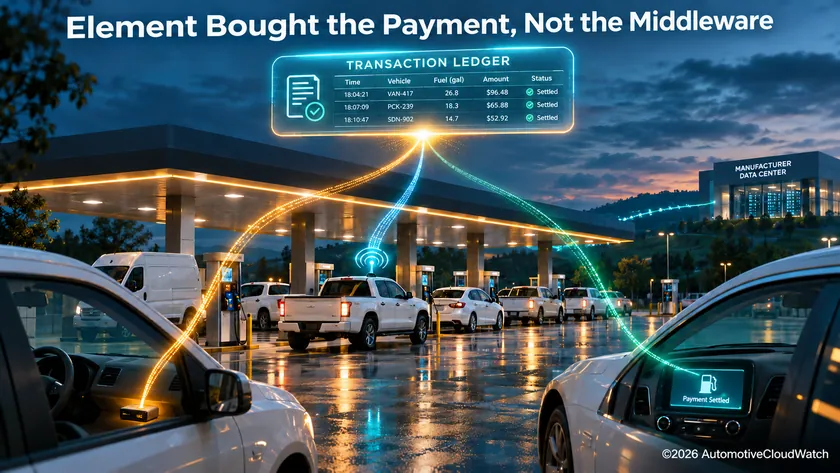
When Element Fleet Management bought Car IQ for about $80 million, a reasonable reading spread through the connected vehicle world. Car IQ had been a showcase partner for BlackBerry IVY, the in-vehicle data platform BlackBerry built with AWS. So Element must have bought a product that depends on IVY, and IVY must now be heading into a fleet of 1.56 million vehicles from many automakers.
A reader raised exactly that in the ACW chat, and it is worth taking seriously because BlackBerry’s own language invites it. The public record points the other way. Car IQ’s fleet product runs on telematics clouds and a phone app, with no new software inside the vehicle.
The more useful point sits underneath the correction. Element did not pay for a data pipe. It paid for vehicle identity, merchant acceptance and a reconciliation ledger, the layer that works no matter how the data arrives. That shift tells automakers, suppliers and fleet operators where the money in vehicle payments is moving.
What Element Paid For
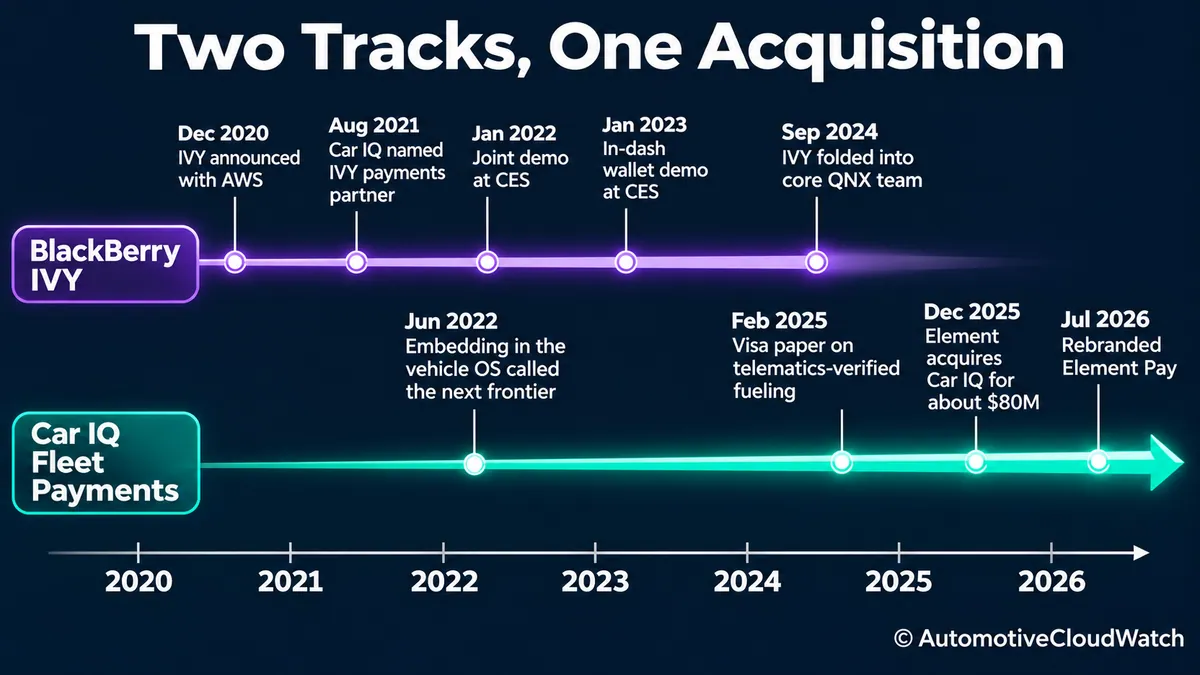
Element announced a definitive agreement to acquire San Francisco based Car IQ on December 2, 2025, and closed on December 31. Element’s full-year results, as reported by Global Fleet, put the price at about $80 million net of working capital adjustments and vehicles under management at 1.56 million. Car IQ became a subsidiary of Element Mobility, and by July 2026 Fleet Auto News reported it had been rebranded Element Pay.
Element described the technology as letting a vehicle start, authenticate and complete a merchant transaction without a card or PIN, built on Car IQ’s Know Your Machine identity platform. When Automotive Fleet asked chief digital and product officer David Attard how the deal would affect Car IQ’s partnerships, the question named Visa, Verra Mobility, Sunoco and Car IQ’s OEM integrations. BlackBerry was not on the list. Attard said Element would assess each partnership against shared clients, which is not how a buyer describes a dependency the product cannot run without.
Where the IVY Story Comes From
The IVY connection was real. BlackBerry and AWS announced IVY in December 2020 as an intelligent vehicle data platform built on QNX, designed to normalize sensor data inside the car and give developers one interface to it. In 2021 BlackBerry named Car IQ an IVY partner for vehicle-based payments, and the two showed an integration on automotive-grade hardware at CES 2022.
BlackBerry’s release on that partnership explains the dependence reading. It said Car IQ’s authentication drew on IVY’s in-vehicle edge computing and direct access to vehicle sensors, and that IVY gave Car IQ common APIs to vehicle data regardless of automaker or model. That describes what IVY added to one embedded integration. It does not say Car IQ needs IVY to function, and no BlackBerry release, blog post or investor document since 2021 says so.
At CES 2023 Car IQ demonstrated what it called the first embedded vehicle wallet powered by IVY, an in-dash wallet for fuel, tolls, parking and charging. That was an OEM-grade consumer demonstration. No automaker announced it shipping in a production vehicle, and it is not the fleet product Element bought.
Car IQ’s founder framed the order of events at the time. In a June 2022 Mastercard interview, Sterling Pratz said Car IQ drew connected vehicle data from automakers and other providers, and he called embedding into the vehicle operating system the company’s next frontier. A next frontier is something a company does not yet depend on.
Three Pipes Into a Vehicle
Any vehicle-initiated payment needs trusted data about the vehicle at the moment of purchase. That data reaches a payment platform through one of three pipes, and each one is controlled by a different party.
The first pipe is aftermarket and fleet telematics, controlled by the fleet operator. This is where Car IQ’s fleet business lives. Car IQ says it integrates with dozens of telematics platforms, and partner documentation from Azuga, Fleetio and the Geotab Marketplace describes a cloud connection that needs no additional hardware. A February 2025 Visa whitepaper describes Car IQ confirming at the pump that the right vehicle is present and checking its tank size and fuel level before approving. Drivers start the transaction on a phone, and Custom Fleet president Chris Tulloch said in July 2026 that the payment “just happens in the background automatically.”
The second pipe is the automaker’s own cloud, reached through an OEM data API. The vehicle’s factory modem sends data to the automaker, and partners pull it cloud to cloud. Samsara opened this route with General Motors in 2022 and with Stellantis through Mobilisights in January 2025, offering fleets hardware-free access to factory telematics. Coverage grows brand by brand, one data agreement at a time.
The third pipe is embedded middleware such as IVY, controlled by the automaker at design time. It reads signals inside the vehicle and offers the richest, hardest to spoof data. It also exists only in vehicles built with it. BlackBerry’s announced IVY programs all sit at the OEM or Tier 1 level, from the PATEO cockpit for Dongfeng’s Voyah to Bosch’s demonstration cockpit, Mitsubishi Electric’s FLEXConnect and Foxconn’s MIH platform. In 2024 WardsAuto reported that IVY needed the compute headroom of newer chipsets, putting realistic production headway in 2025 to 2026.
Mapped this way, the deal makes sense. A payment layer built on the first two pipes reaches whatever a client already drives. A layer that required the third would reach only the vehicles whose automakers chose it.
Why a Lessor Cannot Pick the Third Pipe
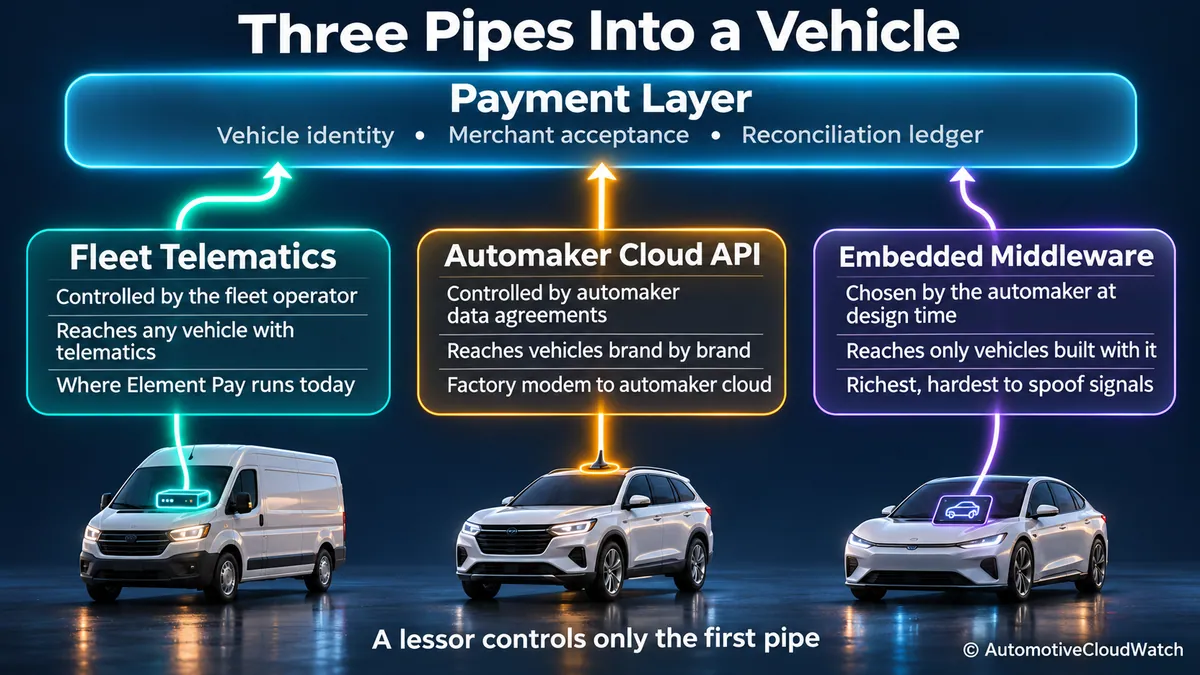
Element finances and manages vehicles its clients order from many brands. It does not control the software stack inside a leased pickup or van, and it cannot flash a middleware layer onto vehicles whose automakers never designed it in. A mixed-OEM fleet is therefore not an argument for IVY everywhere. It is the reason Car IQ built its fleet product on telematics in the first place.
BlackBerry’s own disclosures point the same way. On its September 2024 earnings call, the company said automaker software delays had hit IVY even harder than QNX and that material IVY revenue was unlikely in the near term. It also folded IVY’s sales and R&D into the core QNX team.
IVY still appears inside the QNX segment of BlackBerry’s fiscal 2025 annual report. The growth story BlackBerry tells investors now centers on QNX royalties and the Alloy Kore platform built with Vector, which won its first design win with Coretura in September 2026.
The Case for Going Embedded
The instinct behind the IVY reading is right about direction, even if it is early on timing. Pratz argued in 2022 that native embedding secures data provenance from the actual sensors and improves privacy and latency. A payment authenticated by signals read inside the car is harder to fake than one inferred from a cloud feed that can lag by minutes. When Foxconn’s MIH consortium selected IVY in January 2024, it pitched fleet management built into the vehicle from the factory.
Automakers are moving on in-vehicle payments too. In November 2025 Verra Mobility launched AutoKinex for in-vehicle payments and partnered with Stellantis on tolling. Attard told Automotive Fleet that Element intends to innovate alongside OEMs and payment networks. The realistic shape is layered, with telematics carrying the fleet today, OEM cloud APIs widening coverage, and embedded middleware becoming one more input for the vehicles that ship with it.
Who Owns the Pipe
Element paid for the parts of vehicle payments that work across every brand. Identity, merchant acceptance and the ledger are hard to build and slow to replicate. The pipes underneath them are becoming interchangeable inputs.
For fleet operators, that means the payment decision no longer has to wait on which automakers embed which platforms. For automakers, it is a harder message. A data platform inside the car earns its place in a fleet deal only if it delivers something the automaker’s cloud API cannot.
So which signal, available only inside the vehicle, would make a fleet pay for embedded data instead of settling for the cloud feed it already has?
If you have evidence of IVY or any embedded platform running in a production fleet payment deployment, bring it to the ACW chat.
All opinions are my own and do not reflect those of my employer.
Related research

Get the next Executive Briefing by email
Each new briefing, in your inbox.
Subscribe