Signals · Article · Robotics and Physical AIシグナル · 記事 · ロボティクスとフィジカルAI
Half the Humanoid Is a Car Part
Barclays says brawn is half the cost of a humanoid robot. The companies that make it at scale already sell to automakers.
The Line in the Report That Matters Most to Automotive
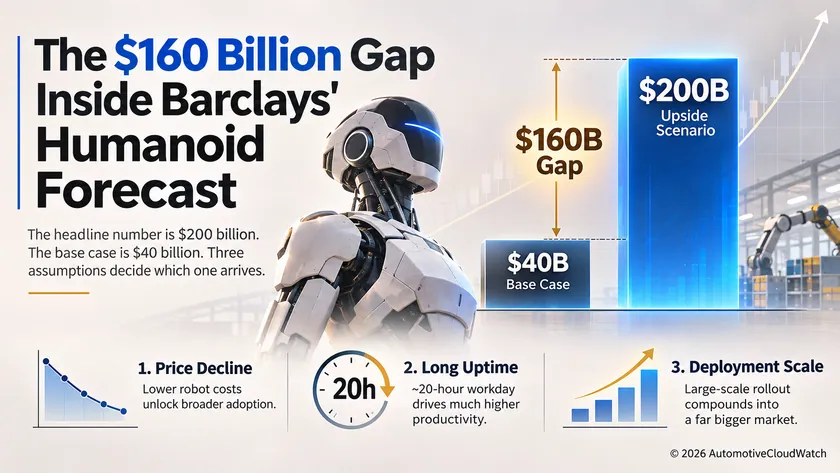
Most coverage of Barclays’ humanoid research fixes on the market size, $200 billion by 2035 in the optimistic case and $40 billion in the base case. The line that matters more for automotive sits further down. Barclays says actuators, the robot’s muscles, account for roughly half of a humanoid’s production cost.
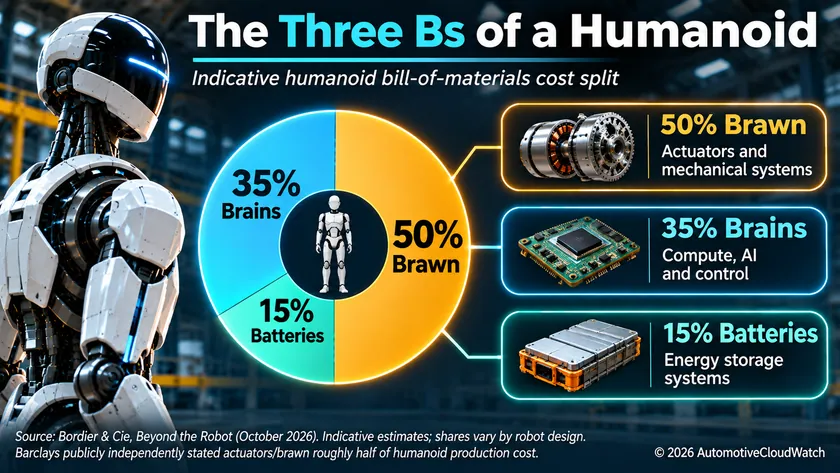
Zornitsa Todorova, who leads thematic research at the bank, splits the robot into brains, brawn and batteries. Brains are the compute and the models, where most of the attention and most of the venture money go. Brawn is the actuators, motors, gears and sensors that turn a decision into torque at a joint. Barclays argues that physical AI shifts value from software back to hardware, and names actuator makers, precision component suppliers and automation companies as beneficiaries that were largely absent from AI’s first wave.
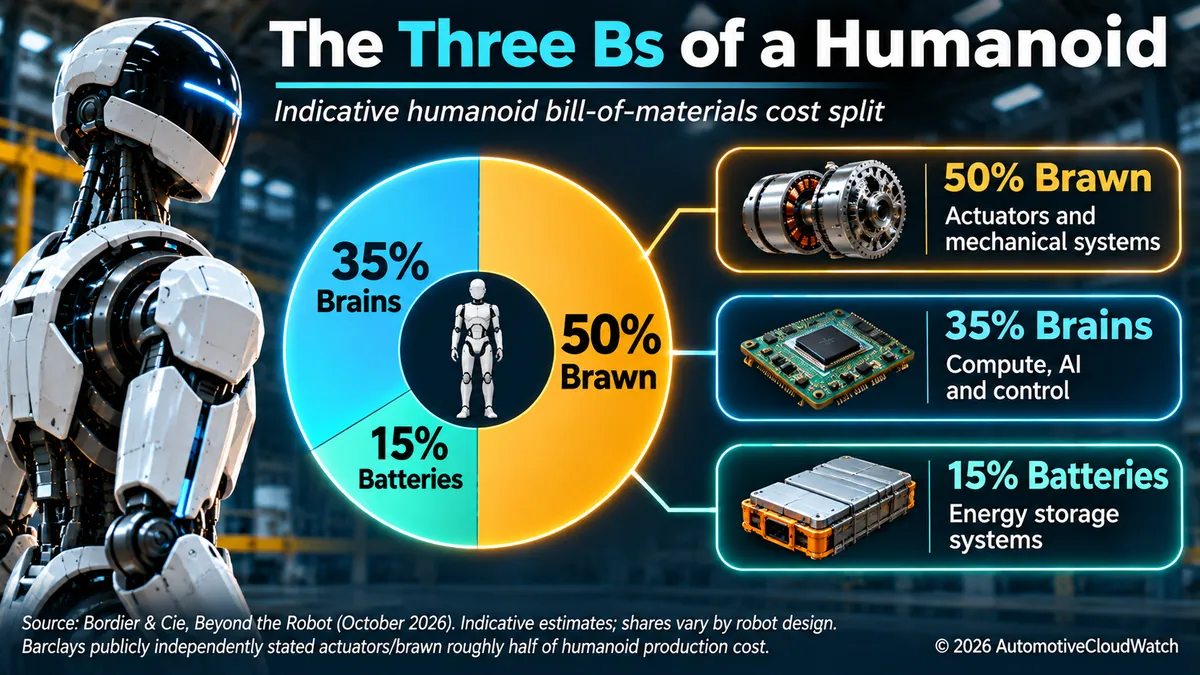
The companies that fit that description are, to a striking degree, automotive suppliers. Barclays comes close to saying so when it argues Europe could hold an edge in the humanoid supply chain because of its precision engineering and automotive manufacturing expertise, especially in actuators.
That claim is no longer theoretical. Two of the largest automotive suppliers in the world signed humanoid actuator deals this year, and a Japanese gear maker began reporting humanoid orders as their own line late last year.
Two Suppliers Already Moved
At CES in January, Hyundai Mobis announced it will supply actuators for Boston Dynamics’ next-generation Atlas, its first commercial customer in robotics components. Mobis says actuators make up about 60% of the material cost of a humanoid, a higher share than Barclays uses. Hyundai Motor Group has announced a North American robot factory with capacity for 30,000 units a year, and Mobis plans to expand from actuators into grippers, sensors, controllers and battery packs.
In May, Schaeffler became the preferred actuator supplier to Humanoid, the UK robot maker. Under a five-year agreement it will cover more than half of Humanoid’s joint actuator demand for wheeled platforms through 2031, which DC Velocity reported as a seven-digit number of actuators. Schaeffler is also the customer, starting deployment of Humanoid’s robots at its Herzogenaurach and Schweinfurt plants in December 2026.
Read the two deals side by side and a pattern appears. Neither supplier is building the robot. Each is building the part that sets its cost, and each is doing it with the manufacturing system it already runs for automakers.
Japan shows the same pull at the component level. Harmonic Drive Systems, whose strain wave gears sit inside robot joints, booked about 1.3 billion yen in humanoid orders in a single quarter of 2025, guided to 2.5 billion yen for its fiscal year to March 2026, and told analysts orders could double or triple the year after, with more than 15 potential humanoid customers.
Those are small numbers next to an automotive supplier’s revenue. They are large numbers next to a market Barclays sizes at $2 billion to $3 billion today.
Why a Car Supplier Knows How to Build a Joint
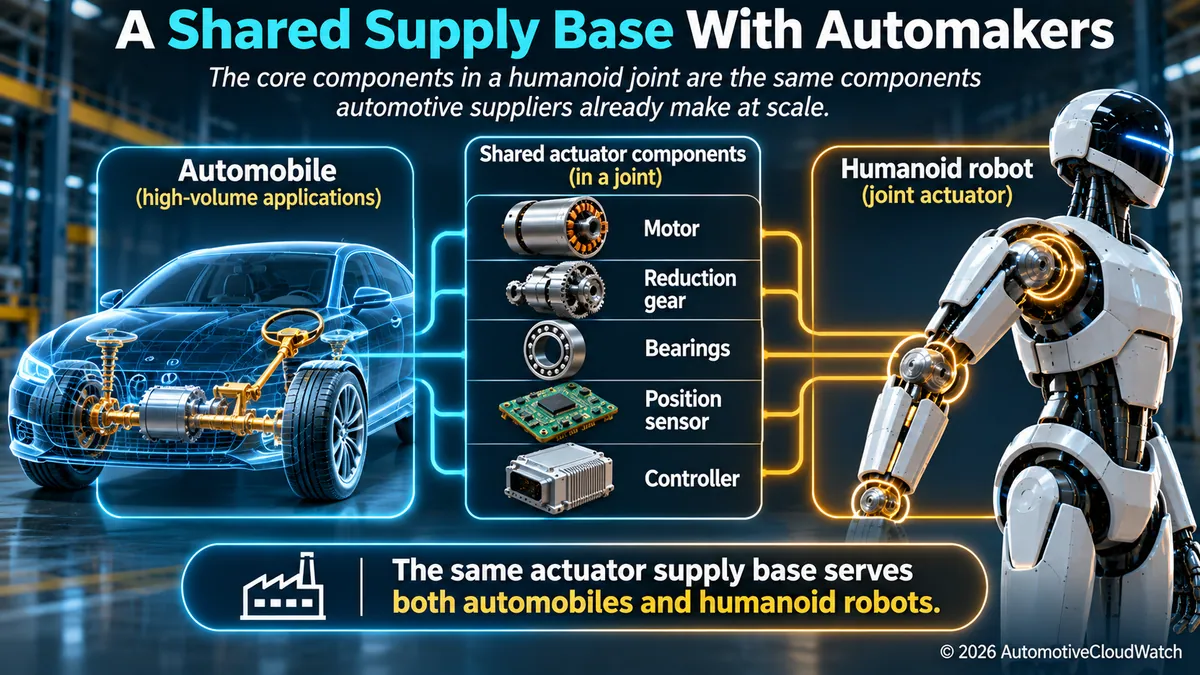
An actuator is a motor, a reduction gear, bearings, a position sensor and a controller packed into a joint. Every one of those is a part automotive suppliers already make by the million, for electric power steering, brake-by-wire, seat adjustment and e-axles. The competence that matters is not invention. It is holding tight tolerances at high volume and low defect rates under IATF 16949, a discipline humanoid makers have no reason to rebuild from scratch.
That is also why the cost assumption in Barclays’ forecast runs through suppliers. A humanoid that costs about $100,000 to build today, down from roughly $3 million a decade ago, still carries half that cost in brawn. Reaching the price points the bull case needs means driving actuator cost down on a curve that looks like automotive component cost reduction, not semiconductor scaling.
The Magnet in Every Joint
The automotive analogy brings automotive risk with it. Most high-torque actuators use permanent magnet motors, and the rare earths in those magnets are refined overwhelmingly in China. When Beijing put seven rare earth elements and related magnets under export licensing in April 2025, Elon Musk told Tesla’s investors that Optimus was affected because its arm actuators use permanent magnets.
Automakers met the same constraint in EV traction motors, which is why magnet-light and rare earth free motor designs have become a point of supplier differentiation. Humanoids carry that exposure in every actuated joint, and a humanoid has dozens of them where an EV has one to four traction motors.
Barclays makes the point at the national level. China leads in humanoid production and deployment, with 85% of 2025 deployments by the bank’s count, and access to critical minerals is part of that lead. Europe’s claimed edge is precision engineering. Precision engineering without secure magnets is a design constraint, and it will shape which suppliers win.
Sizing the Bet
For suppliers facing flat vehicle volumes and delayed EV programs, humanoid actuators look like a rare adjacent market that rewards what they already do well. The early movers share a playbook, one anchor customer, a supply share commitment, and in Schaeffler’s case the customer’s robots running inside its own plants, which turns the supplier into a reference site.
The risk is volume. Barclays’ base case of $40 billion in 2035 is a real market, but suppliers that build actuator capacity for the $200 billion case are making the bull case bet with their own capital. The battery industry made the same call with announced gigafactory capacity, and not all of that capacity was built.
So the question for a Tier 1 is less whether to enter and more how to size the entry. A program that shares lines, motors and gearing with existing automotive products can grow with the market without stranding capital if demand stays near the base case. A dedicated line wins only if the bull case arrives on time.
Barclays describes physical AI as the theme where value moves from software back to hardware. For the automotive supply base, that may be the most useful sentence in the research. What it leaves open is which suppliers treat the humanoid joint as a new product line, and which treat it as a new customer for products they already make.
All opinions are my own and do not reflect those of my employer.
Related research
Get the next Executive Briefing by email
Each new briefing, in your inbox.
Subscribe