Signals · Article · Automotiveシグナル · 記事 · 自動車
The Rust Excuse Has Moved Up the Stack
Suppliers have qualified the silicon, the compiler and the basic software. What still holds Rust back in automotive is no longer theirs to fix.
For years the case against Rust in a production ECU came down to one sentence. The toolchain is not qualified. That sentence stopped being true in October 2023, and in the three years since, almost every supplier beneath the application layer has removed its own objection. The objections that remain sit higher up the stack, and they now belong to OEMs, Tier 1 safety managers and standards bodies.
In April I argued that automotive organizations need to move to Rust now. This piece asks a narrower question. Layer by layer, which suppliers have actually delivered, where does the certificate stop, and who owns the gap that is left.
The Silicon Vendors Said Yes First
Infineon moved before anyone else. In March 2023 it became the first major semiconductor maker to officially support Rust on its microcontrollers, starting with the AURIX TC3xx and TRAVEO T2G families and publishing peripheral access crates on GitHub. Where Infineon sits makes that sequence matter. TechInsights puts its share of the automotive microcontroller market at 36.0 percent in 2025, up 3.9 points in a single year.
STMicroelectronics followed in February 2025. HighTec brought its ASIL D qualified Rust compiler to ST’s Stellar family, which ST describes as the first 28 nm microcontrollers certified to ASIL D. Renesas came next. In March 2026 HighTec extended its safety qualified Rust and C/C++ toolchains to the Renesas RH850/U2x and showed both languages running in one embedded project at embedded world.
The pattern is consistent across all three. No chipmaker built a qualified Rust compiler itself. Each partnered with toolchain specialists instead. HighTec is the common partner across AURIX, Stellar and RH850, while Ferrous Systems covers several Arm-based families. By the spring of 2026, a Tier 1 sourcing an ECU on any of those families had a qualified Rust toolchain for the silicon.
The Compiler Stopped Being the Objection
The qualification argument ended in late 2023. On October 29 TÜV SÜD certified Ferrous Systems’ Ferrocene toolchain for ISO 26262 at ASIL D, and on November 9 AdaCore announced an ASIL D qualification for GNAT Pro for Rust. HighTec followed in April 2024 with what it called the first ASIL D qualified Rust compiler for the AURIX TC3x and TC4x. It shipped with a preconfigured Cargo build system and a binding to its PXROS-HR safety operating system. Automotive teams now choose among several qualified Rust toolchains, each certified for specific host and target combinations rather than for every chip.
The stronger signal came from the companies that own Classic AUTOSAR basic software. In August 2024 Vector and HighTec integrated Rust application components with MICROSAR Classic Safe on AURIX, with both the basic software and the compiler certified up to ASIL D. In late 2024 Elektrobit added Rust support to EB tresos AutoCore using the Ferrocene compiler, and ETAS said it would use Rust for its future embedded software. In July 2025 Elektrobit, HighTec and Infineon bundled Rust and AUTOSAR Classic into Infineon’s Drive Core package for the AURIX TC4x.
The layers around the basic software have moved as well. QNX added support for Rust applications in its SDP 8.0.3 release in late 2025, covering the core, alloc, backtrace and std crates. Synopsys extended its Silver virtual ECUs to Rust software components, so a Rust SWC can be validated against a generated Classic RTE in software-in-the-loop simulation before hardware exists. In December 2025 HighTec and Intellias, working with Vector and Infineon, ran Rust components beside existing C and C++ in an AUTOSAR Classic demonstrator on an AURIX TC375 without changing the system’s infrastructure.

Qualified Rust reaches every layer except the top.
Read together, these announcements describe a complete hybrid path for the microcontroller. A team keeps its validated Classic configuration, its MCAL and its C code, writes the next software component in Rust, compiles it with a qualified toolchain and integrates it through the generated RTE. Nothing that already works has to be rewritten. The Rust component still needs its own safety case and a toolchain the supplier can maintain for the life of the program, but the rewrite cost that dominated every Rust discussion before 2024 is gone.
Where the Certificate Stops
Above the compiler, the coverage thins quickly. The clearest boundary is the library. Ferrous Systems certified a first subset of Rust’s core library to IEC 61508 SIL 2 in December 2025. Ferrocene 26.02 added ISO 26262 ASIL B in February 2026 and lifted the certified function count from 2,903 to 5,169. The compiler is qualified to ASIL D for its listed targets, but as of its October 2026 release Ferrous Systems has published no core library certification above ASIL B.
That gap matters because tool qualification only gives an assessor confidence that the compiler translates source code faithfully. It says nothing about the library functions an application calls at runtime, which are part of the software being certified. An ASIL D team writing Rust today has three options. It can qualify those functions as software components under ISO 26262 Part 8, verify them inside its own safety case, or use freedom from interference so ASIL D requirements never depend on them. The boundary with existing C code is the other weak point, because every call across it is unsafe Rust by definition.
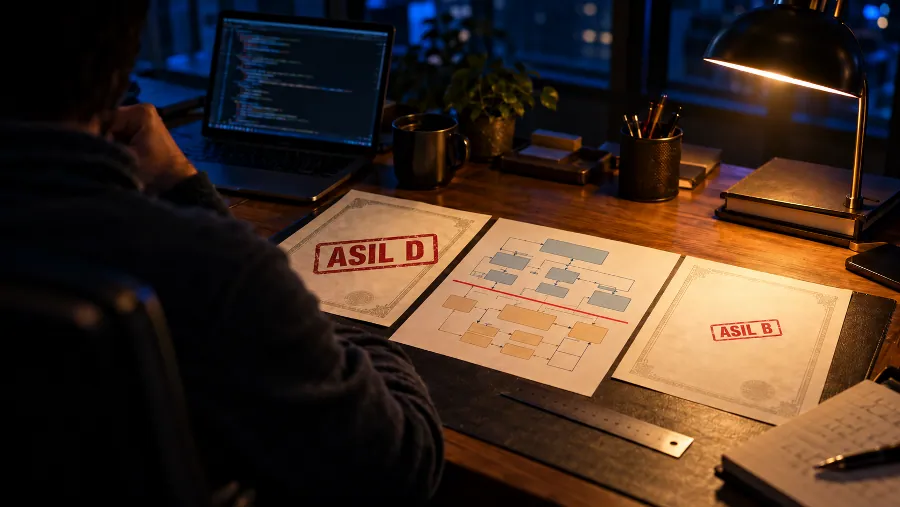
The compiler is qualified to ASIL D. The certified core library stops at ASIL B.
The coding rules lag further behind. MISRA’s response so far is Addendum 6 to MISRA C:2025, which assesses how the existing C guidelines apply to Rust rather than defining rules of its own. The Safety-Critical Rust Consortium, formed under the Rust Foundation in June 2024, is working on guidelines and language subsets. Until one of them produces a Rust standard that assessors recognize, each supplier argues its coding rules from first principles.
AUTOSAR is moving at standards speed. Its Adaptive Platform has carried a Rust document since R23-11, and AUTOSAR classifies it as an explanatory document describing a proposed programming interface. At the R25-11 release event in December 2025, Rust appeared as an outlook topic for the Classic Platform. The Rust integrations that work in Classic projects today come from vendors, not from the standard.
The central computer is further behind than its announcements suggest. Eclipse S-CORE, the open source core stack founded by Accenture, BMW, ETAS, Mercedes-Benz, Qorix and others, announced equal C++ and Rust support with the Ferrocene toolchain in its 0.6 milestone in February 2026. The project’s own notes record that milestone as later revoked over module incompatibilities, and its v0.8 release gate has not yet been developed to an ASIL. Ferrocene did add a qualified target for Red Hat’s in-vehicle operating system in July 2026, an early sign that qualified Rust is heading for high-performance compute as well.
One Production ECU, and It Is Not Safety Critical
The production record is thinner still. The case everyone cites is Volvo Cars, whose low-power processor ECU, presented by Volvo engineers as the first ECU fully written in Rust, ships in the EX90 and Polestar 3. It manages the 12-volt systems that stay on while the car is parked and wakes the electrical system when the driver approaches.
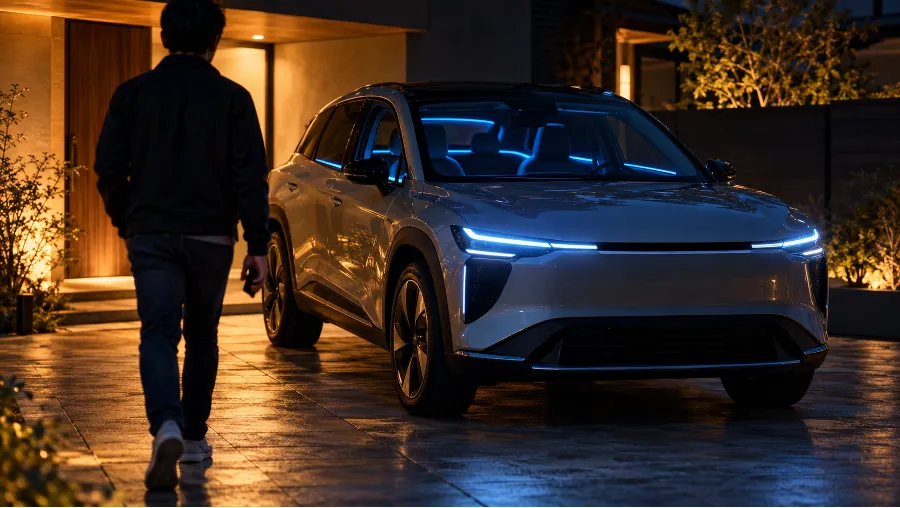
Rust’s best-known production deployment wakes the car. It does not steer or brake it.
It is a genuine milestone, and it is not a safety-critical component. Tweede Golf, which interviewed the ECU’s main software architect, Julius Gustavsson, reports that it carried no safety classification. The industry has shown that Rust can ship at volume in a production vehicle. As of October 2026, I have not found a public case of a Rust component carrying an ASIL rating through a full ISO 26262 safety case in series production.
That missing case is now the binding constraint. Safety managers approve what they can defend to an assessor, and an assessor’s comfort comes from precedent. The first OEM or Tier 1 to document an ASIL rated Rust component in series production will do more for the language than another qualified compiler.
Why the Clock Started in 2026
The regulatory pressure arrived from outside automotive. CISA and the FBI list the lack of a published memory safety roadmap by January 1, 2026 as a bad practice for existing products written in memory-unsafe languages that support critical infrastructure. The guidance is voluntary and exempts products with an announced end of support before January 1, 2030. A vehicle sold this year will be on the road well beyond that date.
Europe adds a sharper edge. The Cyber Resilience Act’s incident reporting obligations have applied since September 11, 2026, and most of its remaining obligations apply from December 11, 2027. Products covered by EU vehicle type approval fall outside the regulation, but aftermarket telematics units, chargers and connected software that are not type approved do not.
The strongest engineering evidence also comes from outside the industry. Google reports that memory safety issues fell from 76 percent of Android vulnerabilities in 2019 to 24 percent in 2024, driven by writing new code in memory-safe languages rather than rewriting old code. Its explanation is that vulnerabilities concentrate in new code and decay as code ages, so the language of the next code matters most.
That finding maps directly onto automotive program timing. The zonal controllers and ECUs that enter production at the end of this decade are being specified and sourced now, and the code written for them will run for the life of each vehicle. Choosing C for that new code means carrying its defect class for another vehicle generation, decided at the moment when switching costs the least.
The View From Tokyo
From Tokyo, the supplier timeline reads differently. HighTec brought its qualified Rust toolchain to the Renesas RH850/U2x in March 2026, nearly two years after it qualified a Rust compiler for AURIX and three years after Infineon first announced Rust support. For programs built on RH850 parts, the qualified Rust path is months old, not years.
Interest has never been the issue. Woven by Toyota was a founding member of the Safety-Critical Rust Consortium in June 2024, alongside Arm, AdaCore, Ferrous Systems and HighTec. In my experience, Japanese automakers and suppliers commit once the full chain is proven on the silicon they already run and a trusted supplier stands behind the integration. On RH850, that chain only closed this year.
That makes 2026 and 2027 the window that matters for Japanese OEMs and Tier 1s. The silicon, compiler and basic software vendors they already buy from have done their part. The decision that remains is internal.
The Question Has Changed Owners
Two years ago the honest answer to whether Rust was ready for automotive was that the supply chain was not. That answer has expired. Silicon vendors, compiler makers, basic software vendors, an RTOS vendor and a simulation vendor have all shipped Rust support, and the compilers carry ASIL D qualification.
What remains is a certified library above ASIL B, a Rust coding standard that assessors accept, a normative Adaptive binding and one published, safety rated production component. None of those will arrive in another supplier press release. They depend on a safety organization inside an OEM or Tier 1 deciding to go first.
The suppliers have every reason to welcome that customer. Each of them shipped Rust support expecting someone to put it into a safety rated production program. The first program to do so will write the safety case that assessors use to judge every program that follows.
So the question for every automotive software leader has changed. It is no longer whether the supply chain is ready for Rust. It is whether your safety organization is willing to become the precedent the rest of the industry is waiting for, or whether it will let a competitor set it.
All opinions are my own and do not reflect those of my employer.
Related research

Get the next Executive Briefing by email
Each new briefing, in your inbox.
Subscribe