Signals · Article · Automotiveシグナル · 記事 · 自動車
Build, Partner or Defer? How Automakers Are Betting on In-Cabin AI
Most major automakers now have an AI assistant in the cabin or one on the way. The real question is whose AI it is.
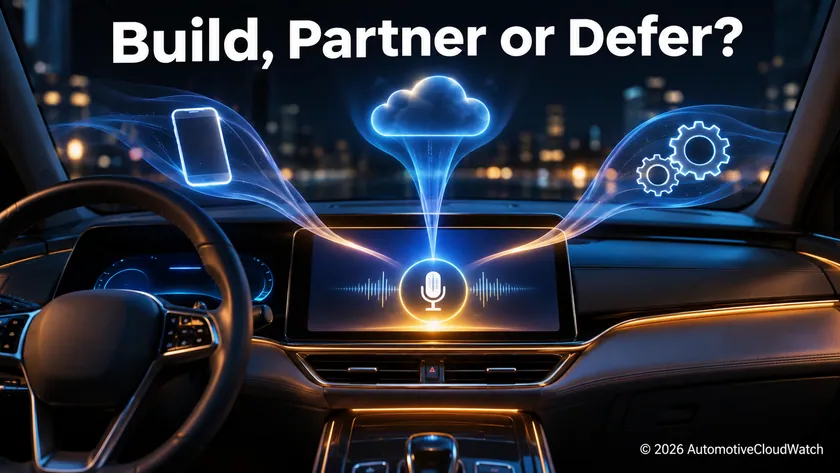
After reading In-Cabin AI [Explained], reader Ishita Tyagi asked for a second piece on the automakers' own bets. The timing is right. Their choices have split sharply in the past two years. Some automakers are building their own assistants. Most are renting a large language model from Google, OpenAI, Amazon or xAI. A few are betting that the phone will keep the screen anyway.
This piece maps who chose what, as of November 2026, and what each bet says about how that company sees the cabin. The companion piece, Who Will Pay for In-Cabin AI?, covers the business models.
Three strategies
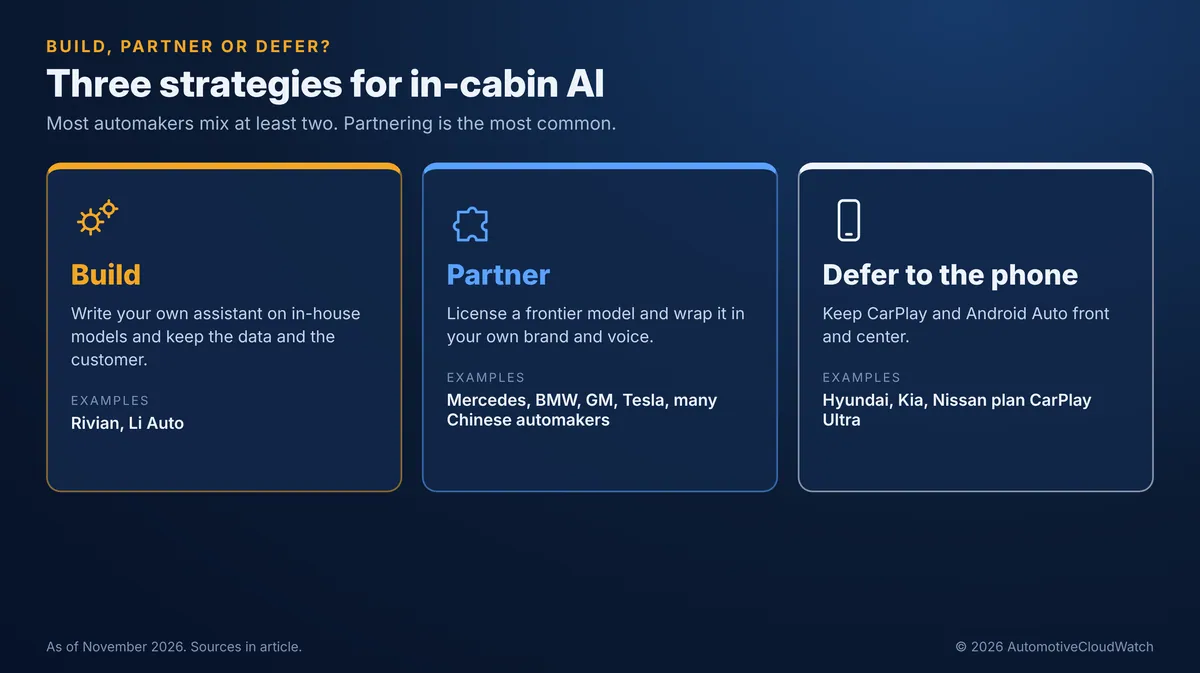
The bets fall into three groups, and most automakers mix at least two.
Build. Write your own assistant, often on in-house models, and keep the data and the customer. Rivian and Li Auto lean this way.
Partner. License a frontier model and wrap it in your own brand and voice. Mercedes with Google and OpenAI, BMW with Amazon, GM with Google and Tesla with xAI all sit here. So do many Chinese automakers, several of which added DeepSeek within weeks of its release in early 2025.
Defer to the phone. Keep Apple CarPlay and Android Auto front and center and let the phone's assistant do much of the talking. Hyundai, Kia and Nissan are among the brands still listed as planning to support CarPlay Ultra, Apple's version that takes over every screen.
The partner group is the largest, likely because building a competitive model is expensive and slow. The open question is whether partners will end up owning the relationship, much as Apple did with CarPlay.
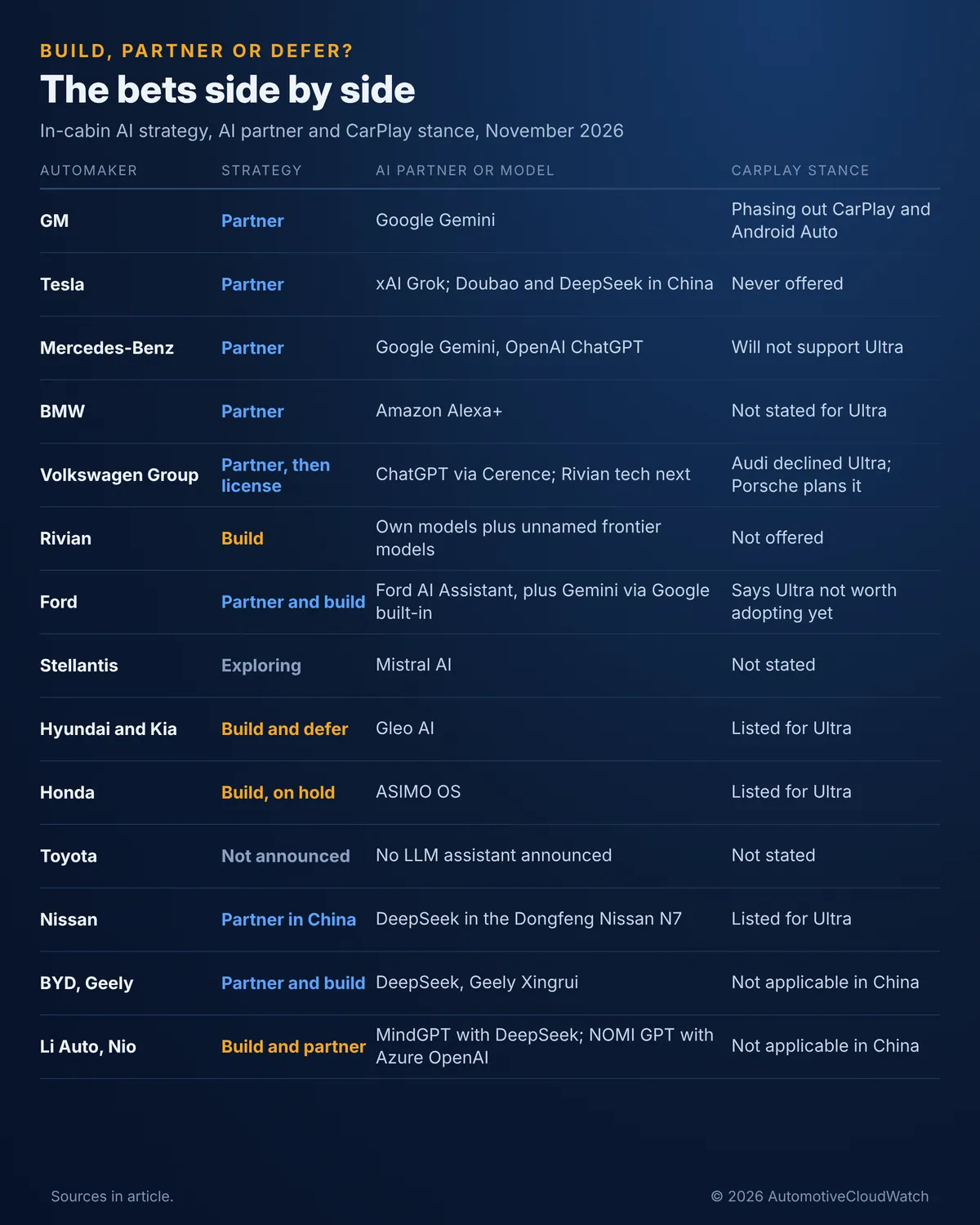
The bets side by side
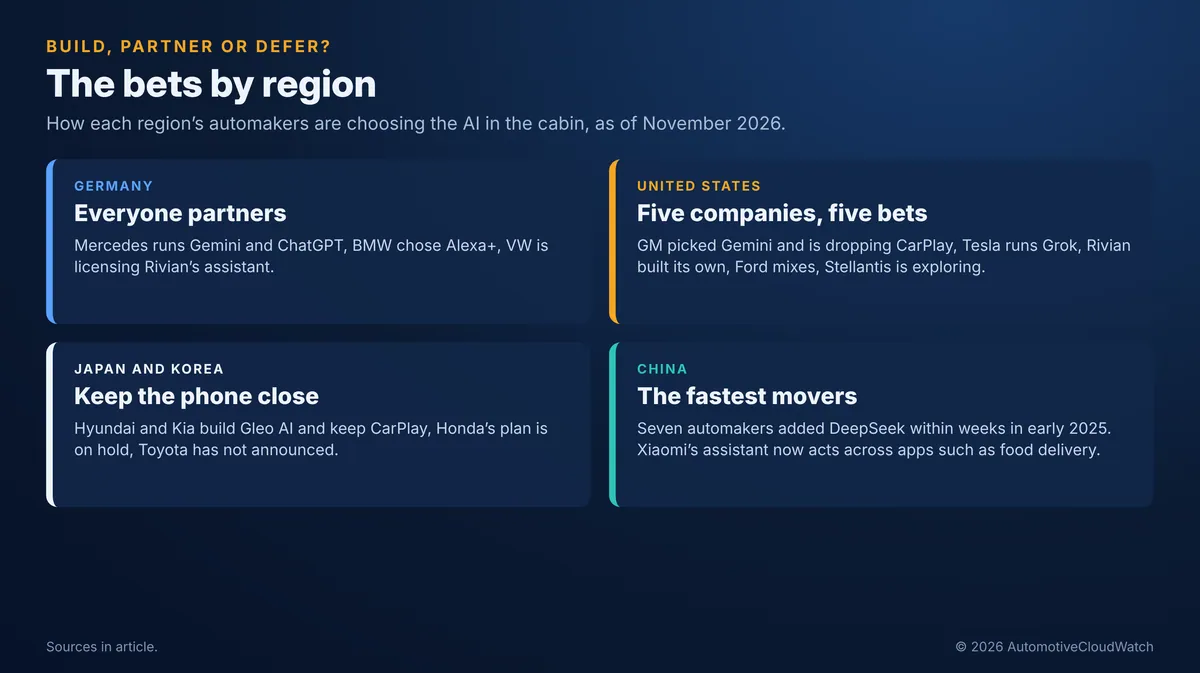
Germany: everyone partners
The three German groups all rent their language models. Only Porsche plans to give Apple the whole dashboard.
Mercedes-Benz runs two models at once. The 2026 CLA, the first car on MB.OS, uses Google Cloud's Automotive AI Agent, built on Gemini, for navigation and conversation.
Earlier MBUX cars got ChatGPT through Microsoft Azure OpenAI as a free update to more than 3 million vehicles. The 2027 C-Class combines ChatGPT, Bing and Gemini in one assistant. Mercedes said in 2025 it will not support CarPlay Ultra.
BMW chose Amazon. BMW calls itself the first automaker to integrate Alexa+ into its Intelligent Personal Assistant. It showed the system on the Neue Klasse iX3 at CES 2026. BMW said it would come to Germany and the US with the iX3's market launch.
Volkswagen Group took two routes. VW and Audi added ChatGPT to their voice assistants in 2024 through Cerence and Azure OpenAI, reaching about 2 million existing Audis alone. For the future, VW is licensing Rivian's AI assistant technology through the companies' joint venture. Audi declined CarPlay Ultra. Porsche, also in the group, plans to support it.
The US: the widest spread of bets
Five companies, five different bets.
GM is all in on Google and out on CarPlay. Gemini is rolling out over the air to about 4 million US vehicles, and GM is phasing CarPlay out of future models, as the companion piece explains.
Tesla uses xAI at home and Chinese models in China. Grok arrived in US cars in July 2025 and works over Wi-Fi or with a Premium Connectivity plan, with no separate charge. It reached European markets in February 2026, where it now handles navigation commands. In China, Tesla added DeepSeek for chat and began rolling out ByteDance's Doubao for car commands in July 2026. Tesla has never offered CarPlay.
Rivian built its own. Rivian Assistant runs on Rivian's own models, supplemented by frontier models it has not named. It began rolling out to R1 owners in May 2026. Volkswagen is now licensing it.
Ford is moving step by step. Its AI Assistant is expanding to about 8 million more eligible vehicles through the Ford and Lincoln apps. An in-car version arrives in select systems from 2027, and Gemini is coming to cars with Google built-in. CEO Jim Farley said in September 2025 that CarPlay Ultra is not worth adopting yet.
Stellantis has said the least. It announced in February 2025 that it was exploring an in-car assistant with Mistral AI that would work as a voice owner's manual. We found no launch date since then.
Japan and Korea: keep the phone close
Hyundai, Kia and Honda are building their own AI, but they are not pushing the phone out of the dashboard.
Hyundai and Kia are doing both. Pleos Connect with Gleo AI, a language model assistant, arrives in the US on the 2027 Tucson, and it still supports wireless CarPlay and Android Auto. Hyundai, Kia and Genesis are also listed as planning to support CarPlay Ultra.
Honda's bet is on hold. Honda unveiled ASIMO OS with a generative AI assistant for its 0 Series EVs. It then canceled the 0 SUV and 0 Saloon in March 2026 and has not named a new launch vehicle.
Toyota and Nissan are cautious. Outside China, neither has launched a large language model assistant that we could confirm. In China, the Dongfeng Nissan N7 has shipped with DeepSeek since its April 2025 launch.
The reason is volume. These companies sell huge numbers of cars to buyers who expect CarPlay, and so far they appear unwilling to risk those sales to own the screen.
China: the fastest movers
Chinese automakers treat the AI assistant as a core part of the car, and they switch models quickly. In February 2025, within weeks of DeepSeek's release, BYD, Geely, Great Wall, Chery, Leapmotor, SAIC and Dongfeng Nissan all announced DeepSeek integrations.
Reuters has reported a Beijing push to embed AI across the auto industry.
BYD put DeepSeek into its Xuanji vehicle software.
Geely built Eva, an AI agent on its Xingrui model, first in the Galaxy M9 and Lynk & Co 10 EM-P.
Li Auto runs its assistant on its own MindGPT and lets drivers switch to DeepSeek.
Nio has had its NOMI assistant since 2017 and moved it to a language model, NOMI GPT, in April 2024, built in part on Microsoft's Azure OpenAI Service.
Xiaomi brought Super XiaoAI to the SU7 Ultra and YU7, and it can act across apps such as Meituan and Douyin.
Huawei ships the XiaoYi AI agent in its HarmonySpace 6 cockpit, used in Dongfeng's Yijing X9.
Xiaomi's approach stands out. An assistant that can order food or book a ride from the driver's seat turns the cabin into a storefront. In my view that is the business model Western automakers are still looking for.
Who is likely right
No strategy has won yet, but each carries a clear risk.
Builders keep the data and the brand, but they need to keep pace with frontier labs that spend far more. Rivian licensing its assistant to VW suggests a builder can turn that cost into revenue.
Partners get the best model fast, but they risk the CarPlay problem in a new form. If drivers come to trust Gemini or Alexa more than the car brand, the partner owns the relationship.
Deferrers keep buyers happy today. They also hand the dashboard to Apple and Google, perhaps for good.
The companion piece asked who pays for the cabin. This one shows who controls it. My bet is that the two answers converge, because the company that owns the conversation will own the revenue.
What to watch in 2027
Whether BMW's Alexa+ and the 2027 C-Class assistant ship broadly, and whether either carries a fee.
Whether GM's CarPlay removal costs it sales as gas models are refreshed.
Whether a Hyundai or Kia model ships with CarPlay Ultra.
How many automakers follow VW in licensing an assistant from another automaker rather than a tech company.
Whether Western brands copy China's assistants that book and pay from the driver's seat.
Build, partner or defer. Which would you choose for your company? Tell me in the comments. Know someone planning a cockpit roadmap? Send this their way, and subscribe for the next piece.