Signals · Article · Automotiveシグナル · 記事 · 自動車
Who Will Pay for In-Cabin AI?
The cabin is turning into a software product. GM is making money from it, and Tesla is making money from the software next to it. Most automakers are not, yet.
Reader Ishita Tyagi asked a question on In-Cabin AI [Explained] that deserves a full answer. She called configurable HMIs and in-cabin AI one of the most exciting things self-driving software is unlocking, and noted Apple CarPlay got there first. Her question is how automakers will run a software business on top of it, and whether it is an untapped market.
The short answer is yes, though Apple and Google already hold much of the screen. The market is large and mostly untapped, partly because the first attempts to tap it went badly. This piece covers the business models, the early numbers and where the money is most likely to come from.
Why the cabin became a product
The cabin used to be fixed at the factory. Its screens, menus and voice commands did what they did on the day the car shipped. Three changes broke that.
Configurable HMIs. Large screens running a central operating system can be redesigned after the sale.
Over-the-air updates. GM is offering Google Gemini to about 4 million eligible US vehicles from model year 2022 and later. The car you bought gets a new assistant without a dealer visit.
Large language models. Assistants that understand natural speech make the cabin something you talk to, not something you poke at. S&P Global Mobility expects light vehicles with generative AI chatbots to grow from about 2.7 million in 2024 to nearly 28 million by 2031.
Apple saw the opening first. CarPlay put the phone's apps on the car's screen. Apple said in 2022 that almost 80 percent of US new car buyers would only consider a car that has it.
That is the precedent Ishita pointed to, and it is also the automakers' problem. The most valuable screen in the car often runs someone else's software.
Six ways the cabin makes money
Automakers and their suppliers are trying six revenue models in and around the cabin. So far only two, connectivity bundles and service subscriptions, have produced large disclosed revenue for automakers.
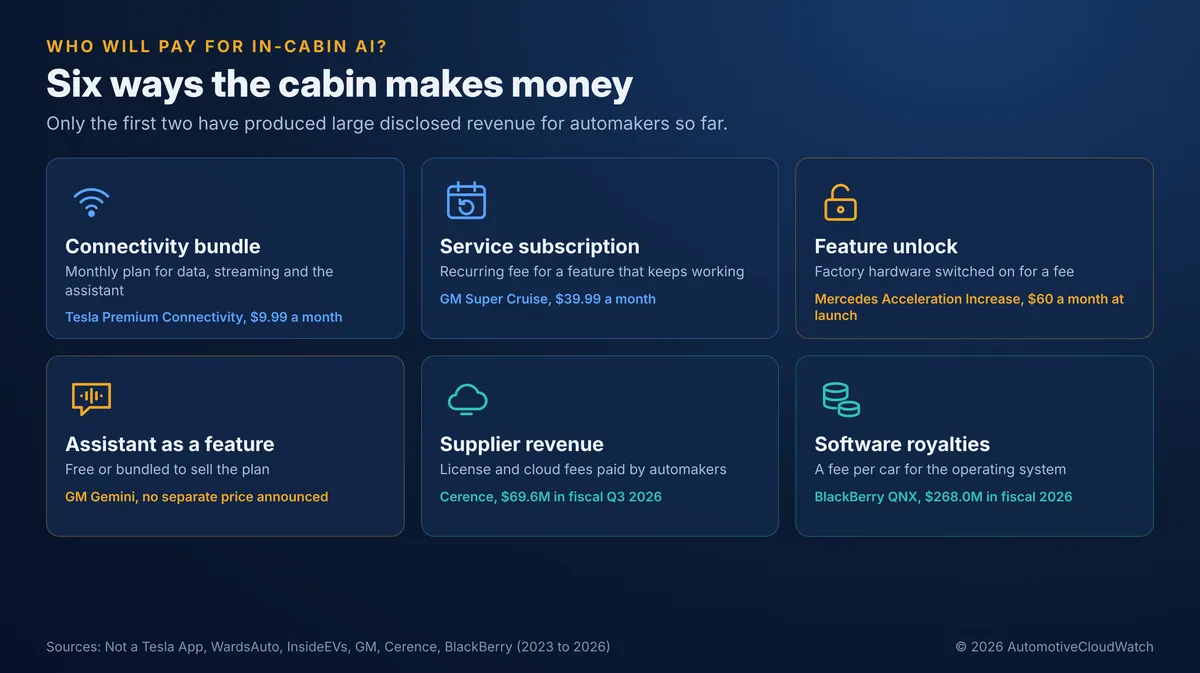
Connectivity bundle, a monthly plan for data, streaming and the assistant. Tesla Premium Connectivity, which includes Grok, costs $9.99 a month or $99 a year.
Service subscription, a recurring fee for a feature that keeps working. GM Super Cruise hands-free driving costs $39.99 a month or $399 a year.
Feature unlock, hardware fitted at the factory and switched on for a fee. Mercedes Acceleration Increase for the EQE cost $60 a month or $600 a year at its 2023 launch.
Assistant as a feature, shipped free or inside the connectivity plan. GM Gemini needs an OnStar connection, and no separate price has been announced.
Supplier revenue, license and cloud fees paid by the automaker. Cerence, which says it is in about half of global auto production, reported $69.6 million in revenue in its fiscal third quarter of 2026.
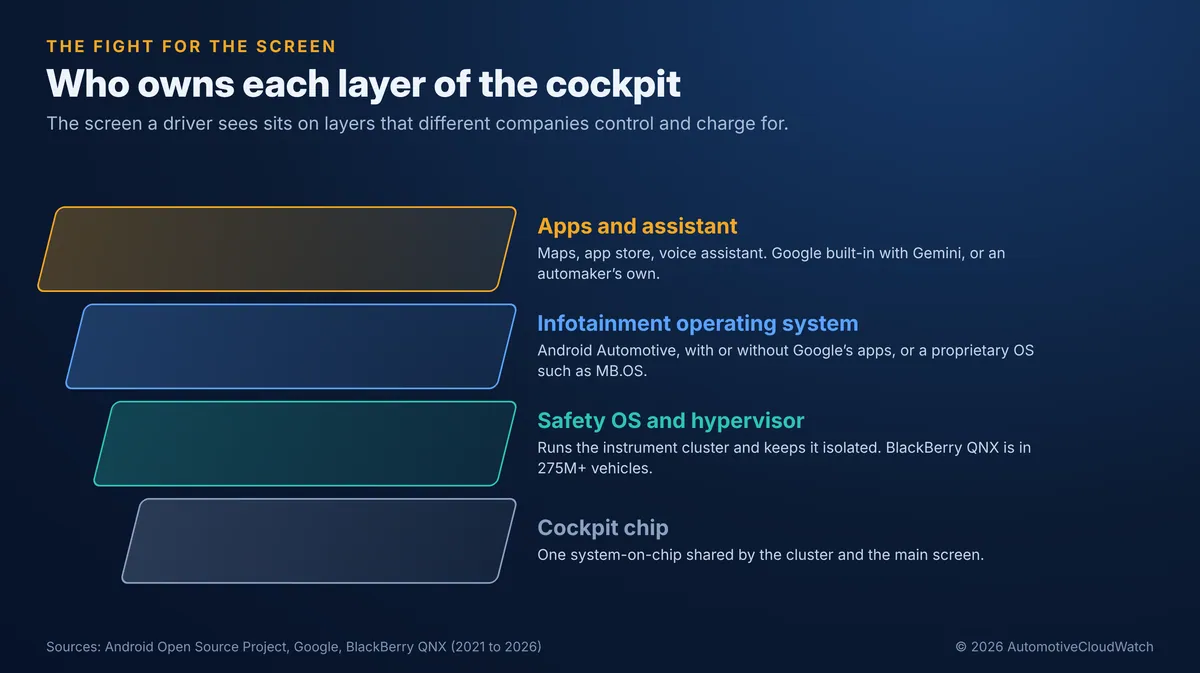
Software royalties, a fee per car for the operating system underneath the cabin. BlackBerry QNX, in more than 275 million vehicles, earned $268.0 million in fiscal 2026 and has a royalty backlog of about $950 million.
Notice what is missing. No automaker has yet announced a separate charge for its AI assistant. For now the assistant is used to sell the connectivity plan, not as a product in its own right.
The fight for the screen
The automaker that owns the screen is best placed to own the customer, and the subscription tends to follow. That is why the CarPlay fight matters more than any single feature.
Apple's next step, CarPlay Ultra, takes over every screen in the car, including the gauges.
As of May 2026, Aston Martin was the only brand shipping it. Mercedes, Audi, Volvo, Polestar and Renault had said they would not adopt it. Hyundai, Kia, Genesis, Nissan and Porsche are among the brands still listed as planning support.
GM went furthest the other way. Mary Barra said GM will drop CarPlay and Android Auto across its lineup as each new vehicle launches. GM said existing vehicles will not change. In its place GM offers its own Google built-in system with Gemini, which runs through OnStar.
But GM did not take the screen back on its own. Its replacement, Google built-in, is Google Automotive Services, or GAS. It bundles Google Maps, Google Play, Google Assistant and now Gemini, licensed to run on Android Automotive, the operating system in the car itself. It is different from Android Auto, which runs on the phone and projects onto the car's screen, much like CarPlay.
GAS has become the main alternative to building your own system. Google lists Volvo, Polestar, GM, Renault, Ford, Lincoln, Honda, Acura, Nissan, Mitsubishi, Mazda and BYD among the brands using it. It counted more than 50 car models with Google built-in in May 2025.
The terms shape the business model. In June 2023, Germany's competition authority said in a preliminary assessment that Google offered Maps, Play and Assistant only as a bundle and required them as defaults.
The authority also objected that Google shared ad revenue only if Google Assistant was the only voice assistant installed. In April 2025 it made binding Google's commitments to license the apps separately and drop those clauses.
Gemini now rides the same rails. Google said in April 2026 that Gemini is rolling out to new and existing cars with Google built-in by software update, starting in the US. Every GAS automaker gets the same assistant, so it is hard for any one of them to stand out on voice.
GM's version is a hybrid. Google supplies the apps and the assistant, while GM keeps the billing relationship through OnStar, which its Gemini rollout requires.
Some automakers took a middle path. Mercedes and BMW adopted the open-source version of Android Automotive without Google's apps. They use other app stores, so they control the ecosystem and the customer data.
Mercedes is now building its own MB.OS, with the stated aim of keeping full control of the customer relationship.
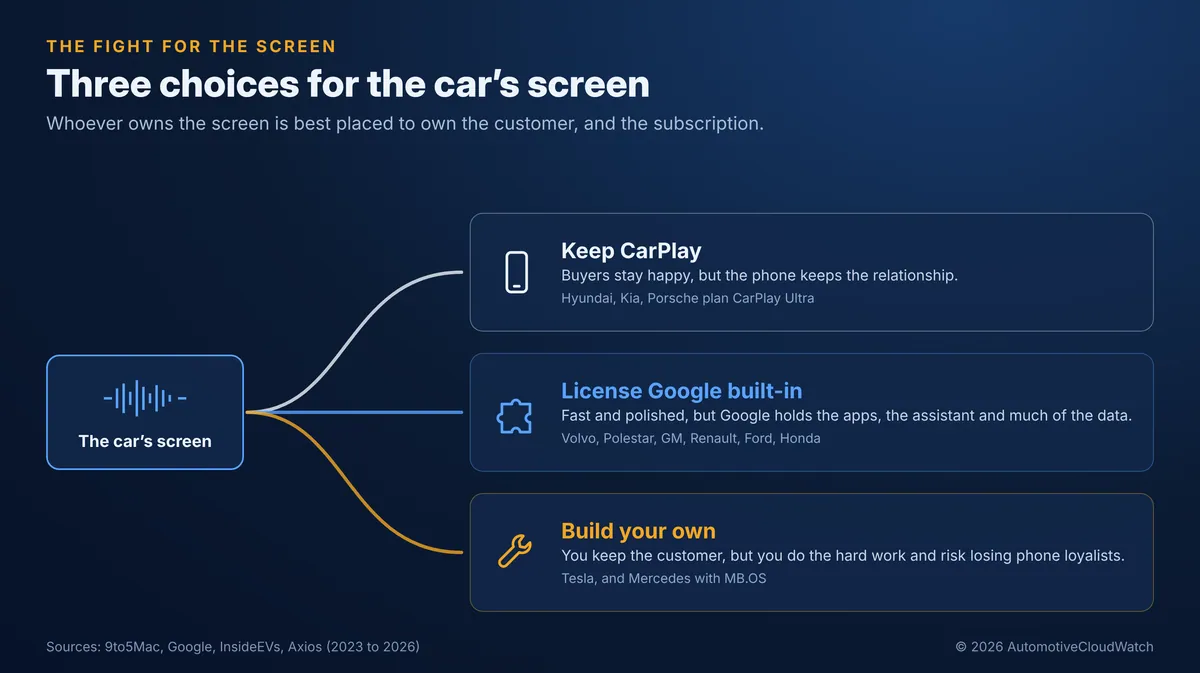
That leaves automakers three choices, not two.
Keep CarPlay. Buyers stay happy, but the phone keeps the relationship.
License Google built-in. You get a polished system and Gemini quickly, but Google holds the apps, the assistant and much of the data.
Build your own, as Tesla has and Mercedes is doing with MB.OS. You keep the customer, but you do the hard work and risk losing buyers who want their phone's interface.
What the numbers say so far
Among automakers, the money is real at two companies and mostly a promise everywhere else. Both kept the billing relationship for themselves.
GM is the clearest case. GM reported OnStar digital deferred revenue of $6.8 billion in the third quarter of 2026, up about 40 percent. GM also said Super Cruise is on track for about $400 million this year.
GM says its software and services business keeps about 70 cents of each revenue dollar. On a vehicle sale, automakers can keep as little as 4 to 10 cents per dollar. In my view, that margin gap helps explain its CarPlay decision.
Tesla is the other. Tesla reported a record 1.74 million active FSD subscriptions in the third quarter of 2026, up 67 percent from a year earlier. That count includes lifetime purchases. FSD is driving software, not cabin software, but it still shows what drivers will pay for a feature they value.
Elsewhere, targets have slipped.
Stellantis promised about €20 billion a year in added revenue from software-enabled vehicles by 2030. Its Fastlane 2030 plan, presented in May 2026, sets no software revenue target. Stellantis now targets 2027 to launch STLA Brain, STLA SmartCockpit and STLA AutoDrive.
Volkswagen bet on an in-house software stack through Cariad. Cariad lost $7.5 billion over 2022 to 2024, and VW turned to a Rivian joint venture worth up to $5.8 billion.
BMW tried selling heated seats as a monthly subscription. It dropped the idea in 2023 after a backlash.
Drivers are cooling, too. The share of consumers willing to pay for connected services fell from 86 percent in 2024 to 68 percent in 2025, according to S&P Global Mobility. A 2025 Smartcar study found 76 percent of drivers had not subscribed to their automaker's connected services.
Where the untapped money is
The market is untapped, but not where most automakers first looked. In a 2022 report, UBS sized the software-enabled revenue pool at about $700 billion by 2030. The market for AI in-car assistants alone is far smaller, about $6.9 billion in 2024 rising to $15.8 billion by 2031.
That figure is one Valuates estimate. Even so, the gap is the lesson. The assistant is a small market, but what it unlocks is a large one.
In my view three places look most promising.
The assistant as the front door. A driver who asks the car to find a charger, book a table or pay for parking is doing commerce through the automaker's system. The fee comes from the transaction or the partner, not from the driver.
The assistant as the reason to renew. GM ties Gemini to an OnStar connection. If the car gets smarter every year, the connectivity plan is easier to keep paying for.
The assistant as the owner's manual. Stellantis and Mistral AI have explored an assistant that explains the car by voice. Fewer dealer visits and support calls are savings, and savings count as much as revenue.
What has not worked is charging again for hardware the buyer already owns, as BMW found. Drivers will pay for a service that keeps doing something new. They resent paying again for something the car already does.
Selling car data has proved harder still, and BlackBerry shows the contrast. With AWS, it announced IVY in December 2020 as a platform to help automakers build and monetize services from vehicle sensor data.
BlackBerry set general availability for May 2023. Dongfeng chose supplier PATEO's IVY-based cockpit for its Voyah H97. Foxconn's MIH consortium selected it in January 2024.
Since then IVY has gone quiet. Its old product page now redirects to the QNX home page, and BlackBerry's April 2026 full-year results release does not mention it.
Meanwhile the QNX business, which charges a royalty per car, kept growing. Inside one company, the per-car fee thrived while the data play dropped out of view.
What it means
The cabin is a software market, but drivers have not shown they will pay for an AI assistant on its own. The assistant earns its keep by making the connectivity plan worth renewing and by sitting in the middle of transactions.
The margin case is strong. GM says it keeps about 70 cents of each software and services dollar, while automakers can keep as little as 4 to 10 cents on a car sale.
In my view, owning the screen is the real prize. An automaker that keeps CarPlay rents part of its most valuable surface to Apple. One that licenses Google built-in rents it to Google, which is rolling out the same Gemini assistant across those cars.
The steadiest money so far sits with suppliers that charge per car, such as QNX, and with services drivers use every week. The missteps charged twice for hardware already in the car, or bet on selling raw data.
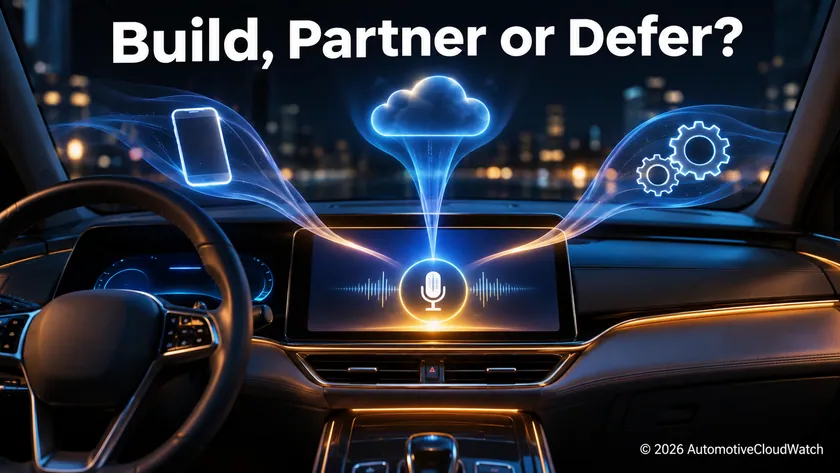
Ishita also asked about each automaker's own bets. The companion piece, Build, Partner or Defer? How Automakers Are Betting on In-Cabin AI, maps who is building, who is partnering and who is handing the screen to the phone.
Is your company charging for in-cabin AI, giving it away or still deciding? Tell me in the comments. If this was useful, share it with someone who sets software pricing, and subscribe for the next piece.