Signals · Article · Automotiveシグナル · 記事 · 自動車
Service-Oriented Middleware [Explained]
The middleware between a car’s operating systems and its applications decides how software talks. It is moving from fixed signals to services, and from paper standards to shared code.

Middleware is a part of the car most drivers never hear about. It is the layer of software that lets applications exchange data and call each other’s functions without knowing which computer or network the other runs on. As cars move to central computers and zonal designs, that layer is being rebuilt, and so is the way the industry writes it.
In June 2026, at the Shanghai open conference of AUTOSAR, the carmaker and supplier partnership that standardizes vehicle software, the Chinese supplier iSOFT contributed its intelligent driving operating system software as the global code baseline for CAPI, the partnership’s first shared code base for its Adaptive Platform, the standard for a car’s high-performance computers. iSOFT says its software has been deployed in more than 25 million units.
For AUTOSAR, the move was symbolic. Publicly launched in 2003, the partnership spent two decades writing specifications that suppliers turned into their own products. Now it ships code, with quarterly CAPI releases, and an iSOFT executive described the shift as moving from standard-first to code-first.
This article explains the difference between signals and services, how SOME/IP, DDS and Zenoh work, what AUTOSAR Classic and Adaptive are for, how a shared vehicle data model helps, what open-source projects such as Eclipse S-CORE are building, how carmakers migrate, and what it all costs. The in-vehicle networks explainer in this series covers the cables and protocols underneath, and the automotive operating systems explainer covers the systems above.
Signals versus services
Traditional car electronics communicate with signals. A control unit packs values such as wheel speed or door status into frames and broadcasts them on a fixed schedule over CAN or similar networks. The sender does not know or care who reads them, and every signal is defined in advance when the car is designed.
Service-oriented communication works differently. A software component offers named services, such as a method another component can call, an event it publishes or a field others can read and subscribe to. Consumers discover those services while the car is running and connect to the ones they need.
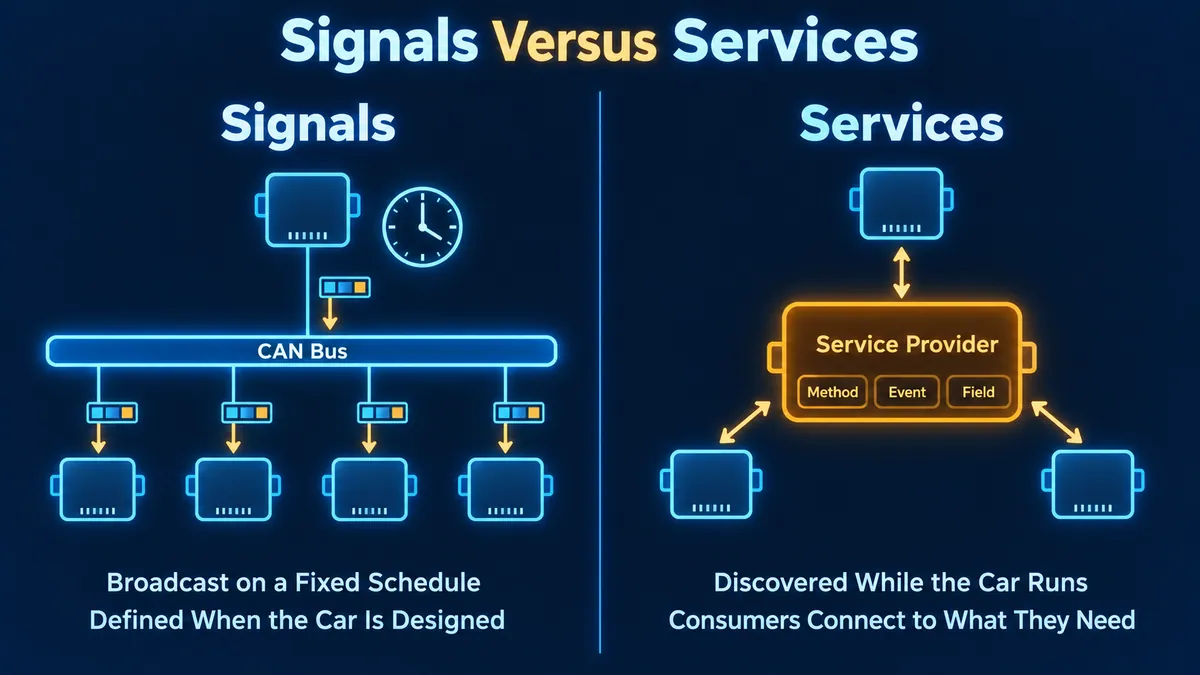
The difference matters for software-defined vehicles. With services, a function on the central computer can be updated or added without redefining every signal on every control unit, which is why central computers and zone controllers are built around them.
SOME/IP
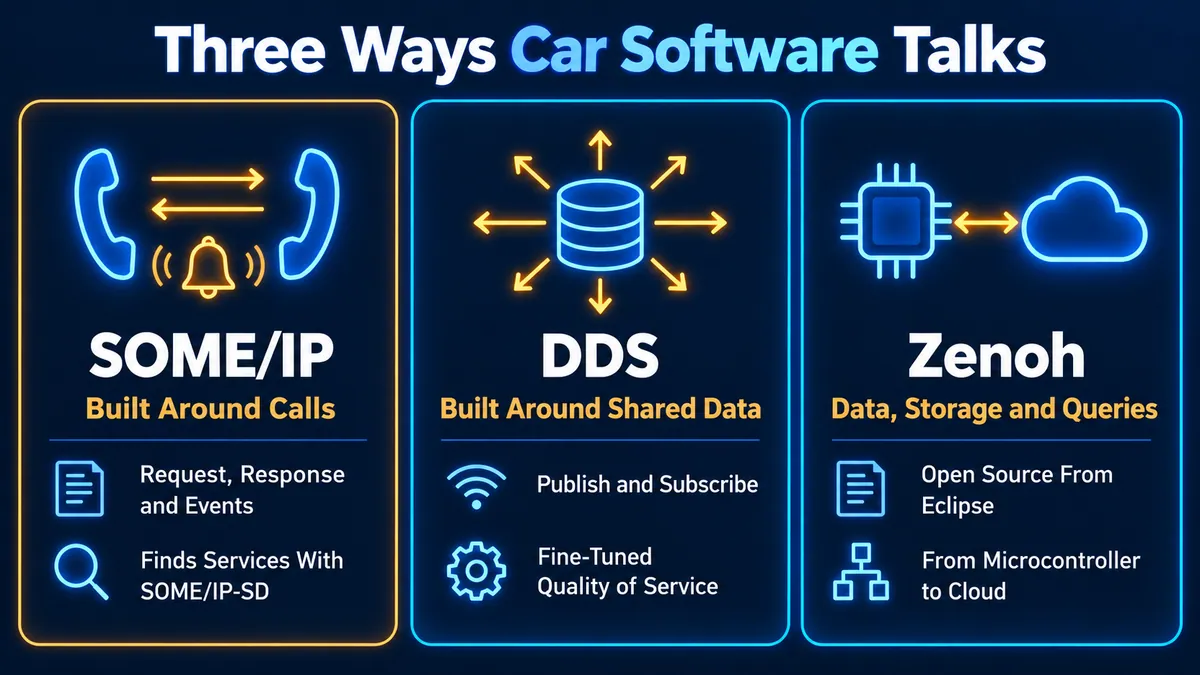
SOME/IP, short for Scalable service-Oriented MiddlewarE over IP, is the protocol most associated with service-oriented cars. It runs over the internet protocol suite and supports request and response calls, one-way messages, events and fields, using TCP when delivery must be reliable and UDP when speed matters more.
A companion protocol, SOME/IP-SD, handles service discovery. Components announce what they offer, find what they need and subscribe to groups of events, so that devices can join and leave the network without fixed configuration.
SOME/IP was first presented in 2011 and was standardized through ISO, GENIVI and AUTOSAR in 2013 and 2014. In a December 2025 article, the automotive networking engineer Lars Völker wrote that its feature set has been essentially stable since 2016.
Völker also proposed an open SOME/IP specification outside AUTOSAR’s licensing, to make the protocol easier to implement in open-source software and to simplify configuration. In January 2026, the suppliers Technica Engineering and KPIT announced that they were releasing a SOME/IP specification under a new open license, according to Automotive World.
DDS and Zenoh
DDS, the Data Distribution Service, comes from the Object Management Group and is built around data rather than calls. Applications publish and subscribe to shared data, with detailed quality of service policies that control reliability, timing and how much history is kept. Its strength is in systems where many components need the same data with different guarantees.
DDS has a foothold in production cars. RTI said in March 2025 that its DDS software ran in more than one million vehicles with more than ten carmakers, and that Xpeng would use it as core technology in all its vehicles from model year 2026. Those are company claims.
Zenoh, an Eclipse open-source protocol that reached version 1.0 in October 2024, combines data in motion with storage and queries and is designed to run from microcontrollers to the cloud. Its developer, ZettaScale, argues that DDS was designed for wired, well-dimensioned systems, and its chief executive has said GM’s uProtocol uses Zenoh, a company claim. The Robot Report also named Volvo among early adopters. GM had contributed uProtocol, a communication protocol meant to let software on Android, Linux and QNX exchange data, to the Eclipse Foundation in April 2023, describing it as a standard with the potential to connect automotive applications and services everywhere.
AUTOSAR Classic and Adaptive
AUTOSAR, the industry partnership behind the most widely used vehicle software standards, had more than 300 partners at the end of 2025, with nine core partners, BMW, Bosch, AUMOVIO, Mercedes-Benz, Ford, GM, Stellantis, Toyota and the Volkswagen Group. It maintains two platforms.
The Classic Platform is for deeply embedded control units whose software and communication are configured before the car is built. The Adaptive Platform, first released in March 2017, is for high-performance computers running POSIX operating systems, where applications can be started, stopped and updated. Its communication interface generates proxies for clients and skeletons for servers from service definitions, and runs over SOME/IP or DDS.
The two platforms coexist rather than compete. The R25-11 release, published on 27 November 2025, brought ten new concepts across both, including DDS support on the Classic Platform, so small control units can take part in service-oriented communication over DDS as well as SOME/IP.
The same release added a Vehicle Data Protocol for collecting data from control units in production vehicles, and raised the Adaptive Platform’s minimum C++ version to C++17.
The separate AUTOSAR and Vector explainers on AutomotiveCloudWatch cover the standard’s architecture and tools in more depth.
A common vocabulary for vehicle data
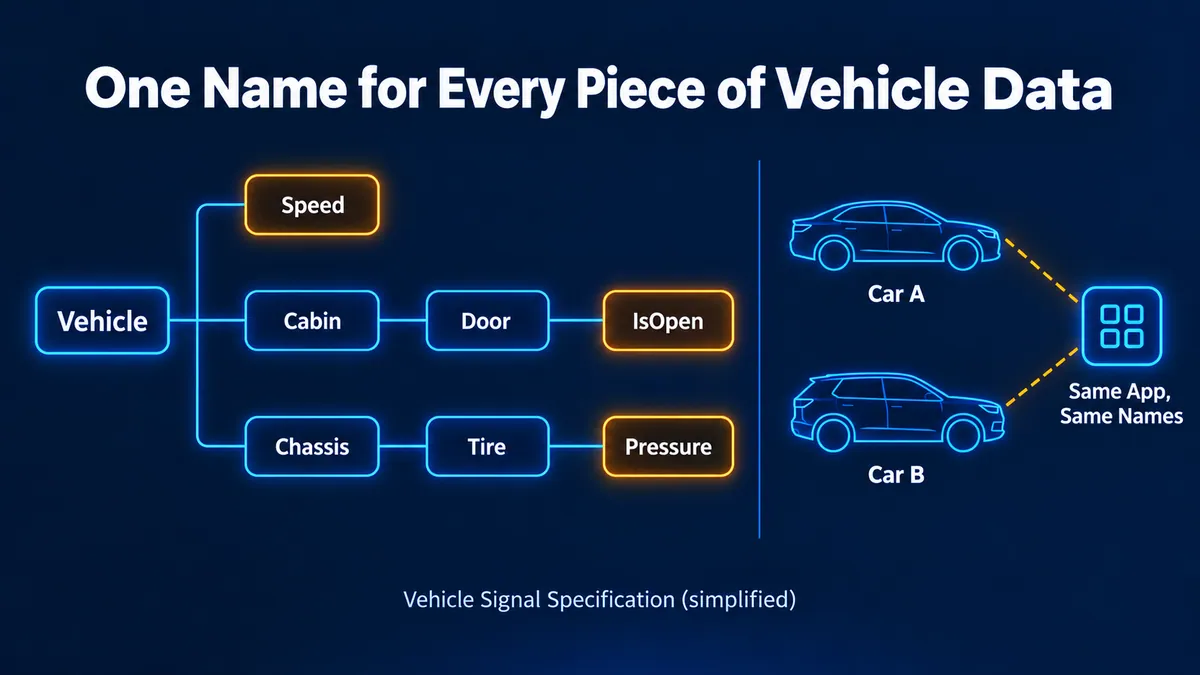
Services need agreed names. The Vehicle Signal Specification, introduced in 2016 and now maintained by COVESA, is an open data model that organizes vehicle data, such as speed or tire pressure, into a tree of standard names. It is a data model, not a protocol.
Other standards build on it. AUTOSAR’s VSS representation maps branches of the tree to Adaptive service interfaces, and the Eclipse Kuksa project provides a data broker that follows the same model, so an application written against standard names can find the data it needs on different cars.
Open source enters the middle
The newest effort is a shared open-source core. The Eclipse Foundation announced S-CORE, short for Safe Open Vehicle Core, on 12 June 2025 in Brussels. It is a middleware stack for vehicle high-performance computers, with early modules covering areas such as communication between processes, orchestration and persistent storage, and Eclipse says its development process is under audit by a certification agency with ISO 26262 as the target.
Industry support grew quickly. A memorandum of understanding between Germany’s automotive association VDA and Eclipse, signed by 11 companies in June 2025, had 32 signatories by January 2026, including Vector, ETAS and Elektrobit, which normally compete to sell middleware.
S-CORE published its first public release, 0.5, in November 2025. Japanese trade publication MONOist reported that version 0.9 was announced on 9 September 2026 and that 1.0 is scheduled for December 2026.
Supporters have set targets of up to 40% less effort on software that does not differentiate brands and up to 30% faster time to market, with production programs by 2030 at the latest. Those are goals, not results. Suppliers are already preparing commercial versions. Qorix, one of the original signatories, offers production-ready middleware based on S-CORE, and ETAS has said it plans a production-ready distribution in its vehicle platform suite. Eclipse has also launched openSOVD, an open-source project for service-oriented vehicle diagnostics.
From standard to code
AUTOSAR’s CAPI is the partnership’s answer to open-source momentum. It is an implementation of the Adaptive Platform intended to be automotive grade and ready for certification, released quarterly, and the iSOFT contribution in June 2026 gave it a production code base to start from. Infineon integrates iSOFT’s middleware in its DRIVECORE offering, and Xpeng has endorsed CAPI, even as RTI says Xpeng will use DDS across its vehicles, a sign that carmakers often run more than one middleware at once.
China shows how far service-oriented design has gone in some programs. A 2025 ResearchAndMarkets report said Changan’s software supports more than 3,000 vehicle-defined service buses and that NIO’s SkyOS exposes more than 1,600 vehicle capabilities as programming interfaces.
The result is a crowded middle layer. Commercial AUTOSAR stacks, open-source S-CORE, DDS, Zenoh and carmakers’ own frameworks are all competing to be the way car software talks.
Migrating from signals to services
No carmaker can replace every control unit at once, so services and signals live side by side. In zonal designs, sensors and actuators at the edge still send signals over CAN or LIN, and zone controllers or gateways translate them into services for the central computer.
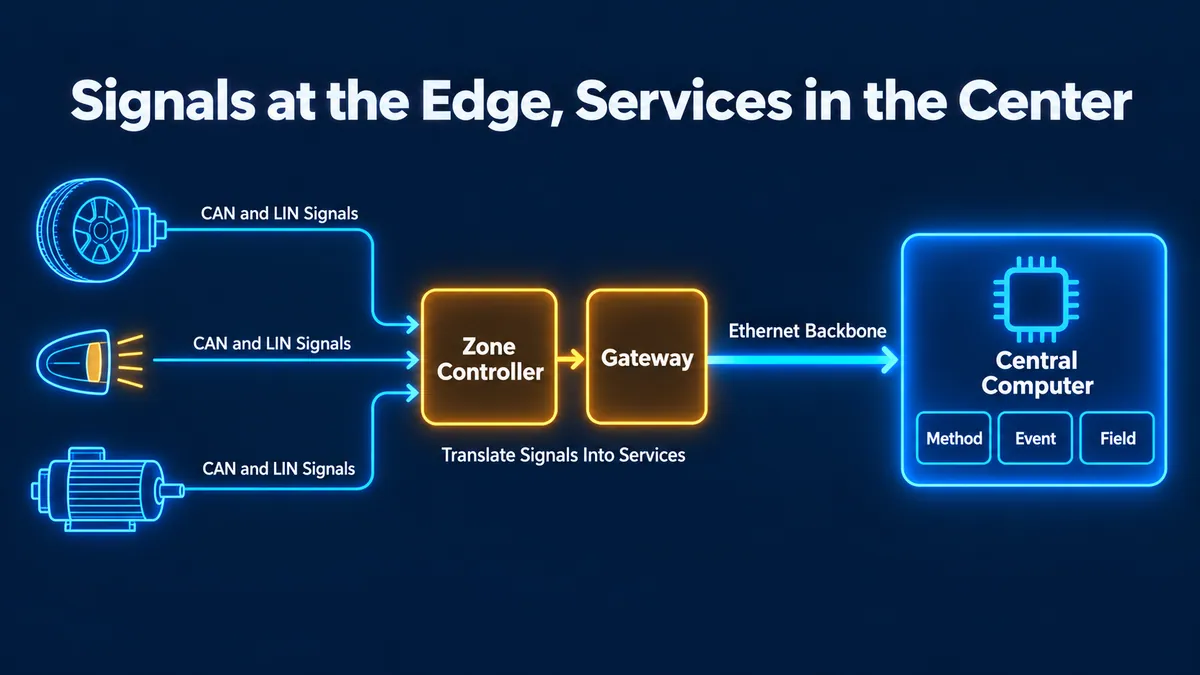
The engineering firm FEV described one such migration in a MathWorks case study. It took a legacy torque management function built for AUTOSAR Classic, converted its signal interfaces into service events and regenerated it as Adaptive code. A follow-on project for a carmaker added a central computer and zone controllers to an existing architecture, with a gateway translating between the new zones and older control units.
AUTOSAR itself reflects this reality. R25-11 introduced a concept that hides whether a signal comes from another control unit or from software on the same one, which smooths migration rather than eliminating signals.
The in-vehicle networks explainer describes the Ethernet backbones that make this possible, and the zonal architecture explainer describes the physical layout.
What services cost
Services are not free. A 2015 university seminar presentation listed computational overhead, more storage, less predictable timing and potential single points of failure, and judged SOME/IP less suited to hard real-time functions such as braking, although safety-certified stacks have narrowed that gap since.
Configuration is another burden. Völker wrote that producing AUTOSAR’s XML configuration files at good quality is slow, and because several middleware types now coexist, bridges between them have become a product category of their own, such as Vector’s System Gateway, which routes between IP, ROS and DDS, SOME/IP and Android.
What middleware really means
Middleware is how a car’s software talks. The industry is moving from signals defined at design time to services discovered at runtime, carried by SOME/IP, DDS or Zenoh, organized by AUTOSAR Classic and Adaptive, and named through shared models such as the Vehicle Signal Specification.
The newest shift is from specifications to shared code. Eclipse S-CORE and AUTOSAR’s CAPI both aim to give carmakers and suppliers a common core so they can spend their effort on what customers notice.
The useful questions for any program are which middleware runs on each computer, how signals at the edge are translated into services, which data model names the vehicle’s data, how many middleware types must be bridged, whether the core will be bought, built or shared in open source, and how its safety evidence will be produced.
Words you will hear
Middleware. Software that lets applications exchange data and call functions without knowing where the others run.
Service-oriented architecture. A design in which components offer and consume named services discovered at runtime.
SOME/IP. An automotive protocol for service calls and events over the internet protocol suite.
DDS. A data-centric publish and subscribe standard with configurable quality of service.
Proxy and skeleton. Generated code through which AUTOSAR Adaptive clients call services and servers provide them.
Vehicle Signal Specification. COVESA’s open data model that gives vehicle data standard names.
S-CORE. Eclipse’s Safe Open Vehicle Core, an open-source middleware stack for vehicle computers.
This article is part of the AutomotiveCloudWatch Explained series. Before it, read Software-Defined Vehicle [Explained] and Zonal Architecture [Explained].
If this helped, subscribe free at automotivecloudwatch.com to get each new explainer when it publishes.
All opinions are my own and do not reflect those of my employer.
Related research


Get the next Executive Briefing by email
Each new briefing, in your inbox.
Subscribe
