Signals · Article · Automotiveシグナル · 記事 · 自動車
Thermal Management [Explained]
An electric car has no engine heat to spare. Keeping the cabin warm, the battery at temperature and the windshield clear decides its winter range, charging speed and which chemicals it can use.

In January 2026, the Norwegian Automobile Federation ran its annual winter range test, El Prix, at Folldal in central Norway. Temperatures fell as low as minus 32°C, the coldest in the test’s history. The 24 electric cars fell short of their official WLTP range by 38% on average, according to GreenFleet. The Lucid Air Grand Touring went furthest, at about 520 kilometers, though it also fell furthest short of its own rated range.
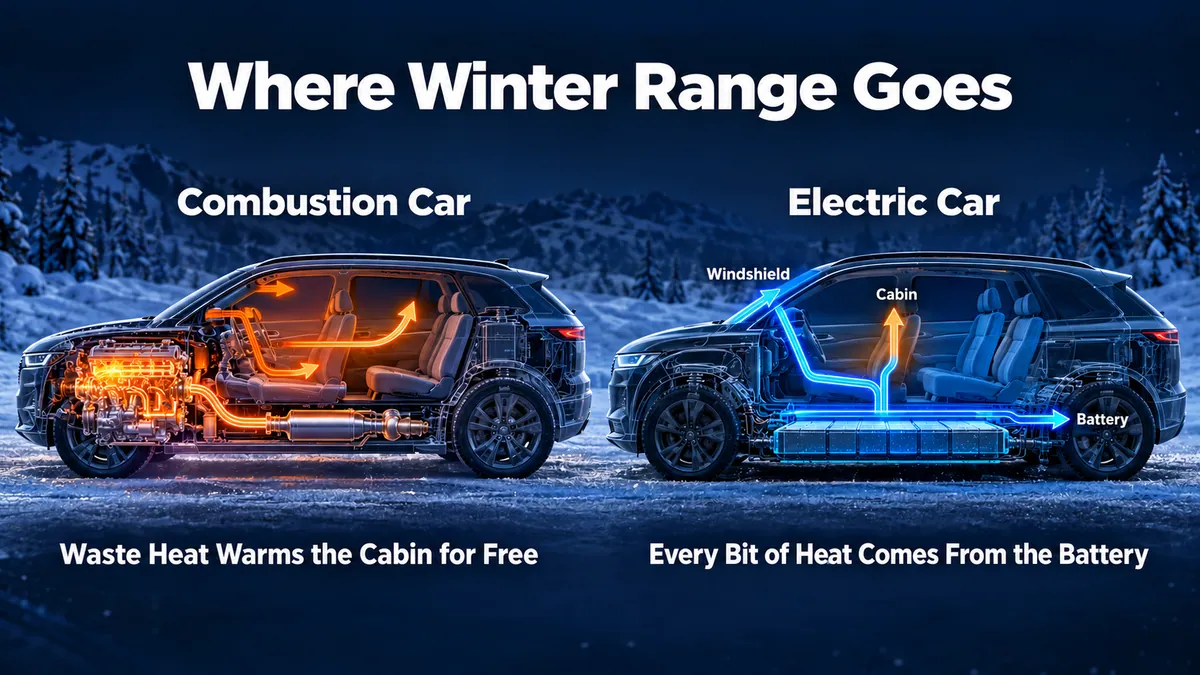
Most of that lost range was not lost inside the battery. It went into heat, for the cabin, for the windows and for the battery itself. In a combustion car, waste heat from the engine warms the cabin almost for free. An electric drivetrain is so efficient that there is little waste heat to use, so the energy for heat comes from the battery.
This article explains how electric cars manage heat, how heat pumps and integrated thermal systems work, why they do not solve winter range on their own, how batteries are warmed for fast charging, when heating becomes a safety issue, and why the refrigerant in nearly every new car is under regulatory pressure. The EV batteries explainer covers cell chemistry, and the battery management systems explainer covers thermal runaway detection.
Why heat is the problem
Heating is the biggest winter drain on an electric car. In a 2019 test by AAA, five electric cars lost 41% of their range on average at minus 7°C with the cabin heat on, compared with mild weather. “There’s not a lot of waste heat that you can just use to warm up the cabin,” Scott Case of the battery analytics company Recurrent told NBC News.
The loss depends on the trip. Consumer Reports’ testing shows that highway range at 70 mph and about minus 9°C falls by roughly 25%, while short trips in the cold lost about half their range, because the car spends a larger share of each trip warming itself up.
Cold also slows the battery. Lithium-ion cells accept charge more slowly when they are cold, so a car that has not warmed its battery can take far longer at a fast charger.
So thermal management has three jobs that compete for the same energy. Keep the people warm or cool, keep the battery and electronics within their best temperature range, and keep the windshield clear.
How a heat pump works
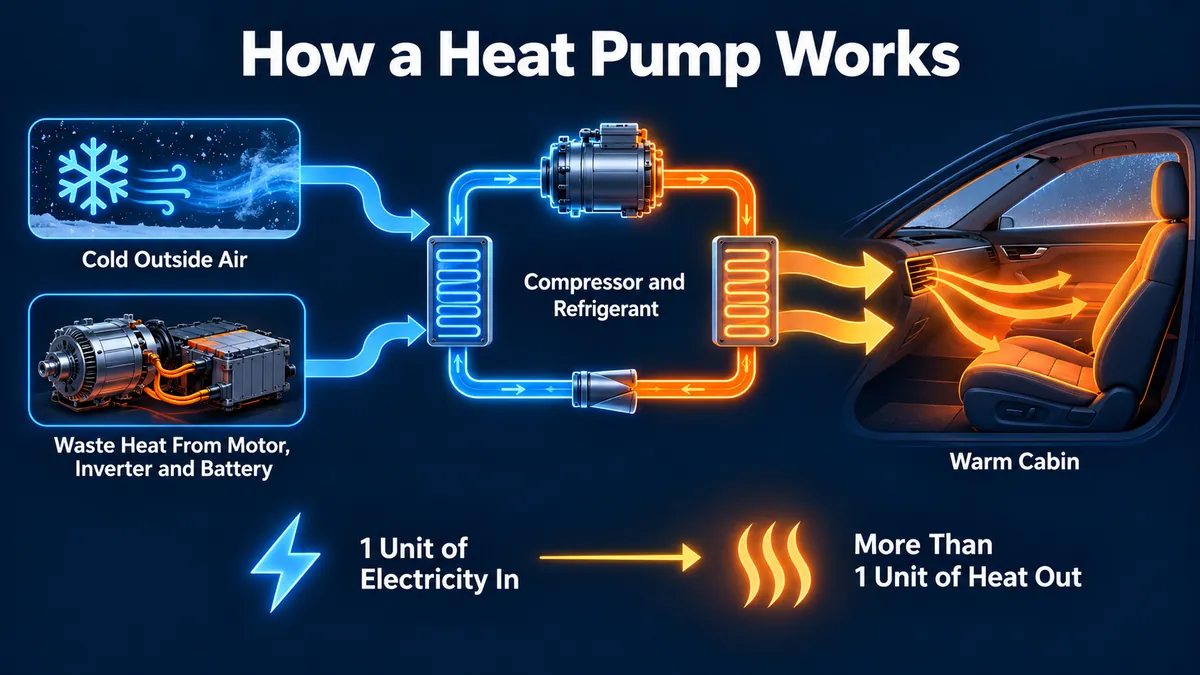
The most efficient answer is a heat pump. It runs the air conditioning cycle in reverse, using a compressor and a refrigerant to move heat from outside air, and from waste heat in the motor, inverter and battery, into the cabin. Because it moves heat rather than creating it, a heat pump can deliver more heat than the electricity it uses.
Heat pumps arrived early in electric cars. The 2013 model year Nissan Leaf offered one on its US SV and SL versions. Hyundai Motor Group says the 2014 Kia Soul EV introduced a heat pump that also captured waste heat from power electronics, and in 2020 it said heat pumps were fitted across its Ioniq Electric, Kona Electric and Niro EV.
Volkswagen took a different route with carbon dioxide as the refrigerant. The supplier Valeo says it has supplied components since 2019 for the CO2 heat pump on Volkswagen Group’s MEB platform, used in ID models, the Audi Q4 e-tron and the electric Ford Explorer.
Heat pumps still need backup. In extreme cold, a heat pump’s efficiency falls, so most cars also carry a resistive heater. A common design is a high-voltage coolant heater, which heats the liquid that warms the cabin and defrosts the windshield.
A heat pump also adds cost and complexity. When Volkswagen launched the ID.3 in Europe, the heat pump was a €1,250 option.
One system instead of many
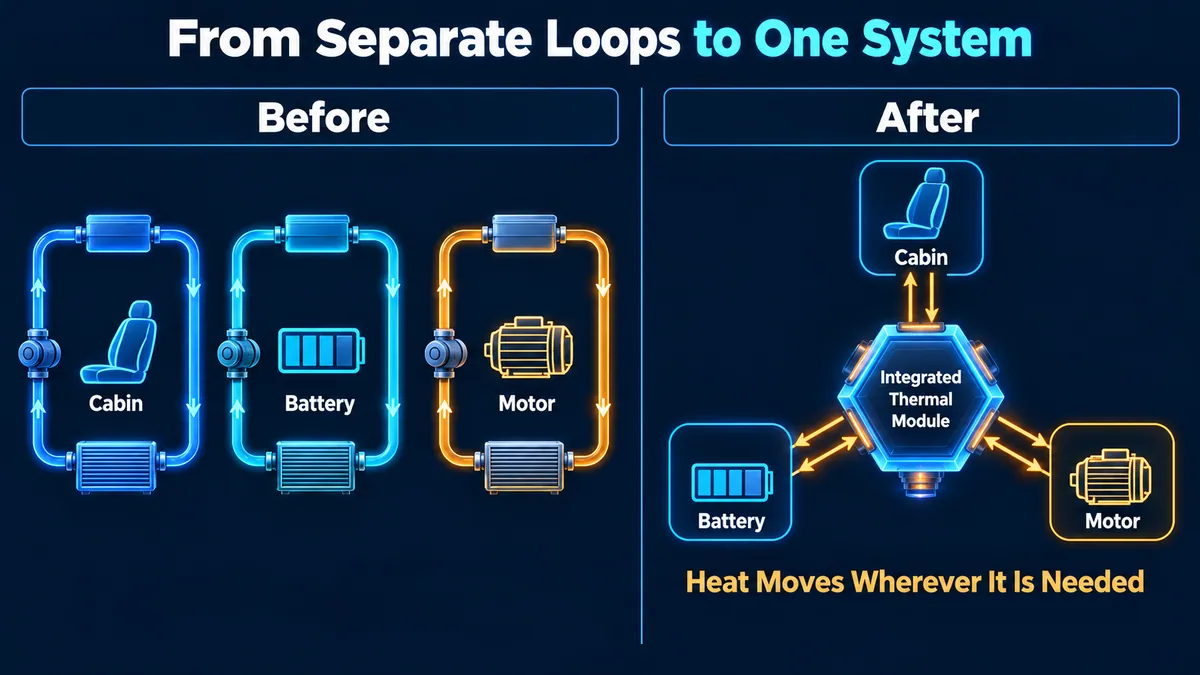
Early electric cars had separate circuits for the cabin, the battery and the motor. Newer designs merge them into one integrated system that can move heat wherever it is needed, from a hot motor to a cold battery, or from the battery to the cabin.
Tesla’s Model Y showed how far this could go. At its center sits the Octovalve, an eight-port rotary valve that routes coolant through the car’s thermal system. Cory Steuben, president of the teardown firm Munro and Associates, called it “the world’s best EV thermal management system.”
Suppliers now sell this integration as a module. Mahle describes its thermal management module as a single unit combining the electric compressor, heat exchangers and refrigerant valves, and claims it can add up to 20% more range. In April 2024, Mahle announced two orders worth just under €1.5 billion for these modules.
Hardware is not enough
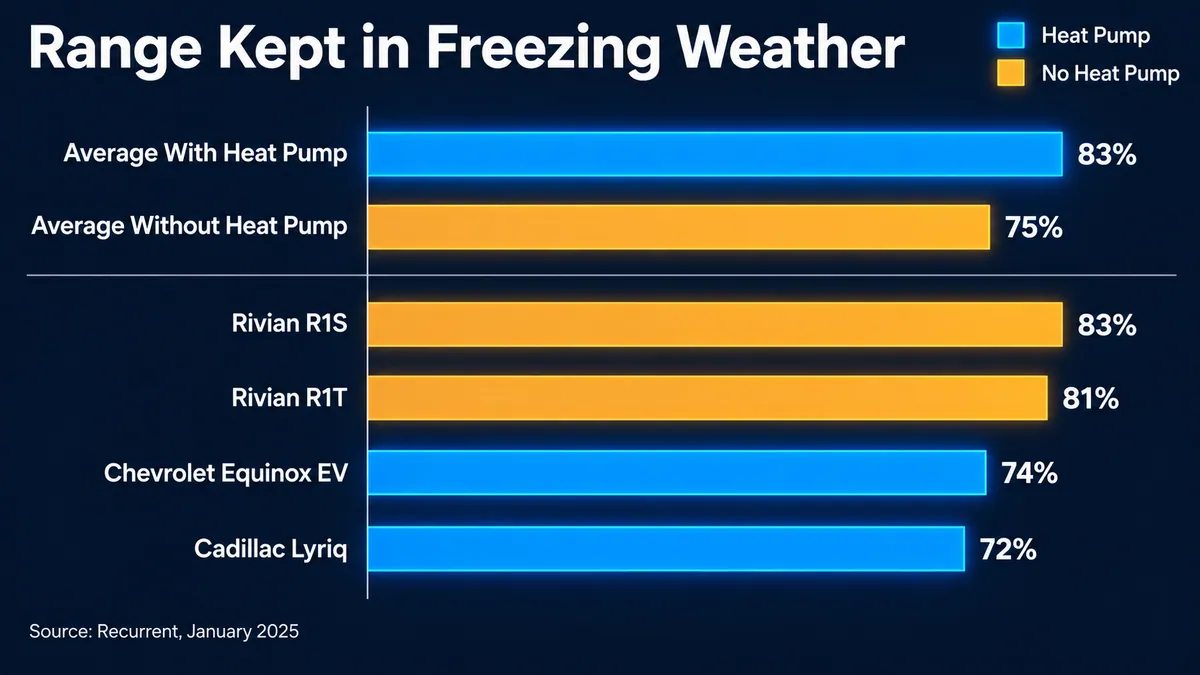
A heat pump helps, but it does not guarantee good winter range. Recurrent studied more than 18,000 vehicles across 20 US models in freezing weather and published the results in January 2025. On average, cars kept about 80% of their range. Those with heat pumps kept 83%, and those without kept 75%.
The details were more revealing. The Tesla Model X kept 89%, while the Volkswagen ID.4 kept only about 64%. The Cadillac Lyriq and Chevrolet Equinox EV, both with heat pumps, kept only 72% and 74%. The Rivian R1S and R1T, without heat pumps, kept 83% and 81%.
Software is a big part of the difference. In December 2020, the electric car rental company Nextmove found that its ID.3 with the optional heat pump used more energy than one without. Volkswagen suggested the system may have been in a dehumidifying mode and pointed to a coming software update.
The lesson is that thermal management is a control problem as much as a hardware one. How the system decides where heat goes, minute by minute, matters as much as which parts are installed.
Warming the battery to charge
Fast charging depends on battery temperature. That is why many electric cars now precondition the battery, warming it on the way to a fast charger, often triggered by navigation. In its 2026 winter test, the Norwegian Automobile Federation found that many cars came close to their stated 10 to 80% charging times when preconditioning was used.
Preconditioning costs energy, and results vary. Consumer Reports found in January 2025 tests that preconditioning the cabin while plugged in improved driving efficiency in the cold by 5 to 7% across three models. A test published by the accessory maker enhance, which sells its own preheating product, found that a 30-minute preheat could use several kilowatt-hours.
Cold snaps show what happens when this goes wrong. During a January 2024 cold spell in Chicago, NBC News reported drivers waiting hours at chargers, and a tow truck driver said he had never seen such volume for electric cars.
When heat is a safety system
In an electric car, the heater also clears the windshield, which makes it a safety system. Tesla recalled Model 3, S, X and Y vehicles in February 2022, covering about 26,700 vehicles, after a software error could fail to close an expansion valve in the heat pump, trapping refrigerant and reducing defrost performance below the US defrosting standard FMVSS 103. An over-the-air software update fixed it.
Lucid recalled 7,506 Air sedans from model years 2022 to 2024 in June 2024 because high-voltage coolant heaters from the supplier Webasto, built before February 2023, could fail internally, removing both cabin heat and windshield defrost. Lucid warned drivers through an over-the-air update and replaces heaters that fail with a redesigned part.
The refrigerant question
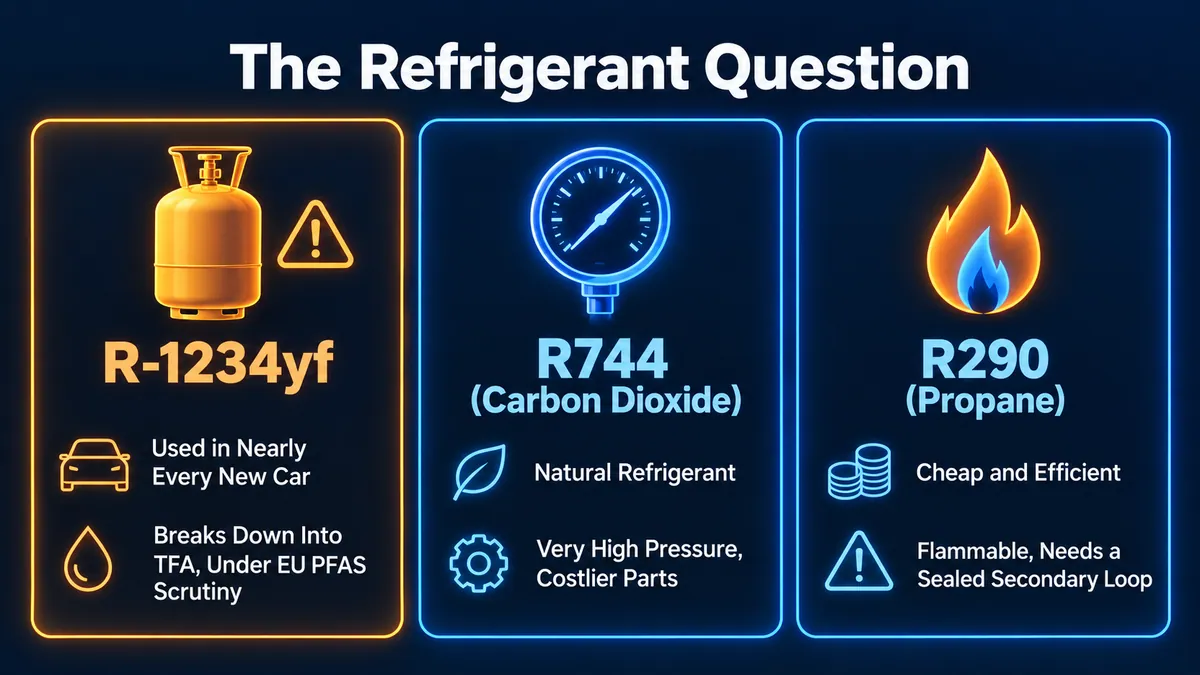
Nearly every new car’s air conditioning and heat pump uses a refrigerant called R-1234yf, adopted because it has a far lower global warming potential than the refrigerant it replaced. But R-1234yf is a fluorinated chemical, and Europe is weighing a broad restriction on PFAS, the class of persistent “forever chemicals.”
The EU proposal, submitted to the European Chemicals Agency in 2023 by Denmark, Germany, the Netherlands, Norway and Sweden, has since been revised and has moved through the agency’s scientific committees. Valeo expected no final decision before 2028.
A related decision raised the stakes. On 6 October 2026, the agency published its risk assessment committee’s opinion, adopted in June, that trifluoroacetic acid, or TFA, should be classified as a presumed reproductive toxicant and as persistent, mobile and toxic. In the atmosphere, R-1234yf breaks down into TFA, essentially molecule for molecule according to the UN’s Environmental Effects Assessment Panel, so the decision matters for car air conditioning even though the opinion itself does not single out refrigerants. The European Commission must still decide whether to adopt the classification.
The alternatives are natural refrigerants. Carbon dioxide, known as R744, runs at very high pressure, which makes components more expensive. Propane, known as R290, is cheap and efficient but flammable, so it needs a secondary loop that keeps the refrigerant in a sealed module outside the cabin and moves heat through liquid coolant. Ford petitioned the US Environmental Protection Agency in 2024 to approve R290 in that kind of design for electric cars.
“We don’t expect a single refrigerant solution adopted by all OEMs,” Valeo’s Rody El Chammas said in February 2025. Valeo is developing both CO2 and propane heat pumps.
Who supplies it
Thermal management has become a large supplier business, but not a very profitable one. Hanon Systems, one of the largest, reported 2025 revenue of 10.88 trillion won, with electrified vehicles accounting for 28%. Its operating margin was 3.5% in the third quarter and 3.4% in the fourth.
Hanon, which became part of Hankook and Company Group in January 2025, said it would prioritize profits from combustion and hybrid products while keeping flexibility on electrification. Mahle and Valeo are betting on integrated modules and new refrigerants.
For automakers, the choice of supplier and architecture is now tied to range, charging speed, cost and regulatory risk all at once.
What thermal management really means
Thermal management decides how an electric car performs when the weather turns. Heat pumps and integrated systems recover energy that would otherwise be wasted, but software determines how much they deliver. Battery preconditioning decides charging speed in the cold, heaters double as safety systems, and the refrigerant inside it all may have to change.
The useful questions for any program are how much range the car keeps in real cold and why, how its control software allocates heat, how it preconditions the battery for fast charging, how its heating and defrost are protected against failure, and which refrigerant it will use if the EU restricts PFAS.
Words you will hear
Heat pump. A reversible refrigeration cycle that moves heat into the cabin or battery using less energy than a resistive heater.
Integrated thermal module. A single unit combining the compressor, heat exchangers and valves that manage heat for the whole car.
Octovalve. Tesla’s eight-port rotary coolant valve in the Model Y, which routes heat around the car.
Preconditioning. Warming the battery or cabin in advance, often before fast charging or while still plugged in.
High-voltage coolant heater. A resistive heater that warms the coolant for the cabin and windshield directly from the battery.
R744 and R290. Carbon dioxide and propane used as refrigerants, alternatives to fluorinated R-1234yf.
TFA. Trifluoroacetic acid, a very persistent breakdown product of fluorinated chemicals, now proposed for EU classification as a reproductive toxicant.
This article is part of the AutomotiveCloudWatch Explained series. Before it, read Software-Defined Vehicle [Explained] and Zonal Architecture [Explained].
If this helped, subscribe free at automotivecloudwatch.com to get each new explainer when it publishes.
All opinions are my own and do not reflect those of my employer.
Related research


Get the next Executive Briefing by email
Each new briefing, in your inbox.
Subscribe
