Signals · Article · Robotics and Physical AIシグナル · 記事 · ロボティクスとフィジカルAI
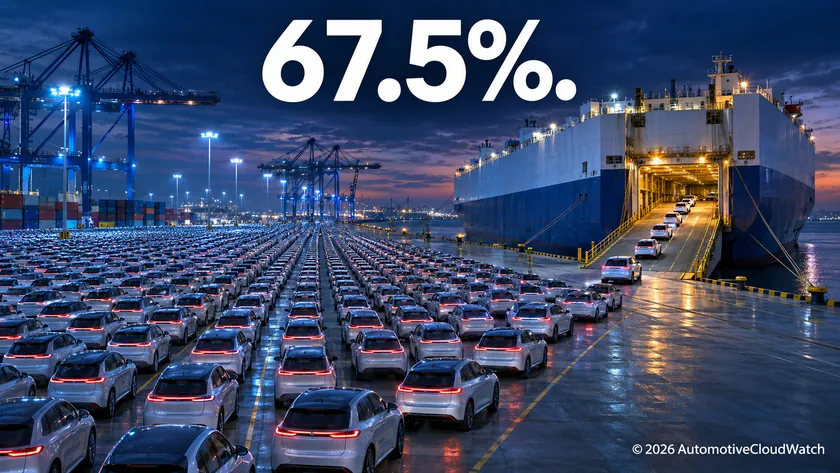
67.5%.
The China record nobody explained, seven better questions for your next supplier review, and three signals from the week.
A lot moved this week.
Not launch-day hype, not earnings beats, not who said what on stage. This newsletter only cares about what changes how vehicles and factories actually get built.
Here is the rundown. A China sales record that is really a story about a shrinking market. Seven questions worth replacing before your next supplier review. And three things that moved this week, from Toyota's factory plan to a Dutch courtroom.
I. The record that came from a shrinking market.
China's new energy vehicles took a record 67.5% of the country's passenger car retail sales in October, on the China Passenger Car Association's final count of 9 November. Most coverage stopped there.
Here is what the record hides. Total passenger car retail fell 27.1% from a year earlier, to 1.643 million. NEV retail fell too, by 13.7%, to 1.109 million. The share hit a record because NEVs shrank more slowly than everything else.
The growth is somewhere else. NEV wholesale rose 9.8% to 1.772 million only because exports jumped 144.7% to 582,000. Exports made up 33% of automakers' NEV wholesale in October, against 15% a year earlier.
My read, and it is a read rather than a fact, is that China's EV plants are now running on foreign demand. A third of what they ship is heading abroad, into markets whose own automakers are still working down their EV cost curves. If you sell vehicles or parts outside China, that 33% matters more to your next pricing round than the 67.5% does.
II. Seven questions worth replacing.
The fastest way to sound informed in a supplier review is to ask the question everyone asks. The fastest way to learn something is to ask a better one. Each swap below comes from an Explained article, where the full reasoning lives.
1. Safety.
Old question. Is it ASIL D certified?
Better question. Which safety goal is ASIL D, and is that a product certificate, a development process certification or a tool qualification?
Those are three separate claims, and a datasheet can mean any one of them. More in ASIL D [Explained].
2. Cybersecurity.
Old question. Is the vehicle R155 compliant?
Better question. Can I see both approvals?
UN R155 requires one approval for the automaker's cybersecurity management system and one for the vehicle type. It does not certify that a car is secure, and it sets no penetration test score. More in Vehicle Cybersecurity Regulation [Explained].
3. Compute.
Old question. How many TOPS does the chip have?
Better question. What is the memory bandwidth, and what does the model spend its time waiting on?
NVIDIA's own figures put DRIVE Thor at 273 gigabytes per second against 205 for Orin, a rise of about a third, while quoted AI throughput rose several times over. More in Central Vehicle Compute [Explained].
4. Sensors.
Old question. Does it have lidar?
Better question. When the sensors disagree, how long does the software take to settle on what it is seeing?
In Tempe in 2018, an Uber test car's radar and lidar detected Elaine Herzberg about 5.6 seconds before impact, and for several seconds the software kept changing its mind about what she was. More in Sensor Fusion [Explained].
5. Driver assistance.
Old question. How well does it drive?
Better question. What does it do when the driver stops paying attention?
Euro NCAP grades safety backup separately from driving competence. In June 2025 it rated the Volvo EX30 Moderate, criticizing the lack of a lockout after repeated hands-off warnings. More in Driver Assistance Systems [Explained].
6. Batteries.
Old question. Whose cells are in the pack?
Better question. What does the battery management software do at a high state of charge, and how do you know a fix reached every car?
Mercedes remedied its February 2025 EQB recall with a battery management software update, not new cells. A December 2025 filing said some vehicles may not have received the correct software. More in Battery Management Systems [Explained].
7. Approval.
Old question. Did it pass the test?
Better question. Was the test run the way the approval says it must be?
Toyota ran a rear impact test with a barrier of about 1,800 kilograms when the rule specified about 1,100. Harder than required, and still a breach of procedure. More in Type Approval and Homologation [Explained].
III. Three things that moved this week.
Toyota put a number on the factory.
On 12 November, at its North American research center, Toyota said it and its suppliers expect to invest about ¥1 trillion a year from 2028 in production equipment and robotics. Arene, already in the RAV4 and Lexus ES, is set to reach about 50 models and 10 million vehicles by 2030, and L2++ driver assistance arrives in selected production vehicles from 2028.
One question to ask. If you supply Toyota, which of your processes will that money touch first, and what will it take to requalify them?
ABB is building BMW's Neue Klasse body shops.
On 11 November, ABB said it is supplying more than 1,700 large robots for Neue Klasse body shops in Munich and in Tiexi, China, for welding, gluing, riveting and assembly, all on its OmniCore controllers. ABB disclosed no order value, delivery schedule or split between the two plants.
One question to ask. When one robot family and one controller run body shops on two continents, does a program change in Munich carry over to Tiexi, and who requalifies it there?
Nexperia took its owner to court.
Nexperia has started proceedings in the Netherlands against its Chinese parent Wingtech and founder Zhang Xuezheng. Wingtech says the claim is $2 billion and rejects it. Wingtech had already sued in China in May for CNY 8 billion, and a Chinese court froze about CNY 2.14 billion of Nexperia assets in August.
One question to ask. How many of your ECUs carry Nexperia parts, and how fast could you qualify a second source?
For the engineers.
The Autoware Foundation released Autoware 2.0 on 2 November, with TIER IV leading the work. It puts rule-based, end-to-end and hybrid driving stacks in one open architecture, with reference designs that pin down modules, model versions, parameters, interfaces and platform requirements for uses from low-speed shuttles to highway assist and urban robotaxis. It is on GitHub, with foundation models on Hugging Face.
That is the open-source version of the question in End-to-End AI Driving [Explained]. A hybrid stack lets a team keep rule-based guardrails in place while it learns what the model is actually reacting to.
If this issue was useful, the paid tier is $110 a year, about half a millisecond of a stopped automotive line. Here is what it covers.
I spent more than 35 years in banking, payments, automotive and cloud before I started AutomotiveCloudWatch in March 2025. The idea was simple. Find the signals that matter before they become obvious, and explain them so a busy executive can act on them.
If someone on your team has a supplier review coming up, send them the seven questions.
See you on the line,
Shawn
PS. The automotive lane of the Explained library reached 19 articles this week with Battery Management Systems [Explained].
Related research

Get the next Executive Briefing by email
Each new briefing, in your inbox.
Subscribe